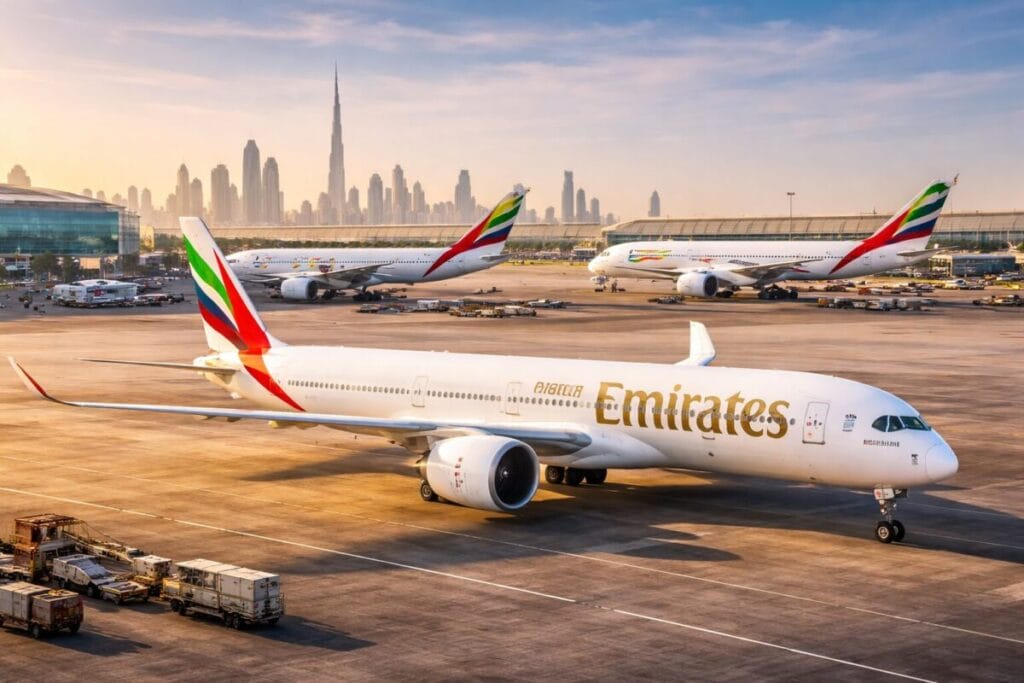
Emirates Airline is accelerating its global fleet transformation with a strong focus on Premium Economy and upgraded long-haul aircraft. The Dubai-based carrier is introducing retrofitted Airbus A380s, modernized Boeing 777 aircraft, and newly delivered Airbus A350 jets across key international routes.
This expansion reflects growing passenger demand for enhanced comfort without premium fares. It also supports Dubai’s position as a major global aviation hub connecting multiple continents.
Fleet Modernisation Drives Network Transformation
Emirates has placed fleet upgrades at the center of its long-term strategy. The airline aims to standardize onboard products while improving passenger experience.
Retrofitted Airbus A380 and Boeing 777 aircraft now include redesigned cabins, improved seating layouts, and updated interiors. Premium Economy remains the main highlight of this transformation.
The first upgraded high-density Airbus A380 is expected to enter service in a three-class configuration by mid-April. It will include Business Class, Premium Economy, and Economy cabins. Initial deployment will begin on the Dubai–Amman route before shifting to European services such as Prague.
By November, all two-class A380 aircraft in Emirates’ fleet are scheduled to complete conversion into three-class layouts. This will significantly expand Premium Economy availability across many markets.
Strong Expansion Across Europe and North America
Several high-demand cities in Europe and North America are receiving upgraded aircraft.
In the United States, select flights between Dubai and New York JFK will feature retrofitted four-class Airbus A380 aircraft starting in April. Daily operations are planned from June, ensuring more consistent Premium Economy availability.
Zurich will become one of the first European destinations to receive four-class A380 service. The upgrade introduces thousands of weekly Premium Economy seats, strengthening links between Dubai and central Europe.
Milan will see Premium Economy introduced on Boeing 777-200LR aircraft, while Dublin will receive consistent Premium Economy service across all weekly flights later in the year. These upgrades aim to deliver a uniform cabin experience across major European routes.
In Canada, Montréal has become a key focus of Emirates’ fleet renewal. The Airbus A350 now operates on Dubai–Montréal flights, marking the aircraft’s debut in the airline’s Americas network. Toronto continues to maintain strong connectivity with daily Airbus A380 services.
Asia Network Receives Aircraft Upgrades
Asia remains a vital market for Emirates, and several routes are scheduled for aircraft transitions.
Ho Chi Minh City will receive upgraded Boeing 777 aircraft featuring Premium Economy seats. The change reflects rising travel demand between the Middle East and Southeast Asia.
Hong Kong services will shift to Airbus A380 operations later in the year. Premium Economy-equipped A380 aircraft are expected to enhance passenger comfort on this busy long-haul route.
Flights to Guangzhou in mainland China will also receive upgraded three-class A380 aircraft, reinforcing Emirates’ presence in East Asia.
New Aircraft Introduced in Africa and the Middle East
Fleet upgrades extend beyond Europe and Asia.
Entebbe in Uganda will welcome the Airbus A350, bringing quieter cabins, improved lighting, and advanced onboard technology. The aircraft is designed to deliver better fuel efficiency and enhanced passenger comfort.
In the Middle East, Basra will see retrofitted Boeing 777 aircraft introduced, ensuring Premium Economy availability across all weekly services to the Iraqi city.
Indian Ocean Routes Strengthened
Mauritius, a popular leisure destination, will receive upgraded Boeing 777-200LR aircraft. The addition of Premium Economy aims to attract both business and leisure travelers seeking improved comfort on medium- and long-haul journeys.
The upgrade aligns with increasing demand for premium leisure travel across the Indian Ocean region.
Airbus A350 Debut Highlights New Cabin Experience
The Airbus A350 introduction represents a milestone in Emirates’ fleet strategy. The aircraft accommodates passengers across Business Class, Premium Economy, and Economy cabins.
Passengers benefit from wider aisles, quieter engines, improved air filtration systems, and modern lighting design. Faster onboard connectivity and advanced entertainment features enhance the travel experience.
Business Class offers lie-flat seats in a 1-2-1 configuration with direct aisle access. Economy cabins include improved seat design and large entertainment screens. Montréal’s selection as the first Americas destination for the A350 underscores Canada’s growing importance within Emirates’ network.
Premium Economy Gains Popularity Among Travelers
Premium Economy bridges the gap between Business and Economy Class. Emirates has focused on comfort and convenience within this cabin category.
Wide leather seats, extended leg rests, and adjustable headrests improve passenger comfort. Larger entertainment screens and in-seat charging options meet modern connectivity expectations.
Enhanced dining experiences and access to thousands of entertainment channels also add value. This offering appeals to travelers seeking upgraded service without the cost of Business Class.
Strengthening Dubai as a Global Aviation Hub
The coordinated rollout of Airbus A380, Boeing 777, and Airbus A350 aircraft supports Emirates’ broader connectivity strategy. Upgraded aircraft now serve destinations across the United States, Canada, Europe, Asia, Africa, and the Middle East.
By aligning fleet modernisation with Premium Economy expansion, Emirates aims to deliver a consistent onboard experience worldwide.
As more aircraft complete retrofits and additional A350 jets enter service, further route upgrades are expected. The airline continues to strengthen Dubai’s role as a leading global gateway for international travel.
For more travel news like this, keep reading Global Travel Wire