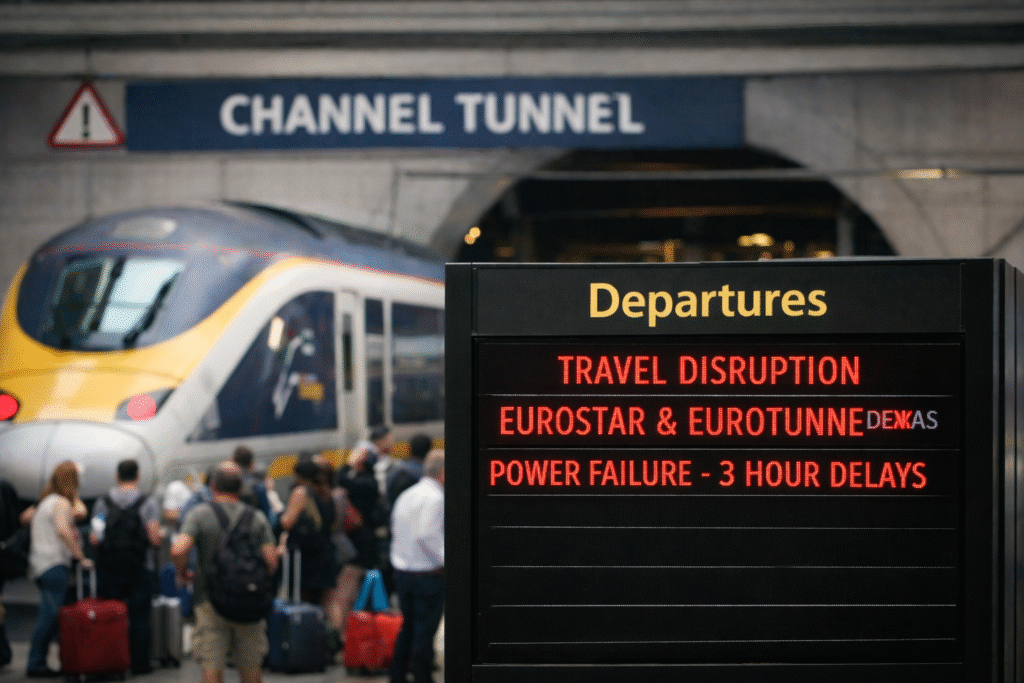
Travel across the English Channel has been thrown into chaos after a major power supply failure disrupted Eurostar and Eurotunnel operations, causing delays of more than three hours and leaving thousands of passengers stranded on one of the busiest travel days of the holiday season. The incident has affected key routes between the United Kingdom and France, intensifying frustration for travelers already navigating peak end-of-year demand.
The disruption began early in the day when a fault in the overhead power supply forced the suspension of services at both the Folkestone terminal in the UK and the Calais terminal in France. As a result, Eurotunnel’s Le Shuttle services, which transport vehicles and passengers through the Channel Tunnel, were brought to a standstill. With trains unable to depart or arrive, queues rapidly built up at both terminals, leading to long waits and mounting uncertainty.
Services Halted and Delays Escalate
At the height of the disruption, no Le Shuttle services were operating between Folkestone and Calais. Passengers reported delays exceeding three and a half hours beyond their scheduled departure times, with many forced to remain in holding areas as technicians worked to diagnose and fix the fault. The suspension of operations created a significant backlog, particularly for motorists and families traveling with vehicles.
Eurostar services, which also rely on the Channel Tunnel for cross-border journeys, were affected as knock-on delays spread across the network. Trains departing from and arriving at London’s St Pancras International experienced schedule disruptions, complicating onward travel plans for passengers heading to major European cities.
Pressure Mounts During Peak Holiday Travel
The timing of the power failure could not have been worse. With many travelers heading to France and beyond for New Year celebrations, demand for cross-Channel travel was already high. The unexpected shutdown left passengers scrambling to adjust plans, rebook connections, or notify hotels and family members of delays.
For travelers with connecting trains, flights, or accommodation bookings, the uncertainty added financial and emotional strain. Some passengers expressed concern about missing celebrations, events, or work commitments, while others faced the prospect of overnight stays near terminals due to the extended delays.
Operational Restrictions Add to the Challenge
In response to the disruption, Eurotunnel implemented temporary operational measures to manage congestion. Only passengers with advance bookings were permitted to check in, and ticket sales at terminals were suspended. Travelers were advised to arrive at least one hour before their scheduled departure time, though this guidance did little to alleviate the long waits caused by the halted services.
Staff at both terminals were deployed to assist passengers, provide updates, and manage crowd control. However, with limited information on when full operations would resume, frustration continued to build throughout the day.
Efforts Underway to Restore Normal Operations
Eurotunnel confirmed that engineering teams were working urgently to resolve the power supply fault. While restoring service remained the top priority, officials warned that disruption could continue for the remainder of the day, depending on how quickly the issue could be fully resolved and systems safely restarted.
Passengers were reassured that the situation was being treated as a critical incident, with additional resources allocated to speed up recovery once services resumed. However, no definitive timeline was provided, leaving travelers to monitor updates closely and remain flexible with their plans.
What Travelers Should Expect Next
As services gradually restart, delays are expected to persist while operators work through the backlog of vehicles and passengers. Travelers with bookings later in the day have been advised to check service status before heading to terminals, as last-minute changes remain possible.
Those already affected by delays are being encouraged to review their options for refunds, rebooking, or compensation, depending on the length of the disruption and individual circumstances. Customer service teams are expected to face heavy demand as passengers seek clarity and assistance.
Wider Impact on Cross-Channel Transport
The incident highlights the vulnerability of critical transport infrastructure, particularly during peak travel periods. When power or technical failures occur within the Channel Tunnel system, the consequences extend quickly across rail, road, and tourism networks on both sides of the Channel.
Airlines, ferry operators, and coach services may see increased demand as some travelers seek alternative ways to reach France or return to the UK. However, capacity constraints mean that alternatives are not always readily available, especially during busy holiday weeks.
Advice for Affected Passengers
Travelers planning to cross the Channel in the coming days are advised to stay informed, allow extra time, and prepare for possible delays. Packing essentials such as food, water, chargers, and warm clothing is recommended when facing extended waiting periods. Those with flexible travel plans may consider postponing journeys until operations stabilize.
Looking Ahead
While efforts continue to restore normal service, the power failure has served as a stark reminder of how quickly travel plans can unravel. For now, patience and adaptability remain essential for anyone traveling between the UK and France. As operators work to resume full schedules, passengers are urged to remain alert to updates and prepared for ongoing disruption until the system is fully stabilized.
For more travel news like this, keep reading Global Travel Wire