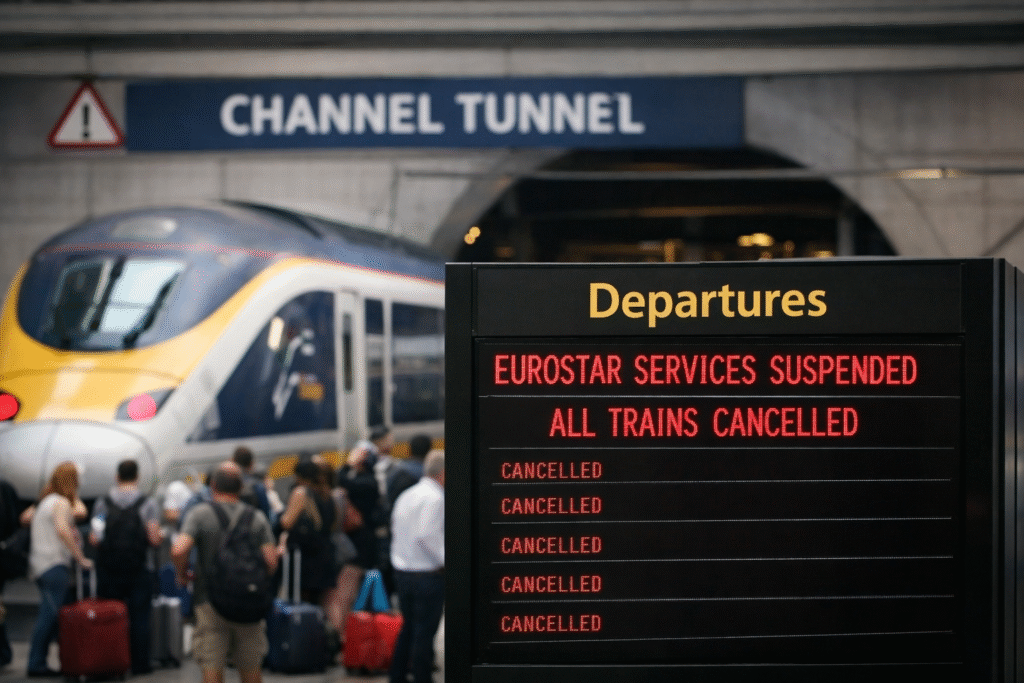
Eurostar services through the Channel Tunnel have been abruptly suspended following a serious technical malfunction, triggering widespread travel disruption across the United Kingdom and mainland Europe. The unexpected shutdown has left thousands of passengers stranded, forcing tourists, business travelers, and commuters to rethink their journeys as uncertainty continues to grip one of Europe’s most important transport corridors.
The Channel Tunnel, a critical piece of cross-border infrastructure linking the UK with France and beyond, was closed after problems emerged with the overhead power supply system, compounded by a breakdown involving a vehicle shuttle train. Together, these failures made it impossible for trains to continue operating safely, prompting Eurostar to halt all services indefinitely while engineers work to stabilize the system.
Passengers were advised not to travel to stations, as no clear timeline has been provided for the resumption of services. With trains between London, Paris, Brussels, and Amsterdam suspended, the disruption has quickly escalated into a major travel crisis affecting both leisure and corporate travel across Europe.
Why the Channel Tunnel Matters So Much
The Channel Tunnel is far more than a rail connection; it is a cornerstone of UK–Europe mobility. Millions of passengers rely on Eurostar each year for fast, city-center-to-city-center travel. For business travelers, it is often the most efficient way to attend meetings, conferences, and exhibitions across borders. For tourists, it provides seamless access between some of Europe’s most visited destinations.
The sudden loss of this connection has created immediate logistical challenges. Travelers who planned rail journeys weeks or months in advance now face cancellations, delays, and increased costs as they scramble to secure alternative transport.
Immediate Impact on Travelers
With Eurostar suspended, demand has surged for short-haul flights between the UK and mainland Europe. Airlines are seeing increased bookings, which may lead to higher fares, limited seat availability, and crowded airports. Budget and legacy carriers alike are under pressure as displaced rail passengers seek faster alternatives.
Coach and bus services are also experiencing heavier demand, particularly for cross-Channel routes using ferries. While buses are often cheaper, they involve significantly longer travel times, adding further strain to already disrupted itineraries. Car rental companies, especially those offering cross-border or one-way rentals, are reporting heightened interest, which may result in shortages and rising prices.
For travelers in the middle of multi-city European trips, the disruption is especially challenging. Many international visitors depend on Eurostar to move easily between the UK and continental Europe. Without it, entire itineraries may need to be redesigned at short notice.
Eurostar’s Response and Passenger Uncertainty
Eurostar has issued a formal apology, acknowledging the scale of inconvenience caused and emphasizing that passenger safety remains the top priority. Technical teams are working around the clock to repair the power infrastructure and remove the disabled train, but the complexity of the tunnel environment means repairs cannot be rushed.
The absence of a confirmed reopening date has added to passenger anxiety. Travelers with upcoming journeys are being urged to monitor official updates and prepare for continued disruption. Refunds, exchanges, and rebooking options are expected to play a key role in managing customer dissatisfaction in the coming days.
Wider Consequences for Tourism and Business Travel
The tourism sector is likely to feel the effects well beyond the immediate disruption. Cities such as London, Paris, Brussels, and Amsterdam depend heavily on high volumes of short-stay visitors arriving by rail. A prolonged suspension could lead to reduced hotel occupancy, lower visitor spending, and fewer last-minute leisure trips.
Business travel is also under pressure. Eurostar is a preferred option for professionals attending same-day meetings across borders. Delays or cancellations can result in missed opportunities, postponed negotiations, and financial losses for companies operating internationally.
Event organizers, conference venues, and exhibition centers may see reduced attendance if travel remains unreliable. Over time, this could influence how companies plan cross-border engagements, potentially shifting demand toward virtual meetings or alternative hubs.
Ripple Effects Across the Transport Industry
The shutdown highlights how interconnected Europe’s transport networks are. When a major rail artery fails, pressure instantly shifts to airlines, ferries, buses, and roads. Airports may face congestion, while ports handling cross-Channel traffic could experience bottlenecks due to increased vehicle and passenger volumes.
The situation also raises broader questions about infrastructure resilience. Aging systems, high passenger volumes, and limited redundancy mean that technical failures can escalate rapidly into international travel crises.
What Travelers Should Expect Next
Until services resume, flexibility is essential. Travelers are advised to allow extra time, budget for higher costs, and remain prepared for sudden changes. Those planning future trips between the UK and Europe may reconsider their transport choices, at least temporarily, until confidence in tunnel operations is fully restored.
The Channel Tunnel disruption serves as a powerful reminder of how vulnerable even the most advanced transport systems can be. As Eurostar works toward restoring normal operations, the travel industry and millions of passengers will be watching closely, hoping for a swift and stable return to one of Europe’s most vital travel links.
For more travel news like this, keep reading Global Travel Wire