In the central lowlands of Azerbaijan, far from mountain passes and seaside promenades, the villages of Goychay unfold across fertile plains shaped by water, work, and repetition. This is a region where life does not pause for visitors, and landscapes are not curated for visual drama. Instead, Goychay’s character is revealed through cultivation, seasonal labor, and the steady continuity of rural life.
For travelers interested in understanding how Azerbaijan functions beyond its iconic imagery, the villages of Goychay provide a grounded and revealing experience. Here, agriculture is not an attraction but a way of life that quietly sustains communities and cultural identity.
A Landscape Defined by Water and Soil
Goychay occupies a strategic position between the foothills of the Greater Caucasus and the Kura lowlands. The terrain is largely flat, enriched by fertile soils and sustained by an extensive irrigation network developed over generations. This geography has shaped settlement patterns that prioritize access to water and productive land rather than elevation or defense.
Villages emerged where water could be reliably controlled, and this practical logic continues to define daily life. Fields, homes, and roads are arranged according to irrigation flow, reinforcing a close relationship between land management and survival.
The Pomegranate Heartland of Azerbaijan
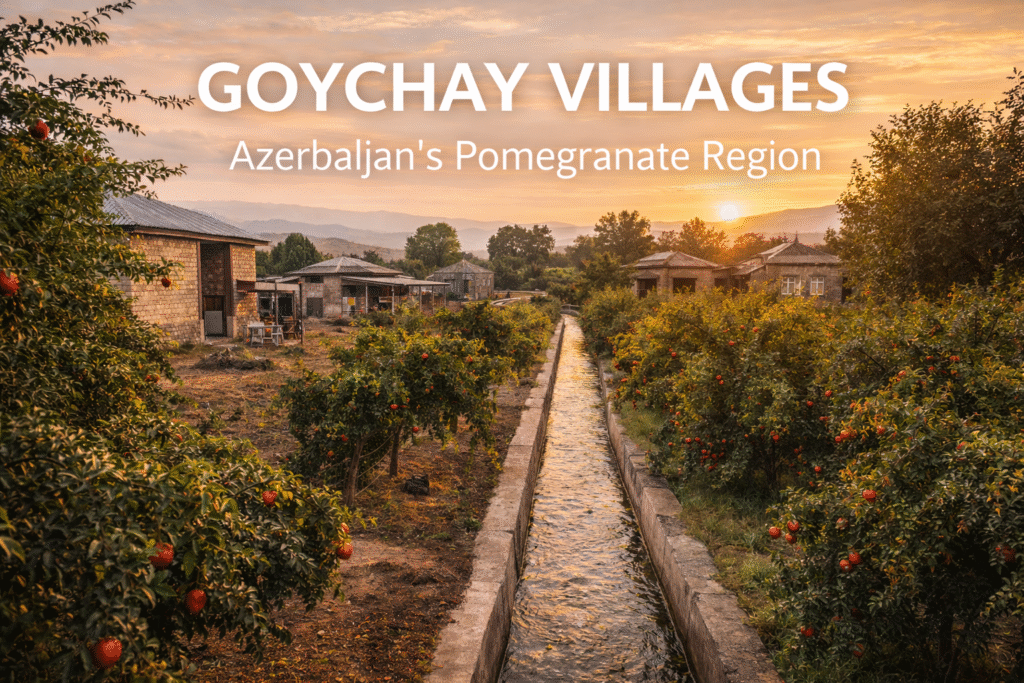
Goychay is nationally recognized as Azerbaijan’s pomegranate heartland, and this identity is visible throughout its villages. Orchards surround settlements, their placement determined by soil quality, sunlight, and irrigation reach. The pomegranate is not only an economic crop but a defining feature of the region’s visual and cultural landscape.
Seasonal change transforms the countryside. Spring brings blossoms and preparation, summer fills orchards with dense greenery, and autumn bends branches under the weight of ripening fruit. These cycles mirror the rhythm of labor, reinforcing a deep connection between people and land.
Irrigation Canals as Living Infrastructure
One of the most distinctive elements of Goychay villages is their visible irrigation system. Narrow canals guide water from rivers and reservoirs into fields and orchards, sustaining crops through dry periods. These channels are not hidden infrastructure; they are central to daily life.
The sound of flowing water accompanies work and movement, while knowledge of water management is passed down through generations. Paths, property boundaries, and even village roads often follow the course of canals, embedding water into the spatial logic of settlement.
Village Architecture Built for Function
Homes in Goychay villages are typically low-rise and designed for durability rather than display. Courtyards serve as extensions of living space, supporting food preparation, storage, and agricultural tasks. Shaded verandas, outdoor work areas, and simple materials reflect adaptation to climate and routine labor.
Village layouts feel open and fluid. There are no sharp boundaries between domestic space and farmland, reinforcing how closely household life and agriculture are intertwined.
Daily Life Shaped by Agricultural Rhythm
Life in Goychay villages follows the agricultural calendar with little deviation. Planting, irrigation management, harvesting, and winter preparation structure both daily schedules and social interaction. These routines define when people gather, rest, or move between spaces.
Visitors encounter work in progress rather than staged experiences. Fields remain active, tools are in use, and routines continue regardless of observation. This authenticity offers insight but also requires respect and sensitivity from travelers.
Sound, Movement, and Working Silence
The countryside carries a steady acoustic presence. Water moves through canals, machinery operates in fields, neighbors exchange brief conversations, and wind passes through orchards. Silence exists, but it is a working silence—punctuated by purposeful activity rather than absence.
Movement is unhurried but deliberate. People travel between home and field with clear intent, reflecting a rhythm shaped by necessity rather than leisure.
Walking Without Destinations
Walking through Goychay villages is intuitive. Flat roads and familiar paths connect homes, orchards, and water sources. Without landmarks to seek out, attention naturally shifts to detail: irrigation flow, orchard patterns, and interactions between people and land.
For travelers, walking becomes an exercise in observation rather than achievement, aligning naturally with slow travel principles.
Seasonal Change and Community Bonds
Seasonal shifts play a central role in strengthening community ties. Autumn harvests bring intensified cooperation, while spring preparation renews shared effort. Winter slows movement, drawing life inward and reinforcing reliance on stored resources and mutual support.
These cycles ensure resilience, allowing villages to adapt to environmental variability without losing cohesion.
Goychay’s Place in Azerbaijan’s Cultural Landscape
Though less visually dramatic than mountainous or coastal regions, Goychay represents the agricultural core that sustains the country. Its villages provide essential context for understanding Azerbaijan’s food culture, seasonal traditions, and rural resilience.
Cultural identity here is maintained not through monuments, but through everyday labor repeated across generations.
Where the Ordinary Becomes Essential
Goychay villages do not perform for visitors, yet everything functions with purpose. Through orchards, irrigation canals, and steady routines, the region demonstrates how landscapes shaped by care and patience become enduring.
For travelers seeking insight rather than highlights, Goychay offers an honest view of rural Azerbaijan—showing that the ordinary, when sustained with care, is what truly endures.
For more travel news like this, keep reading Global Travel Wire