Shenzhen is accelerating its position as a global tourism destination through major financial technology reforms aimed at improving the visitor experience. The city’s focus on accessibility, digital payments, and international financial integration has reshaped how travelers engage with local commerce. Recent data indicates that these advancements are driving significant growth in international tourism spending, making Shenzhen a model for how digital economies can enhance global travel.
According to new financial figures, international tourist spending in Shenzhen surged in 2025, with nearly 189 million recorded transactions totaling more than 24.6 billion yuan. Both the number of transactions and total spending rose by almost 30 percent year over year, reflecting how improvements in payment and financial infrastructure directly influence traveler confidence and consumption.
A core component of Shenzhen’s accessibility strategy begins at the point of arrival. At Shenzhen Bao’an International Airport, the city has deployed specialized payment service centers designed to help foreign tourists integrate seamlessly into a digital-first environment. These centers offer in-person support for visitors who may be unfamiliar with China’s predominantly mobile payment ecosystem, assisting with digital wallet onboarding, SIM card activation, and transportation coordination. Travelers arriving from markets with card-heavy transaction cultures have remarked on how quickly they were able to adapt to mobile payments, often within minutes of landing.
In 2025, airport service points processed more than 23,000 inquiries and supported over 3,300 direct financial transactions. To further reduce barriers, Shenzhen has installed a wide network of self-service kiosks capable of handling currency exchange, ATM withdrawals, and digital yuan onboarding. The kiosks are designed to process applications in as little as two minutes, reflecting a larger effort to streamline the financial transition for inbound visitors throughout the Guangdong-Hong Kong-Macao Greater Bay Area.
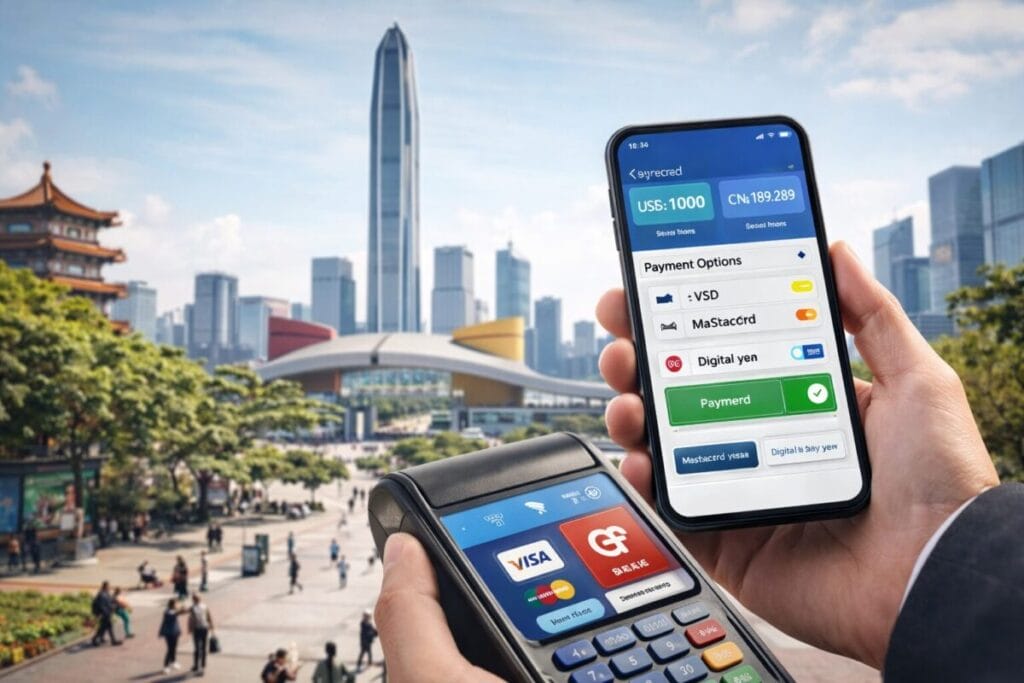
These conveniences extend well beyond airport terminals. During major events such as the High-Tech Fair, interoperability between foreign e-wallets and domestic platforms emerged as a standout feature for international travelers. Visitors reported that they were able to use their native e-wallets directly without needing to download multiple local applications. This level of interoperability is the result of several strategic initiatives, including domestic acceptance of overseas digital wallets and the linking of international credit cards to Chinese mobile payment platforms.
Payment flexibility has also expanded at the retail level, with more than 52,000 point-of-sale terminals capable of accepting foreign credit cards deployed across the city by the end of 2025. These terminals processed roughly 1.76 million transactions totaling 3.74 billion yuan. This infrastructure ensures that international travel spending is not restricted by technical limitations or unfamiliar payment systems, eliminating a common barrier in emerging tourism economies.
The consumer journey concludes with an equally modernized tax refund system. Shenzhen has positioned itself as a national leader in instant tax refund technology, particularly in the Qianhai district, where duty-free shoppers are able to complete refund applications within seconds through mobile processing. Tourists have reported that refunds were finalized in under a minute, a pace unmatched by traditional refund counters that typically require documentation and long queues.
In early 2025, Shenzhen expanded refund channels by integrating third-party platforms into the process, allowing tax refunds to be issued through popular digital payment applications. A dedicated mini-program was also launched, enabling tourists to complete and manage refund submissions with a single click. The results were immediate: in the first eleven months of 2025, tax refund transactions increased more than thirteen-fold, with the sales of eligible goods rising nearly forty times compared to earlier periods. This transformation not only enhances the visitor shopping experience but also strengthens retail performance, especially in key commercial districts.
These developments reflect a holistic understanding of the tourism economy, where the financial experience is viewed as integral to travel satisfaction. By easing the friction associated with payments, currency exchange, and refunds, Shenzhen has boosted its appeal as a destination for international leisure, business, and convention travel. Economic studies consistently show that reducing transactional barriers increases traveler spending and stimulates local economic activity—a trend clearly supported by Shenzhen’s 2025 results.
The reforms also highlight a larger strategic ambition: positioning the Guangdong region as a gateway for international commerce and mobility. Digital payment integration has been among China’s most notable economic innovations, and cities like Shenzhen are now extending these innovations to global audiences. This creates an environment where foreign travelers can participate more fully in local markets without navigating the complexities of unfamiliar financial systems.
The success of Shenzhen’s initiatives demonstrates the effectiveness of coordinated public-private collaboration in the financial sector. By combining infrastructure upgrades, multilingual support, widespread merchant adoption, and fast tax refund systems, the city has created a comprehensive model for tourism financial accessibility. As international travel continues to rebound, Shenzhen’s advancements are being recognized as a case study for how modern cities can integrate global visitors into digital economies.
With continued investment in financial technology and visitor services, Shenzhen is advancing toward a future in which international tourism is not just encouraged but actively enabled through policy, innovation, and user-centric design.
For more travel news like this, keep reading Global Travel Wire