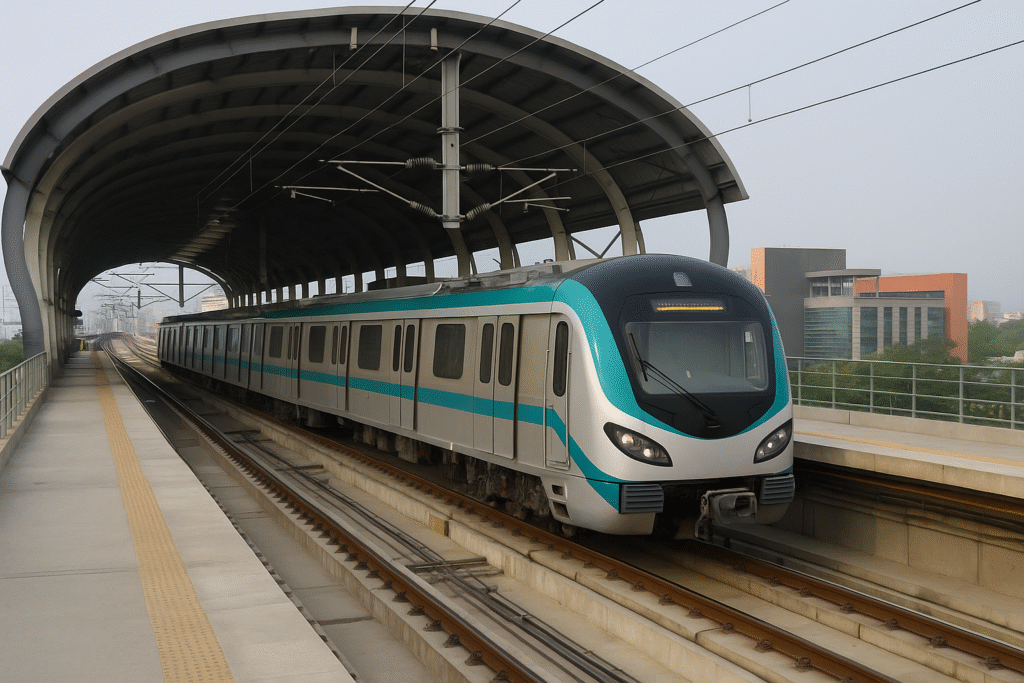
The Pune Metro has crossed an extraordinary milestone of 100 million passengers since its launch in March 2022. This achievement reflects its rising importance as the most dependable, eco-friendly, and time-efficient transit option in Pune and Pimpri-Chinchwad. In just over two years, the metro has not only transformed daily commuting but has also positioned itself as a backbone for sustainable urban mobility.
The metro’s success underscores the city’s commitment to modern, environmentally conscious transport systems that provide seamless connectivity across residential, commercial, and educational zones. It has rapidly become a lifeline for professionals, students, and local travelers who seek faster, safer, and greener alternatives to road-based travel.
Rapid Expansion and Growing Ridership
Since its inception, the Pune Metro has expanded its network in carefully planned phases. Initially, two short stretches — PCMC to Phugewadi and Vanaz to Garware College — were operational, carrying 20,000 to 30,000 passengers daily.
The second phase, opened in August 2023, connected Phugewadi to Civil Court and Garware College to Ruby Hall Clinic. This expansion dramatically increased daily ridership to over 100,000 passengers.
Further momentum came in March 2024 when the East–West corridor between Ruby Hall Clinic and Ramwadi was inaugurated. Passenger numbers quickly rose to 130,000 per day as residents across the city embraced the convenience of metro travel.
The most transformative phase occurred in September 2024, when the underground stretch from the District Court to Swargate became operational. This addition catapulted daily ridership to nearly 200,000, confirming that commuters now prefer the metro over congested road travel.
Sustainable Urban Mobility for a Growing City
Pune is one of India’s fastest-developing metropolitan hubs, with its road networks often burdened by traffic congestion. The introduction of the metro has provided a reliable alternative, easing pressure on highways and arterial routes.
The Pune Metro is more than a transport service — it is a model of sustainable development. By running on clean energy principles and reducing reliance on personal vehicles, the system contributes directly to lowering carbon emissions and improving air quality. This aligns with Pune’s vision of becoming a green and future-ready city.
Modern stations are equipped with digital ticketing systems, accessibility features for differently-abled passengers, and energy-efficient infrastructure. These innovations ensure the metro not only meets immediate commuter needs but also sets a benchmark for responsible urban development.
Impact on Travel Patterns and Environment
The Pune Metro has redefined daily mobility by significantly reducing travel times between key city zones. For thousands of commuters, what once required long hours stuck in traffic is now a matter of minutes. The convenience of a punctual, high-speed rail service has shifted public preference away from cars, bikes, and auto-rickshaws toward collective mobility.
Environmentally, the metro has created measurable benefits. Fewer vehicles on the road mean reduced fuel consumption, improved air quality, and a quieter city environment. With Pune striving toward sustainability, the metro stands as a cornerstone of its eco-conscious strategy.
Integration with Broader Transport Systems
To maximize its reach, Pune Metro is gradually being integrated with other forms of public transport. Future plans aim to link metro services with buses, taxis, and last-mile solutions such as e-rickshaws. This integrated network will ensure a smooth journey for commuters from doorstep to destination, enhancing both convenience and efficiency.
Technological innovations, including real-time tracking apps and advanced ticketing options, are also in the pipeline. These enhancements will help improve commuter experience, reduce waiting times, and further optimize the system’s operational capacity.
Future Developments and Expansion Goals
The journey of Pune Metro is far from over. Several new routes are under construction, with plans to extend the network deeper into suburban and peripheral regions. Once complete, these expansions will serve an even larger population, further reducing dependency on road transport.
In addition, authorities are focused on passenger-centric services such as upgraded amenities, better station facilities, and improved safety measures. With each phase, the metro is becoming a more comprehensive and attractive option for travelers across demographics.
A Symbol of Trust and Progress
Crossing the 100 million passenger mark is more than a statistical milestone; it reflects growing public trust in Pune’s public transport system. Citizens are increasingly recognizing the metro as not just a faster way to move around the city, but also a responsible choice for reducing environmental impact.
For a city like Pune, where traffic congestion and pollution have long been challenges, the metro represents progress, innovation, and sustainability rolled into one. With every new commuter who chooses the metro, Pune takes another step toward becoming a cleaner, greener, and better-connected city.
Conclusion
The Pune Metro has firmly established itself as a symbol of sustainable progress and modern connectivity. Its rapid adoption by over 100 million passengers highlights its role as more than just a transport network — it is a lifeline that shapes Pune’s urban future.
With upcoming expansions, integration with other transport modes, and continuous technological upgrades, the Pune Metro is poised to redefine urban travel in the years ahead. It reflects a future where mobility is not only fast and reliable but also environmentally responsible.
For Pune and Pimpri-Chinchwad, the metro is not just about reaching a destination quickly — it’s about traveling responsibly, sustainably, and with a vision for tomorrow.
For more travel news like this, keep reading Global Travel Wire