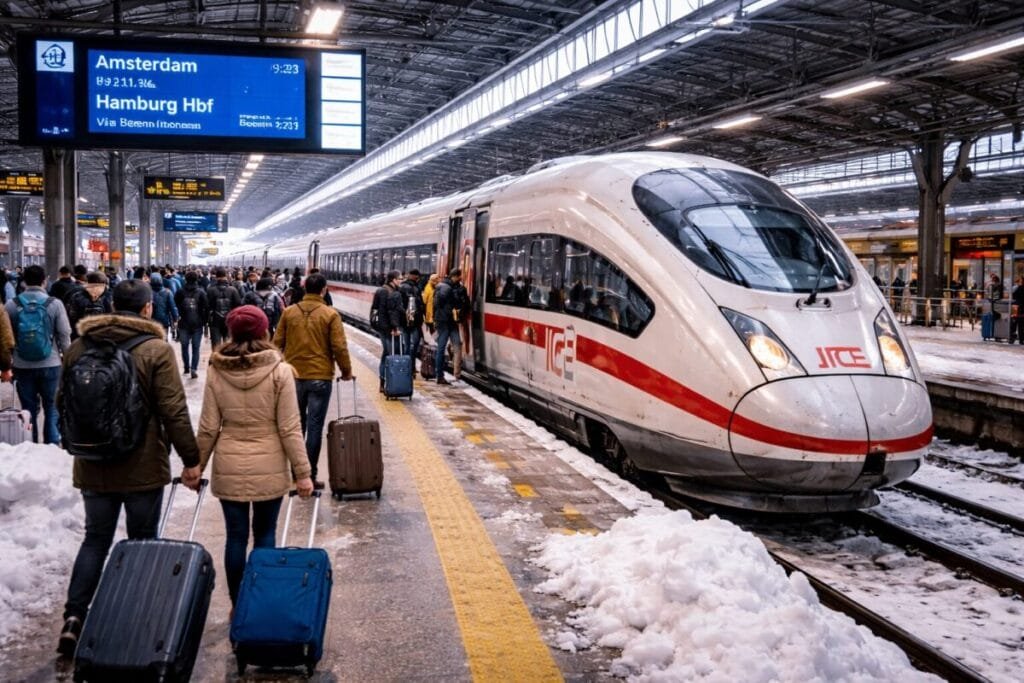
Rail services across the Netherlands and northern Germany continue to recover after heavy snowstorms disrupted travel for several days. Operators face ongoing challenges as they work through frozen tracks, snowdrifts, and post-storm inspections. Many major routes now run again, but several corridors still operate with reduced capacity. Some lines remain suspended while teams clear remaining ice and assess equipment.
Travelers should expect adjusted timetables and delays as operators work through the aftermath. The recovery process highlights the scale of the storm and the complexity of restoring large rail networks during volatile winter conditions.
Dutch Rail Services Run Again but With Adjusted Schedules
Dutch train services resumed early Monday with a revised winter timetable. The schedule reflects near-normal patterns, but many peak-hour trains remain unavailable. Several lines also run fewer trips due to rolling stock shortages created by the cold snap.
Local services between Arnhem and Doetinchem run less frequently as trains undergo inspections. Sprinter services near Amersfoort face pressure due to limited rolling stock. Signal problems between Amersfoort Centraal and Ede-Wageningen add further delays and reduce overall capacity. International travel also feels the impact, with no trains running between Maastricht and Liège on Monday because of equipment issues.
During the storm, the infrastructure manager reduced the number of active switches to improve reliability. Half of the centrally operated switches went offline during the peak of the cold wave. These switches now require full inspection across more than 7,000 kilometers of track. Crews continue to examine each switch, a time-consuming job that slows the return to normal operations.
Thaw Conditions Create New Risks for Rail Operations
Warmer weather brings its own challenges. ProRail issued warnings about potential track flooding caused by melting snow. Crews also face condensation in electrical systems, which threatens signal reliability. Salt contamination at level crossings may affect equipment and cause further disruptions. Rust formed on idle switches and rails, creating additional work for maintenance teams.
These issues highlight the sensitivity of rail infrastructure to sudden shifts between freezing and thawing conditions. Operators caution passengers about possible delays as teams address any new faults that occur during the thaw.
Northern Germany Restores Major Long-Distance Routes
Northern Germany’s rail network also shows steady improvement after severe snowstorms impacted regional and long-distance travel. Deutsche Bahn reopened all major long-distance corridors, including Hamburg-Berlin, Hamburg-Hanover-Southern Germany, and Hamburg-North Rhine-Westphalia-Frankfurt. These routes operate again but at two-thirds of their normal capacity. Travelers should expect reduced frequencies, possible cancellations, and occasional short-turns.
Despite progress, several corridors remain closed. Long-distance routes to Westerland on Sylt and Rostock/Binz stay suspended due to heavy snowdrifts and frozen points. These routes serve important winter tourism zones, creating challenges for travelers heading to seasonal coastal destinations.
Regional Networks Face Ongoing Restrictions
Regional travel in Schleswig-Holstein and Lower Saxony remains limited. Some lines run reduced schedules, while others stay closed for inspections. Hamburg’s S-Bahn network now runs again on most lines, though it operates with partial capacity during busy hours.
Private rail operator Metronom restarted services on lines such as Hamburg-Uelzen and Hamburg-Bremen. However, parts of the operator’s southern Lower Saxony network still need clearance and inspection. Cross-border services to Denmark and the Netherlands now run again but at lower frequency.
Winter storms affected roughly 3,000 kilometers of track in northern Germany. Snowdrifts piled against trains and track sections. Prolonged frost also created ice buildup along platforms, bridges, and switches. Recovery teams continue to remove ice and clear yards, although re-freezing sometimes undoes earlier progress.
Freight Traffic Begins to Move Across Both Regions
Rail freight operations now show gradual improvement after severe disruptions across many terminals. Northern Germany handles major freight flows linked to ports, automotive trade, and industrial goods. Snowdrifts blocked freight yards and created major delays. Teams now work to clear bottlenecks and reopen sidings to support supply chains.
Freight movements around the Port of Rotterdam also stabilize as Dutch teams clear frozen switches and rail yards. Ongoing cooperation between operators in both countries supports the clearing of delayed shipments. This coordination allows essential cargo to reach inland destinations once again.
Travelers Should Expect Ongoing Disruptions
Rail operators across the Netherlands and northern Germany warn that winter conditions may continue to affect schedules. Forecasters expect more snow across parts of northern Europe, which could slow recovery efforts or create new disruptions. Operators urge passengers to check digital journey planners before traveling and to account for possible delays, especially during peak periods.
Recovery Progress Stable but Requires Patience
Rail networks remain resilient despite the challenges created by the snowstorm. The return of many key routes signals progress, yet full capacity will take more time. Maintenance teams continue to inspect tracks, switches, and power systems. Snowploughs remain active across secondary lines to ensure safe operations.
The recovery marks an important step toward stable winter rail service. Travelers across both regions benefit from the reopening of core routes, even as operators work to strengthen reliability and restore normal frequency. The coming days remain crucial, and travelers should stay informed as winter weather continues to shape rail operations.
For more travel news like this, keep reading Global Travel Wire