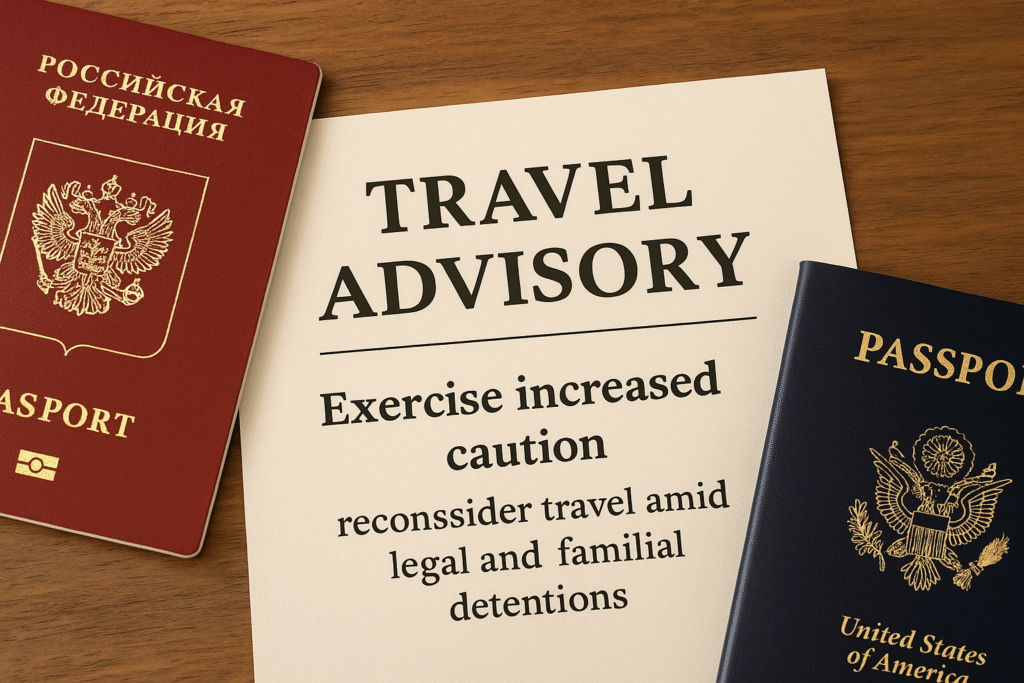
In a stark caution to its citizens, the Ministry of Foreign Affairs of the Russian Federation has issued a formal travel advisory urging Russians to exercise extreme caution or delay travel to the United States. The advisory draws attention to a growing pattern of Russian nationals—especially women involved in family or custody disputes—being detained under what Moscow describes as “vicious practices” by U.S. authorities.
According to the Russian foreign ministry, multiple cases have emerged in which Russian women entering the U.S. have been arrested on allegations of abducting their own children, often stemming from mixed-nationality marriages to U.S. citizens. The ministry argues these accusations are frequently ungrounded and are brought despite evidence such as birth certificates, yet detainees face legal limbo and protracted litigation.
One illustrative example cited involves a Russian woman arriving at a New York airport to retrieve her second child from her American ex-husband. She was accused by U.S. agents of child abduction and detained—even though the child’s birth certificate lacked the father’s name and indicated sole maternal custody. The mother remains separated from her child, now placed in the care of the grandmother in Russia under legal guardianship processes.
The advisory underscores the risk of “arbitrary detention” for Russian nationals travelling to the U.S., particularly in circumstances involving cross-border custody disputes or mixed-marriage families. Moscow warns such legal entanglements can quickly spiral into diplomatic and personal crises, potentially resulting in foreign nationals being treated as bargaining chips in broader geopolitical tensions.
For the Russian government, this puts a spotlight on the deteriorating trust between the two countries. The ministry characterises the trend as symptomatic of a U.S. legal system that is increasingly hostile or unpredictable toward foreign nationals, and raises the spectre of long-term detention without fair evaluation of context or evidence. The advisory explicitly recommends that Russians carefully assess all potential risks before travel and consider postponing visits to the U.S. unless absolutely necessary.
Authorities in Moscow have also offered diplomatic and consular support in specific cases. The Russian embassy in Washington has intervened on behalf of the detained woman, offering legal assistance and pledging to secure her return and reunification with her children. Meanwhile, the Russian Presidential Commissioner for Children’s Rights is reportedly working to obtain legal guardianship in Russia for the child left behind, as the cross-border legal processes unfold.
The broader implications for tourism and international travel are significant. With this advisory in place, Russian citizens considering visiting the U.S.—whether for leisure, family visits or business—are now urged to revisit their plans. They are advised to engage in thorough risk-analysis: Is there a possibility of being drawn into legal or custody disputes? Are their family ties and travel purposes clearly documented and defensible under U.S. law? Could seizing an opportunity to travel now instead expose them to disproportionate legal risks?
For travel industry professionals and travellers alike, this advisory signals an elevated risk environment. Travel insurers, tour operators and immigration-aware advisors may need to reassess U.S. travel packages involving Russian nationals. Agencies specialising in international travel should highlight the advisory’s existence and ensure clients understand the potential legal exposures implicit in crossing national boundaries with contested family status.
Observers note that the advisory reflects not just individual legal cases but an underlying geopolitical dynamic. The tension over treatment of Russian nationals abroad intersects with broader exchange-odds, where both nations view high-profile detentions as leverage. For many Russian citizens, the message is clear: even routine travel to the U.S. has become entangled with political and legal minefields.
While the advisory’s main focus is on custody and family-law issues, an underlying message is broader. Russian travellers may face unexpected detention or legal scrutiny even absent deliberately contentious circumstances. The foreign ministry’s language suggests that the risk is more acute for those already part of complex familial or legal frameworks, such as cross-national marriages or children with dual citizenship. But by creating the advisory at all, Moscow acknowledges that ordinary travel may now carry extraordinary risks.
In short: for Russian citizens eyeing the U.S. as a destination, the recommendation is to stop and think—not simply about flights and itineraries, but about legal exposure and diplomatic dimensions. When the travel advisory mentions “extreme caution,” it is signalling a shift from standard travel worries (like safety or health) into the realm of legal vulnerability and consular uncertainty.
As Russia and the U.S. navigate fraught diplomatic terrain, this advisory may serve as both a protective measure for Russian citizens and a signal of mounting distrust. The question now for travellers is whether the U.S. remains a viable destination when legal ambiguity looms large. For many, the answer may lean toward waiting—not just for better timing, but for clearer legal pathways.
In the interim, Russian travel agents, legal-aid organisations and consular services will likely be the watchpoints to observe how individual cases evolve and whether this advisory leads to measurable changes in travel behaviour. For travels involving family connections across the U.S.–Russia divide, prudent planning and legal counsel may now be as important as passport and ticket.
For more travel news like this, keep reading Global Travel Wire