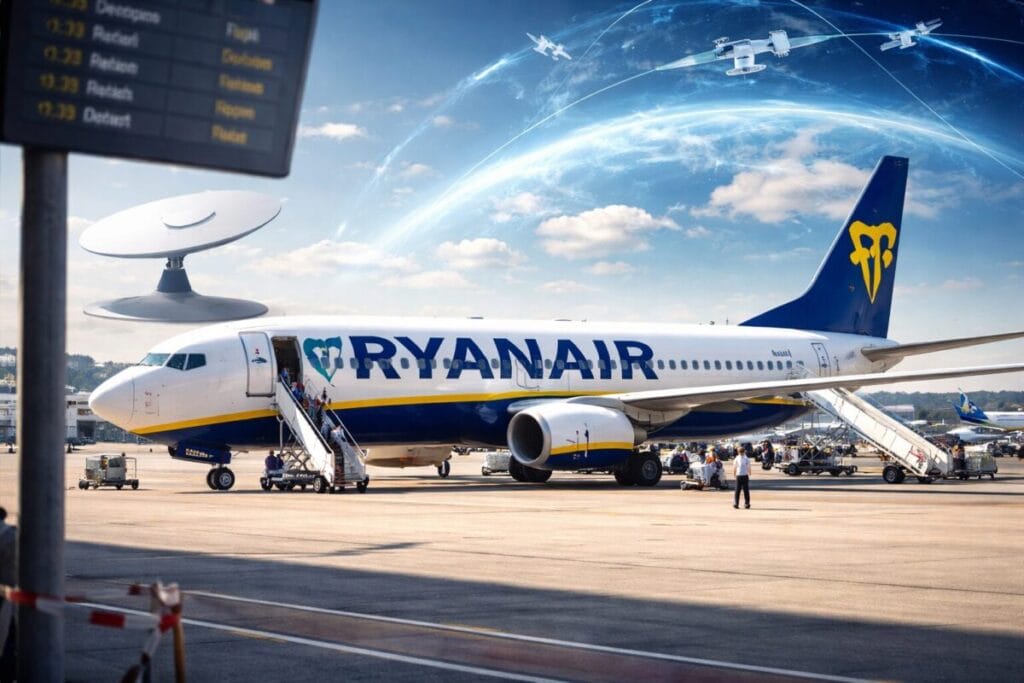
In Ireland and across Europe, the future of airline connectivity is turning into a key debate within tourism aviation. Many carriers now market high-speed satellite internet as a modern passenger necessity. Ryanair, Europe’s largest low-cost airline by passenger volume, has taken the opposite view.
In early 2026, the Irish carrier confirmed that it will not install Starlink satellite connectivity on its fleet. The decision stood out because several global airlines have adopted the technology to upgrade their digital passenger experience. Ryanair chose to go in a different direction based on short-haul travel economics and cost discipline.
A Strategy Built Around Speed and Low Fares
Ryanair has long positioned itself as an ultra-low-cost operator. It serves dense tourism corridors linking leisure cities across Spain, Italy, Portugal, Ireland, Croatia, France, and Greece. Many of these flights last between 60 and 120 minutes. The airline argues that Wi-Fi adds little value during such short segments.
Its leadership has repeatedly emphasized three priorities:
- On-time performance
- Low fares
- Operational simplicity
Connectivity, they argue, does not belong on that list for short-haul Europe. The airline views digital services as secondary to punctuality and pricing, which remain the top drivers of customer satisfaction on leisure routes.
Fuel Efficiency Drives Strategic Decisions
Beyond passenger demand, Ryanair also considered aircraft performance. Satellite Wi-Fi equipment adds antennas, cabling, and modems to aircraft. This increases weight and aerodynamic drag. Even a small rise in drag can elevate fuel burn.
A modest fuel increase multiplies at fleet scale. Ryanair flies hundreds of Boeing 737 aircraft and completes millions of segments each year. For a low-fare airline, these incremental costs accumulate quickly. The company argues that such penalties undermine its competitive advantage in Europe’s price-sensitive tourism market.
Tourism Demand Favors Affordability Over Connectivity
Tourism bodies across Europe consistently report that price is one of the strongest motivators for regional leisure travel. Many travelers choose low-cost airlines to unlock weekend tourism, short breaks, and cross-border holidays.
Data from national tourism agencies shows that over half of intra-European leisure trips last fewer than 4 days. For this segment, flight time is brief and digital connectivity is less critical. Passengers often go offline until arrival, where they reconnect at hotels, airports, or city centers.
Ryanair believes this pattern validates its approach. It argues that travelers do not want to pay higher fares to subsidize technology they rarely use on short flights.
Industry Split on Satellite Connectivity
The airline’s stance reflects a widening split in global aviation strategy. Carriers operating long-haul or premium-heavy cabins have embraced in-flight connectivity. On 8- to 14-hour sectors, travelers enjoy enough time to work, stream, shop, or message. Airlines can charge for access, sell advertising, or integrate loyalty features. These revenue models help pay for the systems.
However, low-cost European carriers serve short stages and leisure passengers. The economics differ. Trials by multiple operators have shown limited Wi-Fi take-up on flights under two hours, particularly when access is priced as an ancillary product.
Environmental and Regulatory Pressure Intensifies
Europe’s aviation sector faces rising environmental scrutiny. Governments and EU agencies are pushing airlines to cut emissions per passenger and meet climate reporting standards. Fuel efficiency sits at the center of this shift.
Ryanair argues that adding satellite hardware undermines these goals. The airline already maximizes efficiency through full seat densities, high aircraft utilization, and swift turnarounds. Additional fuel burn would conflict with environmental commitments and regulatory expectations.
Passenger Expectations in Short-Haul Tourism
Passenger behavior also informs Ryanair’s refusal. On tourism-focused routes, punctual arrival, baggage performance, and ticket affordability outrank onboard amenities. Many leisure travelers sleep, read, or plan activities for their city breaks. Others simply wait to go online after landing.
The airline views this pattern as proof that Wi-Fi does not materially improve customer experience on its core network. It sees digital connectivity as a long-haul product, not a short-haul necessity.
Ireland’s Influence in European Aviation Strategy
Ireland plays an oversized role in European aviation. Dublin has become a strategic hub for leisure travel, aircraft leasing, and airline management. Ryanair’s philosophy grew from this environment. Its business model competes on scale, speed, and cost rather than in-flight comfort or digital amenities.
Rejecting Starlink aligns with this model. It keeps the fleet uniform, light, and easy to maintain. It also preserves the airline’s ability to stimulate tourism through low fares and high route frequency.
A Divided Future for Airline Connectivity
The tourism industry is now witnessing a split in expectations. Some travelers demand constant connectivity, especially business passengers and long-haul tourists. Others prioritize affordability and accessibility.
Ryanair’s refusal does not reject innovation. It reflects a belief that not all technologies fit every market. In Europe’s short-haul tourism sector, operational efficiency still beats digital convenience.
The outcome is a dual-speed aviation ecosystem—one connected, one optimized. Each serves different regions, trip purposes, and traveler budgets. This division is likely to continue as airlines balance economics, regulation, and passenger expectations in an evolving tourism market.
For more travel news like this, keep reading Global Travel Wire