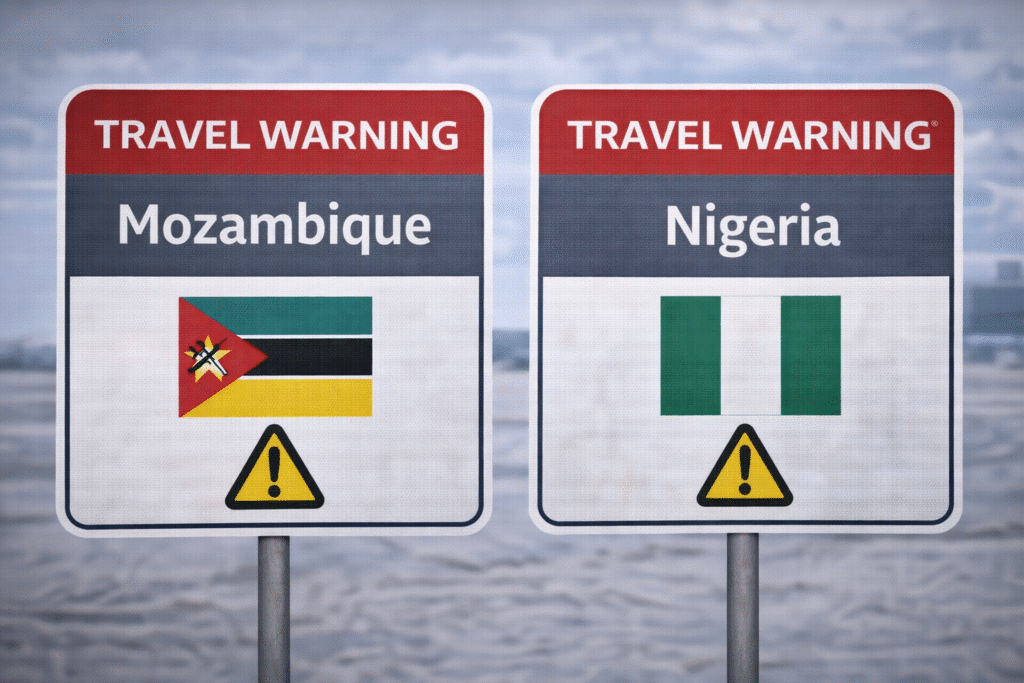
South Korea has issued new and stricter travel warnings for parts of Mozambique and Nigeria, citing a sharp rise in violent attacks, terrorism, and criminal activity that pose serious risks to foreign nationals. The updated advisories reflect growing concerns over regional instability, prompting authorities to urge South Korean citizens to evacuate affected areas or cancel non-essential travel plans.
The revised guidance was released as part of the Ministry of Foreign Affairs’ regular assessment of global security conditions. The decision underscores the government’s heightened vigilance as violence intensifies in certain regions of Africa, particularly where militant groups and organized criminal networks remain active.
Mozambique: Cabo Delgado Under Special Travel Warning
Mozambique’s northern Cabo Delgado province has been placed under a special travel warning due to persistent insurgent violence. The region has faced years of instability driven by armed groups linked to extremist networks, with attacks targeting villages, transport routes, and major infrastructure projects.
Since the conflict escalated in recent years, thousands of civilians have been killed or injured, and large numbers of residents have been displaced. Despite military operations and international support aimed at restoring stability, the security situation remains unpredictable. Authorities note that attacks often occur without warning and can spread rapidly across districts.
South Korea’s advisory strongly discourages travel to Cabo Delgado and urges citizens already in the area to leave as soon as it is safe to do so. The warning reflects concerns that foreign nationals could be caught in attacks or targeted due to limited security coverage in remote areas.
Nigeria: Multiple States Raised to Evacuation-Level Alert
Nigeria has also seen its travel advisory level raised, with several northern states and at least one southern state now under a Level 3 alert. This level recommends evacuation and advises against all travel unless absolutely necessary.
Nigeria’s security challenges are complex and regionally diverse. In the northeast, militant groups continue to carry out deadly attacks on civilians, security forces, and infrastructure. In the northwest and central regions, armed banditry has surged, with kidnappings for ransom becoming a widespread threat. Southern areas have also experienced incidents of violent crime, including attacks on transport routes.
The South Korean government cited a noticeable increase in the frequency and severity of kidnappings, ambushes, and attacks on public spaces. Foreign nationals are considered particularly vulnerable, especially those traveling outside major urban centers or without adequate security arrangements.
Heightened Risks for Travelers
The updated advisories highlight several risks faced by travelers in affected regions, including unpredictable violence, limited emergency response capabilities, and challenges in accessing consular assistance. In both Mozambique and Nigeria, attacks have occurred near roads, residential areas, and economic sites, raising concerns for anyone conducting business or tourism activities.
The Ministry of Foreign Affairs has emphasized that its ability to provide rapid assistance in high-risk zones may be limited. Citizens are therefore encouraged to prioritize personal safety, avoid unnecessary exposure, and follow evacuation guidance where issued.
Adjustments in Other African Destinations
While warnings were raised for Mozambique and Nigeria, South Korea also adjusted advisories for other countries based on improved conditions. Travel warnings for South Africa and Botswana were lowered following assessments indicating greater stability and improved safety for visitors.
Namibia was placed under a Level 1 advisory, indicating a relatively low risk for travelers. This classification reflects general caution rather than active conflict, with authorities advising travelers to remain aware of local conditions and health-related considerations.
These changes demonstrate South Korea’s dynamic approach to travel risk assessment, balancing emerging threats with improving conditions elsewhere.
Broader Global Advisory Updates
Beyond Africa, the Ministry of Foreign Affairs also reviewed travel advisories across multiple regions. Alerts for Bolivia’s Cochabamba region were eased, reflecting a decline in unrest. Several provinces in Turkey saw adjustments based on localized security evaluations.
At the same time, existing travel advisories for countries such as Senegal, El Salvador, Tanzania, and parts of Russia, China, and the Democratic Republic of the Congo were extended. These regions continue to face ongoing challenges ranging from political instability and security threats to public health concerns.
Implications for Tourism and International Travel
The heightened warnings for Mozambique and Nigeria are likely to affect tourism flows, business travel, and international mobility. Tour operators and travel agencies may reassess itineraries, while airlines and insurers may adjust policies related to high-risk destinations.
For travelers, the advisories serve as a reminder of the importance of staying informed and flexible. Governments worldwide increasingly rely on real-time security assessments to guide travel decisions, particularly as regional conflicts and criminal activities evolve rapidly.
A Call for Vigilance
South Korea’s latest travel warnings highlight the growing complexity of global travel safety. With violence surging in certain regions and conditions changing quickly, travelers are urged to monitor official guidance, assess risks carefully, and prioritize safety over convenience.
The Ministry of Foreign Affairs has reaffirmed its commitment to protecting citizens abroad through timely information and updated advisories. As security conditions continue to shift, travelers are encouraged to remain alert, maintain contingency plans, and comply fully with evacuation or travel restriction recommendations.
In an increasingly uncertain global environment, informed decision-making remains the most important tool for ensuring safe and responsible travel.
For more travel news like this, keep reading Global Travel Wire