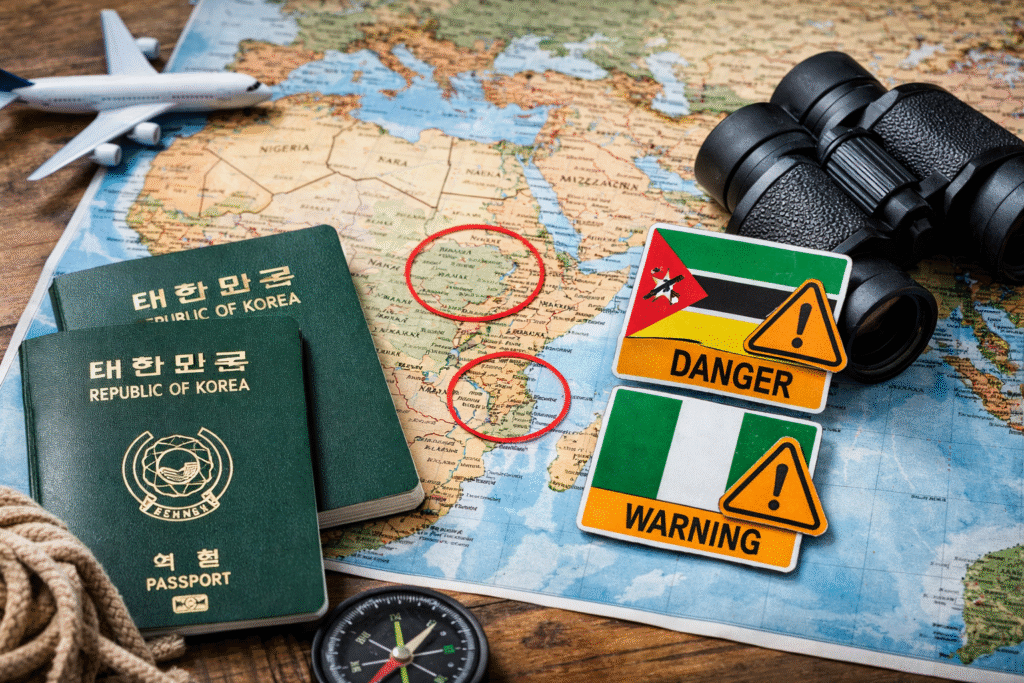
South Korea has issued stricter travel warnings for parts of Mozambique and Nigeria following a sharp rise in violent attacks and security threats. The move aims to protect South Korean citizens as militant violence, kidnappings, and insurgency expand across key regions in both countries.
The Ministry of Foreign Affairs announced the updated advisories after its latest global risk assessment. Authorities urged citizens to cancel non-essential travel and evacuate high-risk areas where possible. The decision reflects worsening on-ground realities and limited improvement in local security conditions.
Cabo Delgado in Mozambique Faces Heightened Risk
Mozambique’s northern Cabo Delgado province now faces a special travel warning. The region has remained unstable for years due to extremist violence linked to Islamist militant groups. Attacks on villages, roads, and energy projects continue to disrupt daily life.
Insurgents have targeted civilians and foreign-linked infrastructure since 2017. The violence has displaced hundreds of thousands of residents. Many areas still face restricted access, damaged public services, and ongoing military operations.
Despite international security support and regional cooperation, attacks persist. Armed groups continue to exploit remote terrain and weak local governance. These factors make the region unpredictable for travelers.
South Korea now strongly advises its citizens to avoid all travel to Cabo Delgado. Those already present are encouraged to leave when safe routes remain available.
Nigeria Sees Advisory Raised to Evacuation Level
South Korea has also raised its travel advisory for several Nigerian states. Five northern states and one southern state now fall under a Level 3 alert. This level urges citizens to evacuate and avoid travel unless absolutely necessary.
Nigeria has struggled with multiple security threats. In the northeast, extremist groups continue attacks on towns, schools, and military targets. In the northwest and central regions, armed bandit groups carry out mass kidnappings and village raids.
Kidnapping for ransom remains one of the most serious risks. Criminal groups often target highways, rural communities, and even urban outskirts. Foreign nationals face higher vulnerability due to perceived ransom value.
The government cited rising attack frequency and expanding threat zones as reasons for the upgrade. Transport routes, including roads and public transit, face regular disruption. Emergency response capacity also remains uneven across regions.
South Korean citizens have been urged to reassess travel plans and register with diplomatic missions if movement becomes unavoidable.
Kidnappings and Armed Violence Impact Tourism Safety
Both Mozambique and Nigeria present growing challenges for tourism safety. Armed violence affects not only conflict zones but also transit corridors and nearby urban areas. Tourism infrastructure struggles under constant security pressure.
Hotels, transport operators, and tour services face operational risks. Insurance costs rise, and emergency evacuation options remain limited in remote areas. These factors make travel planning difficult and risky.
South Korea’s warning highlights the importance of real-time risk evaluation for international travelers. Safety conditions can change rapidly, even in regions previously considered stable.
Advisory Levels Lowered for Southern Africa Destinations
While warnings increased for Mozambique and Nigeria, South Korea eased advisories for several other African destinations. South Africa and Botswana saw lowered warning levels following improvements in security conditions.
Authorities noted better law enforcement response and reduced unrest in key tourist zones. These changes suggest a more stable travel environment compared to earlier assessments.
Namibia was placed under a Level 1 advisory. This level signals general caution rather than active conflict risk. Officials cited isolated public safety and health concerns rather than widespread violence.
Other Global Travel Advisory Adjustments
South Korea also adjusted advisories beyond Africa. Bolivia’s Cochabamba region saw an easing of warnings due to reduced unrest. Several provinces in Turkey experienced revised advisory levels after improved local stability.
At the same time, South Korea extended existing advisories for Senegal, El Salvador, Tanzania, and parts of Russia, China, and the Democratic Republic of the Congo. These regions continue to face political tension, crime risks, or security challenges.
Most extensions will remain in effect for another 90 days. Authorities plan to reassess conditions during the next review cycle.
Regular Risk Reviews Guide Travel Safety Decisions
South Korea conducts travel advisory reviews twice a year. Officials analyze security threats, public health issues, natural disasters, and diplomatic inputs. These reviews help ensure that warnings reflect current realities.
Travelers are encouraged to stay informed and follow official guidance. Registration with embassies, careful route planning, and emergency preparedness remain essential for international travel.
As global security conditions shift, South Korea continues to adapt its travel guidance. The latest updates reflect a firm focus on citizen safety in an increasingly complex travel environment.
For more travel news like this, keep reading Global Travel Wire