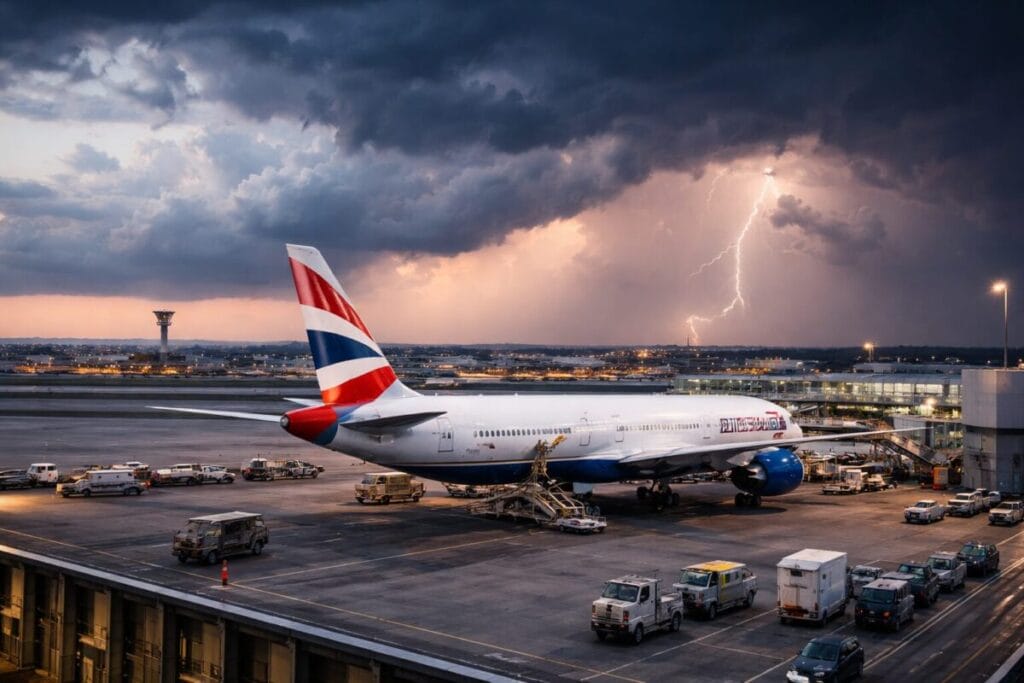
A recent legal decision in the United Kingdom has drawn international attention to aviation safety, crew liability, and the growing India–UK travel market. The UK court has dismissed a long-running turbulence injury claim against British Airways, ruling that the incident could not have been foreseen or avoided using standard aviation procedures. The decision has brought clarity to how courts interpret unpredictable atmospheric events on long-haul services.
The case centered on a 2019 London–Mumbai flight during which a senior cabin crew member suffered serious injuries after a sudden drop in altitude. The flight was approaching Mumbai when the turbulence struck. Despite the compensation claim seeking £72,500, the court concluded that no negligence occurred and that the pilots acted within international aviation standards.
Background of the Incident
The flight operated between London Heathrow and Mumbai’s Chhatrapati Shivaji Maharaj International Airport, two major international gateways. As the aircraft descended into Mumbai airspace, an abrupt vertical movement generated severe turbulence. Seatbelt signs were already on due to earlier unstable weather conditions detected en route.
The injured crew member, a veteran with decades of service, suffered a fractured knee and a dislocated shoulder following the sudden jolt. The force of the movement also caused service items to fall, compounding the injuries. The event was described as the most violent turbulence episode she had encountered during her career.
Compensation Claim and Allegations
Legal representatives for the claimant argued that the pilots should have altered the flight path earlier due to proximity to storm clouds. The case claimed that cockpit decision-making failed to mitigate risk, and that the crew should have been seated sooner. The core argument rested on allegations that the turbulence was avoidable, rather than an uncontrollable atmospheric event.
For the claim to succeed, the court required evidence that British Airways breached operational duties or ignored visible weather warnings. The burden of proof also required the claimant to show that standard aviation procedures would have prevented the injuries.
Court Findings and Pilot Testimony
British Airways contested the allegations, supplying testimony from both flight officers. They stated that no storm clouds were observed visually or on radar during approach. Instead, only harmless cumulus cloud formations were noted, which are not associated with severe turbulence. Meteorological experts also confirmed variable turbulence levels over Mumbai during that period, especially during descent phases when certain atmospheric layers become unstable.
Judge David Saunders ruled that the event could not have reasonably been anticipated. He concluded that the pilots acted professionally and adhered to established airline protocols. The court also highlighted the importance of radar technology, pilot judgment, and real-time decision-making in preventing navigational hazards. With no breach in duty identified, the claim was dismissed.
Impact on Aviation Liability Standards
The ruling highlights a key legal distinction in aviation: injuries alone do not establish liability. Courts differentiate between negligence and unavoidable atmospheric events, particularly sudden clear-air turbulence. This type of turbulence often produces no radar alerts and leaves pilots with little time to adjust altitude or course.
The decision reinforces international standards governing pilot obligations and risk assessments. The aviation sector recognizes turbulence as a leading cause of in-flight crew injuries worldwide. However, most cases originate from weather phenomena that cannot be forecast with precision.
Tourism and Aviation Context Between India and the UK
The India–UK air corridor remains one of the busiest international routes outside the Middle East and North America. Millions of passengers travel annually for tourism, education, family visits, and business. India is also a major tourism growth market for the UK, with increasing demand for year-round connectivity between major hubs such as London, Mumbai, Delhi, and Bengaluru.
During peak travel seasons, flights operate at high load factors, reflecting sustained bilateral demand. Industry data shows increased airline interest in expanding capacity as both governments view commercial aviation as a core economic driver. Despite fluctuations linked to global health events and fuel prices, the market continues to expand.
Crew Safety and Training Considerations
The ruling also brings attention to cabin crew safety. Unlike passengers, crew members spend portions of flights standing, serving, or preparing cabins, placing them at greater risk during turbulence. International aviation authorities consistently encourage compliance with seatbelt advisories, and airlines reinforce turbulence drills throughout crew training programs.
Commercial airlines have also invested in improved weather mapping systems, cockpit radar enhancements, and predictive analytics. These tools aim to reduce turbulence exposure but cannot eliminate it entirely due to atmospheric unpredictability.
Conclusion: A Case That Clarifies Aviation Responsibility
The turbulence injury case marks a significant moment in aviation law. The dismissal underscores that airlines cannot be held liable for every inflight injury, especially when crews act responsibly and without technical warnings. The decision also strengthens confidence in pilot training and reinforces existing legal standards governing international routes.
For passengers and crew, the case illustrates both the resilience of modern aviation safety systems and the unavoidable nature of certain weather events. For the India–UK tourism and aviation market, the ruling comes at a time of continued growth and cooperation, emphasizing the need to balance operational safety with expanding global mobility.
For more travel news like this, keep reading Global Travel Wire