
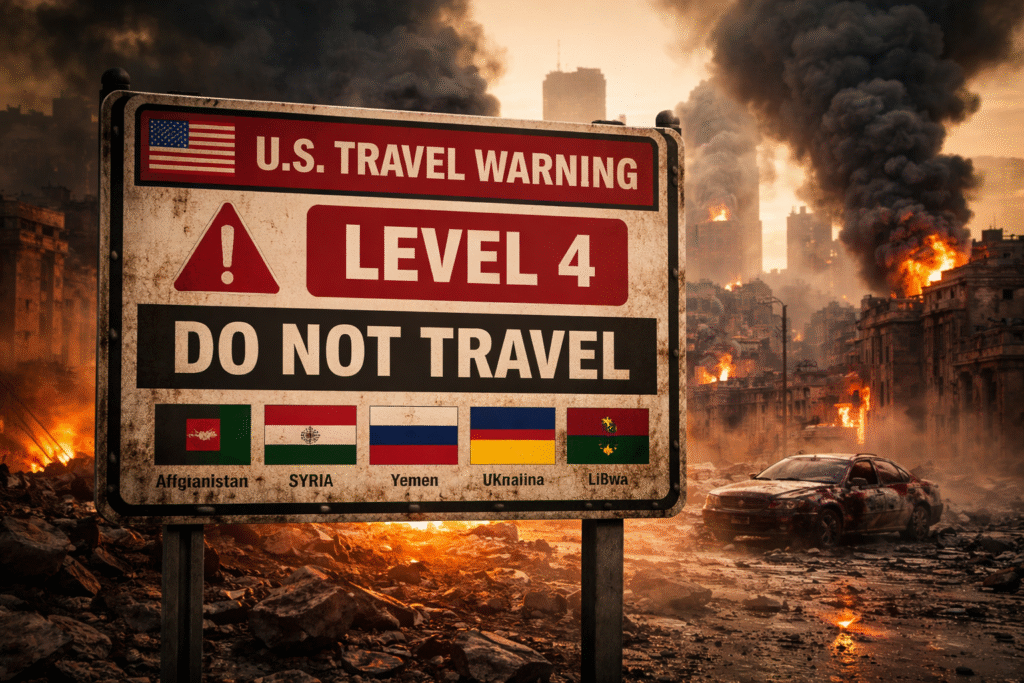
The United States has expanded its strictest travel advisory as Afghanistan joins a long roster of countries labeled under the Level 4 “Do Not Travel” designation. This category represents the highest alert level issued by the U.S. State Department and signals that Americans should avoid travel due to immediate threats to safety, political instability, and the near absence of consular support. The growing list reflects a volatile global climate shaped by armed conflicts, economic collapse, terrorism, and civil unrest.
What the Level 4 Advisory Means for Travelers
The State Department evaluates each destination based on direct risks to American citizens abroad. Its four-tier system ranges from normal caution to the stern “Do Not Travel” advisory. Level 4 warnings are rare and reserved for situations where the likelihood of harm is high. This includes war zones, failed states, or countries experiencing systemic collapse.
Travelers entering Level 4 regions may face severe challenges. Emergencies such as injury, legal disputes, or medical crises may be impossible to resolve due to the lack of diplomatic presence or functioning services. In some cases, U.S. embassies have closed, evacuated, or are unable to operate due to hostile conditions.
A Growing List of Dangerous Destinations
More than twenty nations now fall into the Level 4 category. The newest addition, Afghanistan, remains unstable after years of conflict, governance changes, and territorial struggles. Insurgent groups and criminal networks continue to operate, making it one of the world’s most dangerous environments for foreign nationals.
Afghanistan joins countries such as Russia, Ukraine, Syria, Yemen, Libya, and Venezuela that have faced severe travel restrictions due to ongoing crises. While each has its own circumstances, the common denominator is instability and the inability of local governments to guarantee basic safety.
Conflict and War Zones
Countries like Syria, Yemen, Ukraine, Libya, South Sudan, and the Central African Republic continue to endure active fighting. Battles between government forces, militias, separatist groups, or foreign militaries have devastated civilian infrastructure including hospitals, airports, and transportation networks. For tourists, moving safely within these territories is nearly impossible.
Terrorism and Extremist Threats
Nations in the Sahel region, including Mali, Niger, and Burkina Faso, face frequent attacks from extremist organizations. These groups target civilians, government facilities, and sometimes foreign nationals. Kidnappings and roadside attacks are common, and remote areas often lie outside government control.
Somalia presents similar risks due to the presence of al-Shabaab and other armed groups. Combined with piracy threats along the coast, the overall security situation remains critical.
Political Repression and Civil Unrest
Countries like Belarus, Iran, Venezuela, and Myanmar face unrest driven by political tensions, contested elections, or mass protests. Government crackdowns and unpredictable violence create hazardous conditions in urban centers. Foreigners risk detention, limited legal protections, or becoming entangled in political disputes.
North Korea, long isolated from the international community, poses unique challenges. Strict regulations, limited communication access, and harsh penalties for perceived infractions make it difficult for foreign visitors to navigate safely.
Economic Collapse and Criminal Activity
Haiti and parts of Latin America are experiencing widespread instability driven by gang control, kidnappings, and failing state institutions. Humanitarian crises worsen as access to healthcare and food declines. In Venezuela, shortages and hyperinflation have fueled crime and civil disorder, further discouraging travel.
Geopolitical Flashpoints
Russia and Ukraine remain dangerous due to ongoing conflict and heightened tensions with Western countries. Risks include military attacks, surveillance, arbitrary detention, and disruptions to airspace and transport routes. The war has displaced millions and reshaped travel patterns across Europe and Eurasia.
Limited Diplomatic Assistance
One of the most significant factors in Level 4 designations is the inability of the U.S. government to help its citizens. In some countries, embassies have suspended operations. In others, security conditions prevent diplomats from moving freely or offering essential services. Without consular support, travelers are left vulnerable during emergencies.
Why These Advisories Matter for Tourism
The Level 4 list is a grim barometer of global tourism viability. Travel thrives on stability, mobility, and security. Conflict-zone destinations, by contrast, experience declining visitor numbers, halted investment, and destroyed tourism infrastructure. Airlines reroute flights, insurance companies restrict coverage, and tour operators suspend itineraries.
Travelers planning international trips must now conduct deeper research before finalizing itineraries. Safer alternatives remain abundant, and many governments encourage travel to stable destinations where safety and medical care are reliable.
Looking Ahead
The expansion of the Level 4 advisory list signals a world grappling with overlapping crises. While some destinations may stabilize in time, others face prolonged turmoil. For now, travelers are urged to heed official warnings, avoid high-risk regions, and prioritize personal safety over adventure.
For more travel news like this, keep reading Global Travel Wire