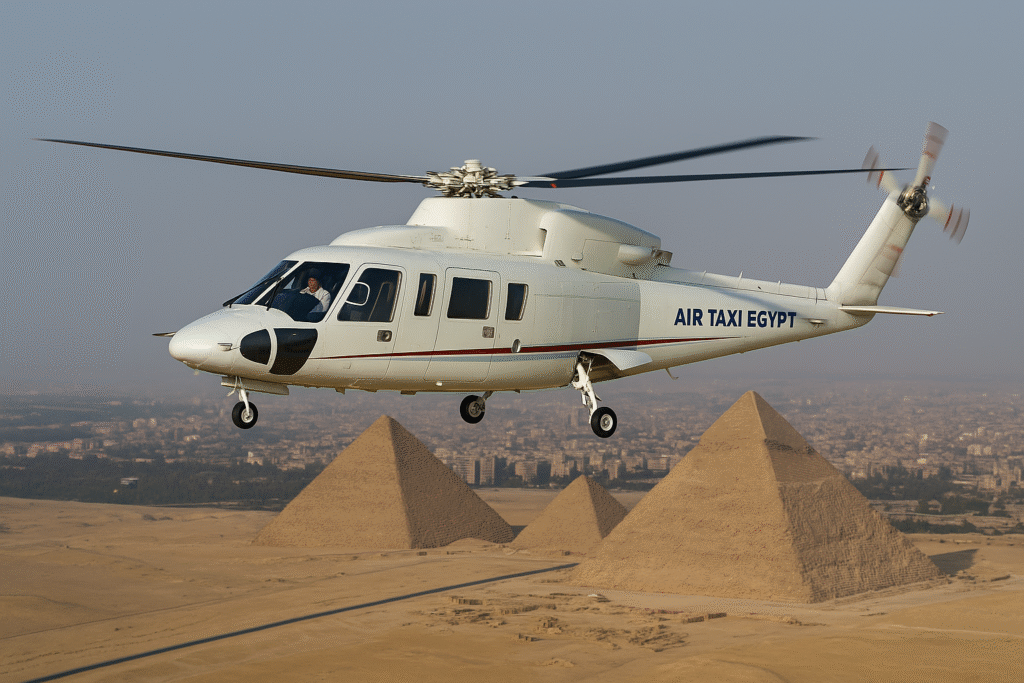
In a bold leap forward for Egypt’s transport and tourism landscape, Air Taxi Egypt has officially launched its luxury vertical flight services, promising to reshape how residents and visitors traverse the country. The joint venture between Abu Dhabi Aviation and TCM Economic Consulting marks the debut of a streamlined, high-end aerial alternative to traditional overland and scheduled airline travel.
A New Era for Domestic Air Mobility in Egypt
With the inauguration, Air Taxi Egypt introduces a network of vertical flights linking Cairo to the New Administrative Capital, Sheikh Zayed, North Coast, Siwa Oasis, Sharm El-Sheikh, Hurghada, Luxor, and Aswan. What once required hours on winding roads or multi-leg airline connections can now be traversed in mere minutes — a development that has the potential to transform internal travel dynamics and boost accessibility across Egypt’s most sought-after destinations.
This service blends the operational experience of Abu Dhabi Aviation—which has nearly five decades of regional aviation history—with TCM’s proven expertise in local consulting and commercial operations. Passengers will be able to choose between a Comfort Class, offering premium levels of convenience, and a more exclusive VIP Class, tailored to corporate clients, diplomatic delegations, and medical transport needs.
Slashing Travel Time, Elevating Experience
One of the most compelling selling points of Air Taxi Egypt is the dramatic reduction of journey durations. The trip from Cairo to the North Coast now takes just about 60 minutes, and the journey to the remote Siwa Oasis is cut to roughly 90 minutes — a vast improvement over long road alternatives. In addition, intra-city vertical hops between Cairo and landmarks like the Pyramids, the New Administrative Capital, or Sheikh Zayed aim to offer travelers speedy, seamless access to key points in and around Egypt’s urban corridors.
Flights are expected to appeal to a cross-section of users: tourists eager to maximize time at destinations, business travelers seeking efficiency, government officials managing intercity logistics, and medical travelers in need of rapid transport.
Strategic Investment & Fleet Strategy
Behind this initiative is a foundation of strong financial backing—an initial injection of around EGP 5 billion underscores the commitment to transforming domestic aviation infrastructure. The service rollout is backed by a modern fleet composed of vertical aircraft (e.g., helicopters or similar rotorcraft), designed to operate from helipads already planned in over 25 locations across Egypt. These include major tourist hubs, urban centers, and resort areas, ensuring broad geographic coverage.
The service launch included demonstration flights over the Giza Pyramids and the Grand Egyptian Museum — symbolic testaments to operational readiness and the ambition behind this undertaking. From its earliest phase, Air Taxi Egypt is projecting robust returns. Abu Dhabi Aviation’s first half of 2025 posted post-tax net profits in the region of AED 394 million, setting a solid financial backdrop for expansion.
Boosting Tourism & Economic Diversification
For Egypt, which continues to pursue growth via tourism, sustainable infrastructure, and economic diversification, Air Taxi Egypt couldn’t be more timely. The facility to swiftly connect Cairo with beach resorts, archaeological landmarks, and UNESCO-listed sites could open up new itineraries, spur regional tourism, and encourage travelers to combine multiple destinations in a single trip.
Tourists reaching Sharm El-Sheikh, Luxor, or Aswan will now have a much more compelling, time-efficient option. That convenience is likely to drive growth in domestic tourism and make multi-city tours more appealing. At the same time, by connecting to burgeoning urban zones like the New Administrative Capital and New Alamein, the service aligns with Egypt’s broader vision of modernizing infrastructure and enhancing internal connectivity.
Pricing & Accessibility
To meet different traveler profiles, Air Taxi Egypt introduces flexible pricing tiers. Shorter sightseeing or intra-Cairo hops may cost around USD 200, while more distant routes such as Cairo to Siwa or Hurghada to Luxor are priced closer to USD 1,500. Intermediate legs—say from Almaza Airport to Sheikh Zayed or Cairo to the Citadel—are expected to fall within USD 300–350. These tiers balance exclusivity with broader accessibility, ensuring that both high-end and discerning travelers can benefit from the service.
Collaboration, Security & National Vision
This ambitious aviation project enjoys strong institutional support, notably from the Egyptian Air Force, which is closely aligned with maintaining national security standards and integrating aviation governance. The UAE-Egypt partnership underpinning Air Taxi Egypt is frequently hailed as a model of regional cooperation in sustainable infrastructure and technological advancement.
Beyond its immediate borders, Air Taxi Egypt situates Egypt within a growing global movement toward urban air mobility—where vertical-flight solutions transition from novelty to mainstream transport mode. As cities worldwide explore aerial mobility, Egypt’s initiative might serve as a regional benchmark or even trendsetter.
What’s Next for Vertical Egypt Travel?
In the months ahead, Air Taxi Egypt aims to scale operations, increase flight frequencies, and broaden its network as demand grows. The launch of a mobile app for seamless booking and payment, integration with hotels and resorts, and potential tie-ins with tourism operators suggest an ecosystem approach.
For travelers in 2025 and beyond, Egypt’s domestic aerial landscape is changing fast. With luxury, speed, and connectivity as its pillars, Air Taxi Egypt may redefine how people traverse Egypt — making remote oases, coastal retreats, and historical treasures more accessible than ever.
For more travel news like this, keep reading Global Travel Wire