
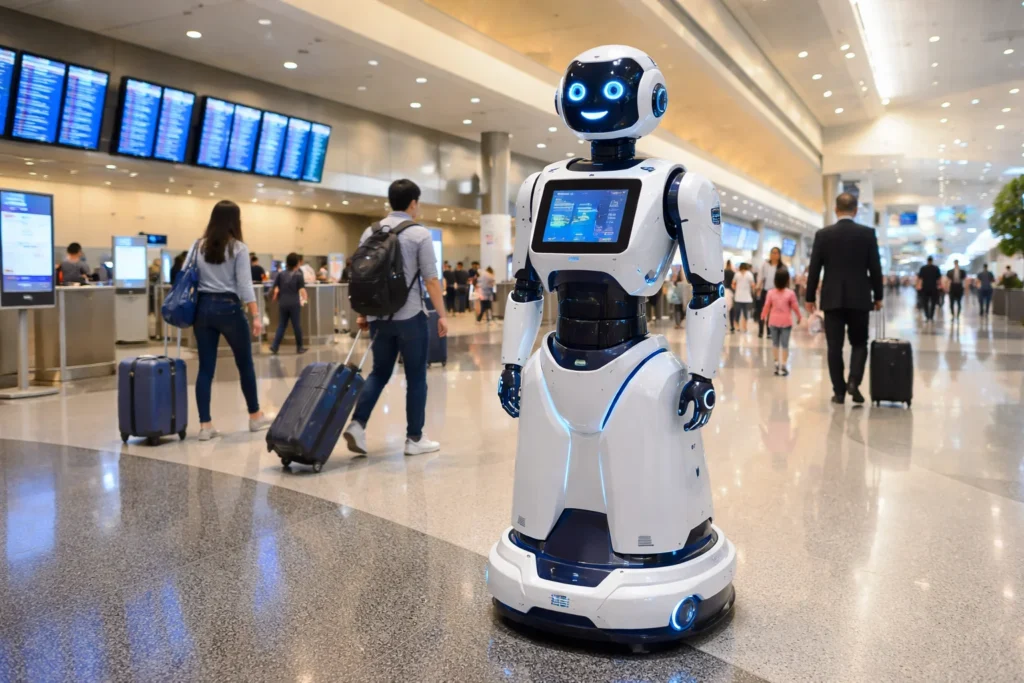
San José is reinforcing its reputation as a global innovation hub with the introduction of a humanoid AI robot at its international airport, marking a significant leap in the evolution of smart travel. The deployment of “José,” an advanced artificial intelligence-powered robot, at San José Mineta International Airport represents a forward-thinking approach to improving passenger services and operational efficiency.
Positioned in Terminal B, José has been designed to interact with travelers in a highly intuitive and human-like manner. The robot can communicate in over 50 languages, offering assistance to a diverse range of international passengers. From answering basic queries about flight schedules to guiding travelers through airport facilities, José aims to make airport navigation faster, easier, and more accessible.
This initiative reflects the airport’s ongoing commitment to integrating emerging technologies into public infrastructure. Located near Silicon Valley, San José Mineta International Airport has long collaborated with technology firms to pilot new solutions that enhance both efficiency and customer satisfaction. The addition of José is another step in transforming traditional airport operations into a more digital and responsive ecosystem.
The AI robot is the creation of a local startup specializing in socially intelligent robotics. These systems are built to interpret human behavior, understand context, and respond in real time. Unlike static information kiosks, José can move, engage, and adapt to dynamic environments, making it particularly suitable for busy settings such as airports.
One of the most notable features of José is its ability to deliver multilingual support instantly. For international travelers, language barriers often create confusion and stress, especially in unfamiliar environments. By offering assistance in dozens of languages, the robot ensures that passengers from different parts of the world receive equal access to information and support.
The introduction of José is currently part of a pilot program that will run for several months. During this period, airport authorities and developers will monitor how effectively the robot performs in real-world conditions. Data collected from passenger interactions will help refine its capabilities, paving the way for broader implementation in airports and other public spaces.
Beyond customer service, José is expected to contribute to operational improvements. By handling routine inquiries, the robot can reduce the workload on airport staff, allowing human employees to focus on more complex tasks. This balance between automation and human interaction is seen as a key factor in creating efficient yet personalized travel experiences.
The timing of this innovation is particularly relevant as global travel continues to rebound and passenger volumes increase. Airports worldwide are exploring ways to manage growing crowds while maintaining high service standards. Technologies such as AI-driven robots, biometric systems, and automated check-ins are becoming essential tools in modern aviation infrastructure.
San José’s approach highlights a broader trend toward smarter airports that prioritize convenience, speed, and accessibility. By leveraging artificial intelligence, airports can provide real-time updates, minimize wait times, and offer tailored assistance to individual passengers. This shift is transforming airports from simple transit points into intelligent service hubs.
The presence of José also aligns with wider government-backed initiatives promoting digital transformation and innovation in urban infrastructure. Many cities are investing in AI and automation to improve public services, reduce inefficiencies, and enhance user experiences. Airports, being high-traffic environments, are ideal testing grounds for such technologies.
For travelers, the benefits are immediate and tangible. Instead of searching for information desks or waiting in queues, passengers can simply approach José for instant assistance. Whether it’s finding a gate, checking flight updates, or locating amenities, the robot provides quick and reliable answers. This not only saves time but also reduces the stress often associated with air travel.
Moreover, the friendly and interactive nature of the robot adds a unique element to the travel experience. As airports compete to offer memorable and seamless journeys, innovations like José can play a crucial role in shaping passenger perceptions and satisfaction.
Looking ahead, the success of this pilot program could lead to the expansion of AI-powered robots across other terminals and airports globally. Developers are already exploring additional features, such as integration with mobile apps, personalized travel recommendations, and enhanced navigation capabilities using augmented reality.
San José Mineta International Airport’s initiative demonstrates how technology can redefine the future of travel. By embracing artificial intelligence and robotics, the airport is not only improving its current services but also setting a benchmark for others in the aviation industry.
As the demand for smarter, more efficient travel solutions continues to grow, innovations like José signal a new era where technology and human-centric design come together to create seamless airport experiences.
For more travel news like this, keep reading Global Travel Wire