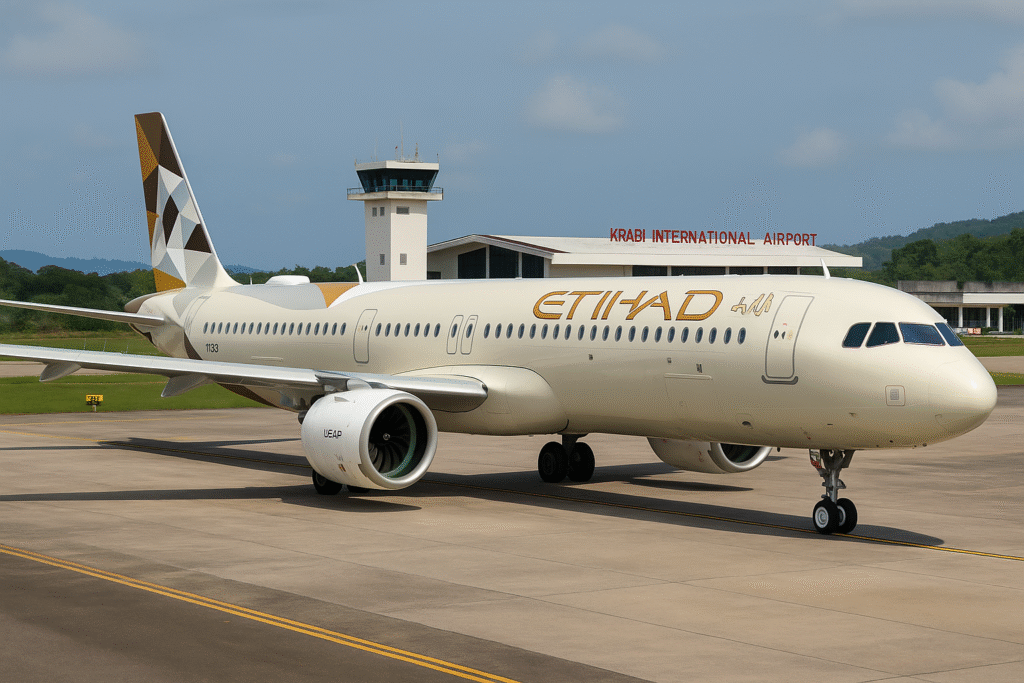
On October 9, 2025, Etihad Airways rolled out its first direct flight from Abu Dhabi to Krabi, reshaping connectivity between the Middle East and southern Thailand. Inaugurated with a formal welcome at Krabi International Airport, the launch underscores Thailand’s push to deepen ties with high-value tourism markets.
The Airbus A321LR flight EY424 carries 160 seats and adds about 7,650 seats monthly on this route — boosting capacity by roughly 16 percent. Travel time cuts drastically, from more than 12 hours previously (with transfers) to under 7 hours now.
Thailand’s Deputy Prime Minister and Transport Minister, along with the Governor of the Tourism Authority of Thailand and senior officials, attended the welcome ceremony. Traditional Thai cultural performances greeted arriving passengers, reinforcing the warmth and hospitality the country hopes to project.
A Major Boost for Krabi and Southern Thailand
Krabi ranks among Thailand’s top beach destinations, known for dramatic karst cliffs, emerald waters, and rich biodiversity. Beyond its scenic charm, Krabi has been promoting sustainable tourism — including marine conservation, community-based ecotourism, and heritage protection. The new direct route places Krabi within easier reach, especially for travelers from the Gulf region seeking beach, wellness, and culture.
The Tourism Authority of Thailand intends to tap this connectivity to attract premium visitors interested in wellness retreats, halal-friendly options, family travel, and deep cultural experiences. Officials stress that the focus now is on “value over volume” — drawing guests who spend more and stay longer.
Krabi already draws about six million visitors annually, and the province has been working to smooth out seasonality under its “Krabi 365 Days” plan, encouraging travel even in monsoon months. The direct link from Abu Dhabi may help even out visitor flows across the year.
Middle East Market: High Value, Growing Demand
Thailand’s pivot toward the Middle East comes amid a slowdown in Chinese arrivals. Visitor growth from the Gulf region has been climbing by 17–18 percent year over year. Middle Eastern tourists typically stay for 10–12 days and spend well over 100,000 baht per trip, making this a highly prized market.
By April 2025, Thailand had welcomed more than 162,000 travelers from the Middle East — Saudi Arabia alone saw a double-digit rise. Thailand aims to attract up to 1.1 million tourists from the Middle East and Africa in 2025, with expected revenue near 98 billion baht.
The new Abu Dhabi–Krabi route aligns with the Tourism Authority’s airline-focus strategy, which fosters partnerships with international carriers to open fresh access to regions beyond Bangkok and Phuket.
Strategy and Sustainability in Focus
Thailand’s tourism leadership sees this route as more than just a flight path — it is part of a broader push to deepen tourism in under-visited provinces through sustainable and responsible development. Familiarization trips for Gulf media and opinion leaders are already planned for Krabi to spotlight hidden gems, local gastronomy, wellness routes, and eco-ventures.
Krabi’s own environmental accolades contribute to its attractiveness. The Lanta Archipelago, part of the province, recently appeared on the Green Destinations Top 100 list, reinforcing its credentials in sustainable travel.
In terms of religious and cultural alignment, Krabi has been expanding halal-friendly services, from halal restaurants to certified resorts, to accommodate Muslim travelers. The goal is to deliver seamless, culturally aware hospitality.
Challenges, Opportunity, and the Road Ahead
Despite a promising new route, Thailand’s tourism sector still faces headwinds: tourist arrivals through September 2025 were down about 7.4 percent year over year, prompting authorities to temper annual forecasts. The dip is largely due to declines in Chinese travelers, historically one of the largest source markets.
Still, analysts forecast that Thailand could welcome up to 41 million foreign visitors in 2025, exceeding pre-pandemic levels. To meet that goal, the country must diversify sources, improve infrastructure, and strengthen niche tourism draws.
The Abu Dhabi–Krabi link is a powerful signal. It emphasizes Thailand’s intention to rebalance its dependence on certain traditional markets and to accelerate development of southern and regional tourism hubs.
Krabi now stands to benefit most. As the new flights open, the province’s offerings — from rugged coastlines and jungle escapes to wellness sanctuaries and cultural villages — may find fresh audiences in the Gulf market. For travelers from the Middle East, Thailand becomes closer, more accessible, and more inviting than ever.
Thailand’s strategy blends connectivity, sustainability, and selective targeting. If executed well, the direct route could serve as a model for further regional aviation links and become a cornerstone in the nation’s recovery and growth in global tourism.
For more travel news like this, keep reading Global Travel Wire