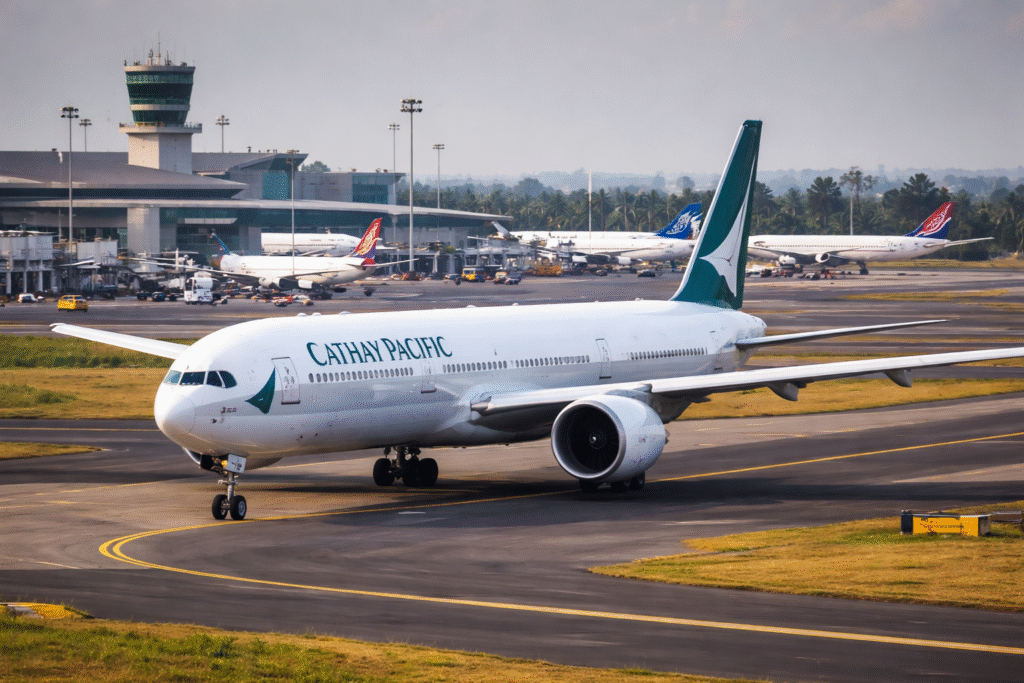
A brief taxiway error involving a Cathay Pacific Boeing 777 at Manila Ninoy Aquino International Airport has placed renewed attention on ground operations at one of Southeast Asia’s busiest gateways. The aircraft, operating as CX918 to Hong Kong, entered the wrong taxiway during routine ground movement before departure. The deviation was detected quickly, allowing air traffic controllers to step in and manage the situation without compromising safety.
The event caused only short delays. Yet, for a region experiencing strong travel growth, it served as a reminder of how crucial ground precision is to smooth and reliable aviation operations.
Quick Detection and Controlled Response
Air traffic controllers in Manila acted immediately after spotting the deviation. They corrected the aircraft’s taxi path and adjusted the sequence of nearby flights to keep safe spacing. Two arrivals experienced temporary delays while controllers ensured all movements followed proper separation standards.
This incident showed how multiple layers of safety oversight function in real time. Manila Airport handles dense daily traffic, making such rapid coordination essential. Despite the disruption, passengers faced minimal inconvenience, and departures soon returned to normal flow.
Cathay Pacific Begins Internal Review
Cathay Pacific launched an internal review after the deviation, focusing on ground procedures and communication protocols. The airline also coordinated with Philippine aviation authorities to assess whether signage, lighting, or instructions may have contributed.
The airline emphasized that safety margins remained intact throughout. The review aims to enhance procedures, reinforce crew awareness, and maintain consistent ground discipline. The approach reflects a commitment to continuous improvement rather than assigning blame.
Growing Complexity at Manila Ninoy Aquino International Airport
Manila Airport has long operated near maximum capacity, and ground traffic can become challenging during peak hours. Its taxiways intersect in several areas, and ongoing infrastructure upgrades add temporary barriers, reroutes, and markings that crews need to navigate with care.
In September, the airport shifted to private management under a new concession led by a major Philippine conglomerate. The consortium plans substantial investment in terminal modernization, runway rehabilitation, and improved air traffic systems. These upgrades aim to boost capacity, reduce chronic congestion, and strengthen safety performance across all airport zones.
As the airport transforms, operational precision on the ground becomes even more important. Ensuring clear markings, updated airport charts, and effective communication between pilots and controllers forms part of this modernization effort.
Aviation Safety Trends and Global Lessons
Ground deviations are rare but recognized risks in major airports worldwide. Similar events in other regions have led aviation authorities to stress improvements in surface lighting, ground radar systems, and standardized taxi signage.
The Manila case aligns with broader global aviation priorities. As airports expand and handle more flights, continuous investment in technology and training becomes essential. Many large airports now use advanced surface guidance and alert systems to help crews avoid incorrect turns, especially in complex layouts or low-visibility conditions.
Importance for Travel and Tourism Connectivity
The flight route between Manila and Hong Kong is one of the most heavily traveled in Asia. It supports both tourism and business travel, linking two major economic and cultural hubs. Any disruption, even minor, can influence travel confidence and airport efficiency.
Fortunately, the swift handling of this incident reassured passengers. Travel continued without cancellation, and passengers onboard CX918 arrived in Hong Kong without further delay. This response reinforced the reliability of aviation systems that support millions of travelers between the two destinations each year.
With the Philippines experiencing strong tourism recovery and Hong Kong regaining global traveller traction, consistent airport performance is key to supporting the region’s tourism rebound.
Future Safety Enhancements at Manila Airport
As part of the ongoing modernization program, Manila Airport plans targeted improvements that will directly reduce the risk of similar taxiway errors. Expected enhancements include:
- Clearer and brighter taxiway markings
- Updated layout designs to simplify ground routes
- Enhanced lighting systems for night and low-visibility operations
- Modern ground surveillance and alert technology
- Streamlined communication tools for controllers and pilots
These upgrades aim to build a safer, more efficient operating environment that can keep pace with increasing regional travel demand.
Cathay Pacific’s Safety Commitment
Cathay Pacific continues to position safety as its top priority. Findings from the internal review may influence future training sessions and ground operation guidelines. The airline also maintains strong collaboration with airport authorities across Asia to ensure smooth operations and consistent standards.
The incident has been treated as a learning opportunity within the wider context of aviation growth in the Asia Pacific region.
What Travelers Should Take Away
The taxiway deviation at Manila Airport ultimately showcased the strength of aviation safety systems. Rapid detection, coordinated controller action, and established protocols prevented escalation. While slight delays occurred, no risk to passengers or crew was recorded.
For travelers flying between Hong Kong and the Philippines, the event highlights the well-practiced safety culture that supports the region’s thriving air travel network. As airports and airlines continue to invest in modernization and training, travelers can expect even greater reliability in the years ahead.
For more travel news like this, keep reading Global Travel Wire