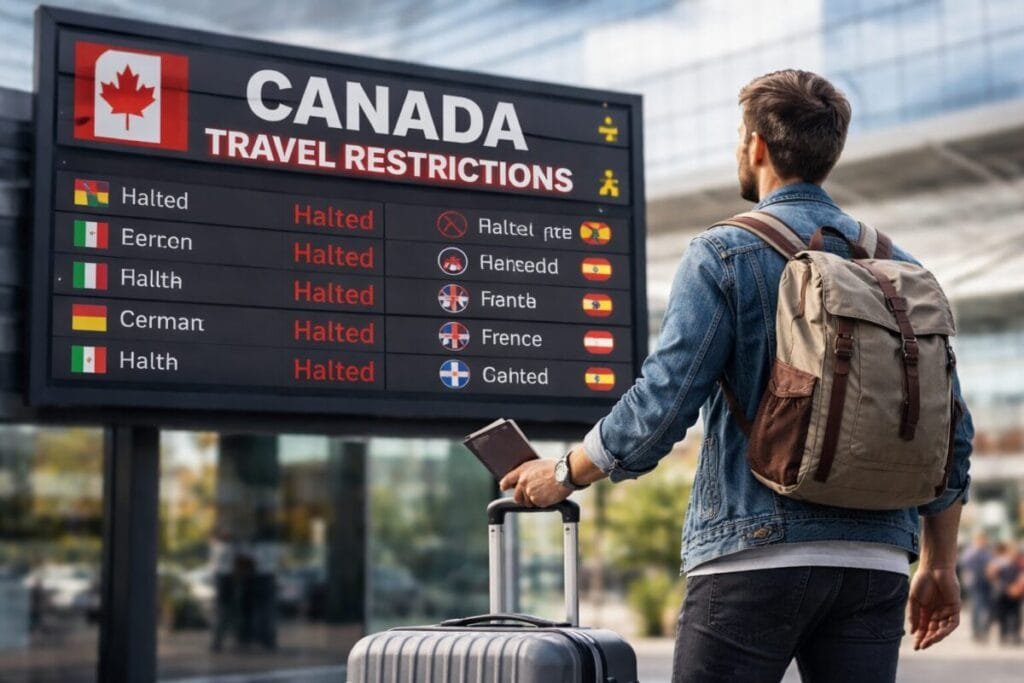
Switzerland, Germany, Sweden, Italy, Portugal, Iceland, France, and more than thirty European nations are now confronting new travel challenges to Canada in 2026. The freeze on Canada’s Start-Up Visa program has shocked entrepreneurs, investors, and international students across Europe. The decision has also struck the broader tourism and business travel sectors, as long-stay travel routes become more restricted.
These changes mark a sharp shift in Canada’s approach to talent and mobility. They also reflect a new era in selective immigration policy driven by labor needs, education strategies, and long-term competitiveness.
Start-Up Visa Freeze Reshapes Mobility Trends
Canada suspended the Start-Up Visa program on January 1, 2026. The program once attracted thousands of global entrepreneurs, many from Europe’s strongest innovation hubs. It offered permanent residency to applicants who secured support from Canadian incubators, investors, or venture capital firms.
The freeze blocks new applications until Canada launches a more selective pilot program later in 2026. Entrepreneurs with certification from 2025 may still apply until June 30, 2026. Everyone else is left waiting without clarity.
This pause has halted one of Canada’s most unique gateways for business relocation and long-term residency. For European innovators, Canada’s start-up scene was not only a market entry point, but also a platform for global expansion. Now, that path is temporarily closed.
Tourism and Business Travel Experience Collateral Impact
Canada’s visa and regulatory environment influences more than immigration. Business travel and long-stay tourism also rely heavily on predictable mobility frameworks. With uncertainty rising, tourism boards and travel agencies across Europe are monitoring how travelers may adjust their plans.
Entrepreneurs who once traveled to Canada for due diligence meetings, accelerator visits, and investment sessions now face delays. Multi-purpose trips that mixed tourism, work exploration, and study scouting are being disrupted.
Destination competitiveness is crucial in long-stay travel markets. Canada risks losing high-value travelers to other nations during this policy transition.
Europe Reacts to Shifting Travel Pathways
The freeze has affected travelers from nearly all EU and EEA economies. Countries with strong innovation cultures, such as Germany, Sweden, Finland, the Netherlands, and Switzerland, are among the most impacted. These are also nations with high outbound travel rates and strong demand for academic mobility and business relocation.
As barriers rise, European travelers may redirect exploration trips to other English-speaking destinations or innovation hubs. The United Kingdom, Ireland, Singapore, and Australia are positioned to benefit if Canada’s policy shifts extend beyond 2026.
Positive Reforms Ease Entry for Graduate Students
Not all 2026 changes make travel harder. Canada introduced a notable reform for graduate students. Master’s and PhD applicants no longer need to submit a Provincial or Territorial Attestation Letter.
This simplifies entry for academic tourism, which includes short-term research visits, campus tours, and long-stay study programs. Canada has long relied on international students as tourism contributors, especially during pre-arrival and holiday travel seasons.
India and Europe remain major contributors to this flow. Graduate-level easing may help partially offset the slowdown from business travel barriers.
Workforce Policies Support Skilled Newcomers
Another 2026 reform benefits skilled workers. Starting January 1, 2026, Ontario banned employers from requiring “Canadian work experience” in job postings. This removes a major obstacle for skilled immigrants who arrive with strong international credentials.
The travel sector sees this as a positive sign for long-term labor mobility tourism. Skilled migrants often travel before relocation to explore cities, schools, and housing options. Reducing professional hurdles can stimulate these trips and reinforce Canada’s competitiveness in talent attraction.
Tourism Economies Adjust to New Reality
Travel analysts expect mixed results throughout 2026. Business tourism may slow as the Start-Up Visa pipeline remains closed. Academic tourism and skilled talent scouting may grow as new reforms take effect. The short-term imbalance may reshape hotel bookings, international student housing demand, and travel agency itineraries.
European travel markets are also adjusting their marketing strategies. Agencies that specialized in relocation-related travel are now diversifying to student mobility and tourism-first packages.
What Comes Next for Travelers and Talent
Canada plans to launch its new entrepreneur pilot program later in 2026. Officials have signaled a more selective, innovation-focused model. This could improve applicant quality, but it will restrict volume. For tourism sectors, lower volume means fewer long-stay business travelers, fewer repeated visits for scale-up operations, and fewer ecosystem tours.
Travel experts believe that the program’s relaunch will shape mobility trends for years. If it remains restrictive, Europe may permanently diversify travel toward other countries with open innovation landing zones.
A Transforming Landscape for Tourism and Mobility
Canada’s 2026 reforms show a nation recalibrating its immigration and talent strategy. The transition has made travel more complex for European entrepreneurs, while easing pathways for graduate students and skilled workers.
For Europe, the key challenge will be adapting travel behavior and redirecting flows. For Canada, competitiveness will hinge on emerging pilot programs and the ability to attract global talent without undermining tourism demand.
The year marks a pivotal point for tourism, business travel, and long-stay mobility between Canada and Europe. The road ahead remains dynamic, uncertain, and strategically important for both sides.
For more travel news like this, keep reading Global Travel Wire