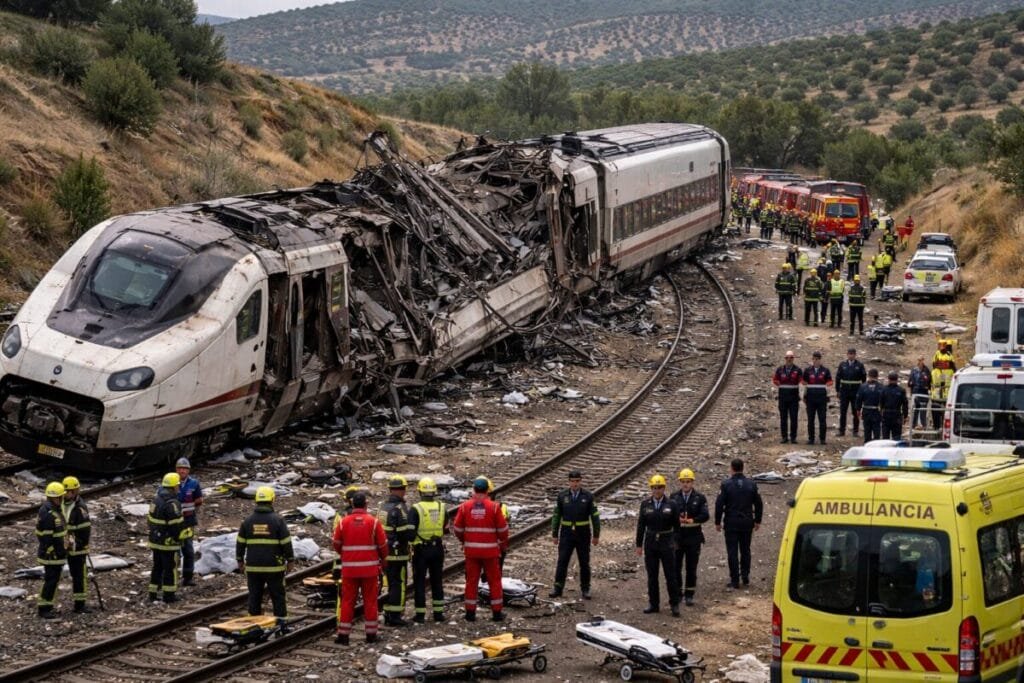
Travel and tourism in Spain faced a sudden shock after authorities confirmed that a broken rail joint is a key piece of evidence in the investigation of a deadly high-speed train crash. The accident, which occurred in southern Spain, has killed at least forty people and left many more injured.
The crash took place on a straight section of track near Adamuz in Córdoba province. Two high-speed trains were involved. One train derailed and stopped on the line. A second train, traveling in the opposite direction, collided with the wreckage. The force of the impact was devastating.
Rescue teams worked without pause to free trapped passengers. Hospitals in nearby cities were put on emergency alert to treat the injured. Families and friends waited anxiously for news about their loved ones. A national outpouring of grief spread across Spain.
While investigations continue, a damaged rail joint has emerged as a critical lead. The discovery has raised questions about rail infrastructure safety in one of Europe’s busiest and most advanced travel networks.
What Happened on the Tracks
Rail investigators found that a rail joint—also known as a fishplate—was broken on the stretch of track where the derailment began. Rail joints connect segments of track. Their integrity is vital for smooth and safe train movement. Early reports suggest that the joint gave way right before the train derailed.
The section of track had recently been renovated and had passed safety checks. Experts describe the failure as highly unusual, especially on a straight track where trains travel at high speeds. The derailment triggered a chain reaction that set the stage for the high-impact collision with the second train.
While officials have not released a final conclusion, the broken rail joint is now the focus of intense scrutiny. Authorities say it could have caused a sudden track misalignment. Even a small shift can send a high-speed train off its rails within seconds.
Impact on Spain’s Rail Network Reputation
Spain’s high-speed rail system is a symbol of modern travel in Europe. Millions of tourists rely on it each year to reach popular destinations like Madrid, Barcelona, Seville, Valencia and Málaga. The network is renowned for speed, comfort and reliability.
Rail operators face questions about routine maintenance, inspection schedules and monitoring systems after this incident. With tourism central to Spain’s economy, any threat to traveler confidence matters greatly.
Officials have pledged full transparency in the investigation. Government leaders have stressed that safety remains their top priority. Yet travelers and local communities are urging faster reforms and clearer answers.
How the Crash Unfolded
The two high-speed trains involved were on regular service routes. One train derailed first. Its passengers were caught unaware. Many were thrown from their seats or trapped as the train cars twisted off the track.
Before emergency crews could clear the scene, a second train appeared. Moving at high speed, it struck the derailed carriages. The impact was catastrophic. Emergency response teams immediately began rescue operations amid debris and chaos.
Local authorities set up crisis centers to help families. Psychological support and translation services were made available for foreign passengers. Hospitals stayed open round the clock to treat the injured.
National Mourning and Public Reaction
Spain declared three days of national mourning. Flags flew at half-mast at government buildings and public spaces. Memorial services were held across cities and towns. Citizens left flowers, candles and messages at makeshift tributes near train stations and town squares.
The victims included Spanish nationals and international visitors. Some were returning home after holidays. Others were commuting for work or family visits. The international travel community expressed grief and solidarity with Spain.
Local tourism businesses, already facing pandemic recovery challenges, now confront new uncertainty. Hotels, tour operators and transport providers are watching closely as rail safety reviews unfold.
Tourism Sector Response
Tourism officials are keen to reassure travelers that Spain remains a safe and welcoming destination. Many popular sites are far from the crash location. Tourist routes including coastal resorts, historic cities and cultural hubs remain open and fully accessible.
Yet travel planners and visitors are adjusting itineraries. Some are choosing alternative transport or ensuring they have insurance coverage. Tour operators are updating safety information and support services to address concerns.
Spain’s travel industry leaders see this moment as an opportunity to reinforce commitment to passenger safety. They emphasize improvements in infrastructure and communication between rail operators and tourism networks.
What the Rail Probe Could Mean for Travelers
The government has ordered a comprehensive review of rail tracks, joint components and maintenance procedures. Engineers and safety experts are testing track materials and joint stability across the network.
Officials say new inspection technologies could be introduced. More frequent checks and real-time monitoring may become part of standard rail operations. Travelers can expect tighter safety protocols on all high-speed services.
The crash has highlighted the risks inherent in any large transport system. Authorities say learning from this tragedy can strengthen safety for years to come.
Long-Term Priorities for Rail and Tourism
Spain’s leadership has pledged upgrades to rail infrastructure. They also plan to enhance emergency response systems, training for personnel and public communication during crises.
Tourism boards are working with transport authorities to keep visitors informed. Safety campaigns and traveler briefings are in development. The aim is to maintain Spain’s strong appeal while reassuring visitors about travel safety.
Officials stress that rail remains one of the safest ways to explore Spain. Millions of journeys are completed smoothly each year. Yet this incident underscores the need for constant vigilance and investment.
Looking Forward
As Spain transitions from immediate crisis management to long-term planning, priorities are clear:
- Improve rail inspection and maintenance.
- Strengthen safety protocols on all routes.
- Support victims and their families.
- Rebuild traveler confidence.
Spain’s travel industry is resilient. Officials and businesses alike are committed to learning from this event. As investigations continue, the nation looks ahead with resolve to protect both residents and visitors.
The legacy of this tragic crash could be a safer, stronger rail system that better serves Spain’s people and the millions of travelers who explore this vibrant country each year.
For more travel news like this, keep reading Global Travel Wire