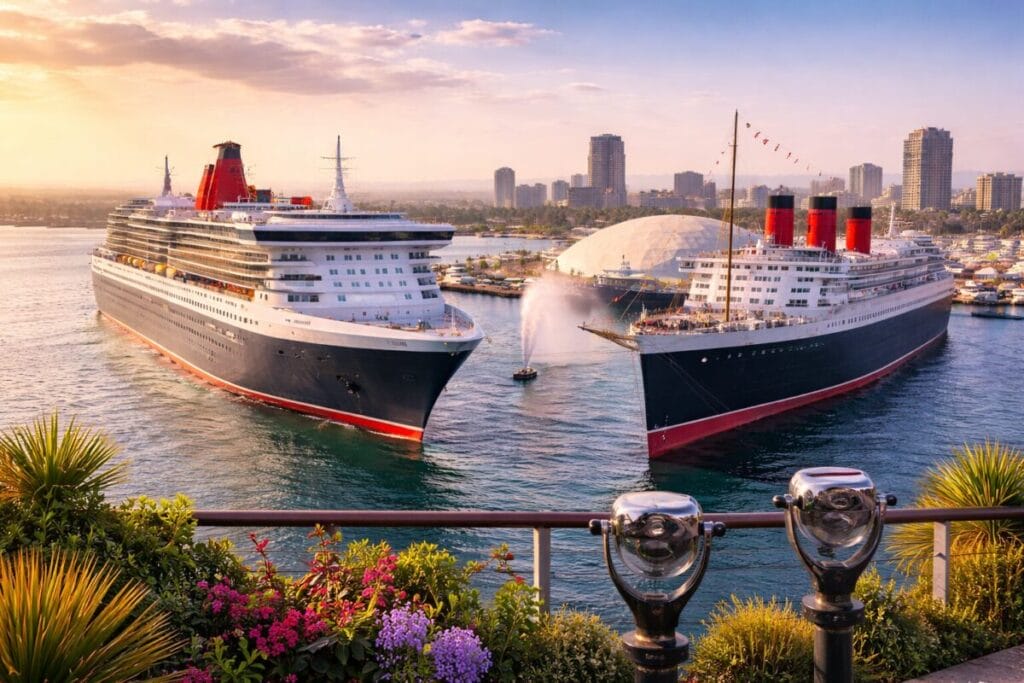
A remarkable chapter in global maritime history unfolded in Long Beach, California, when two legendary ocean liners connected to the United Kingdom were reunited after 20 years apart. The modern flagship Cunard vessel, Queen Mary 2, was carefully positioned near her historic predecessor, the Queen Mary, creating a powerful visual bridge between nearly a century of ocean travel.
This rare encounter was not staged for spectacle alone. Instead, it was framed as a meaningful tribute to continuity, engineering evolution, and the enduring cultural significance of ocean liners. The setting at the Port of Long Beach added international resonance, reinforcing how British maritime heritage has found a permanent home in the United States.
A Rare Convergence Across Generations
The reunion took place on February 2, 2026, when Queen Mary 2 briefly anchored off Long Beach during her global sailing itinerary. This marked the first time in two decades that the two vessels had been aligned in the same harbor. While Queen Mary 2 remains actively engaged in worldwide voyages, the original Queen Mary has stood docked in Long Beach for decades as a preserved landmark.
Seeing the two ships together offered a striking contrast between eras. One represents modern ocean travel with advanced engineering and contemporary luxury, while the other stands as a symbol of early 20th‑century elegance and innovation. Together, they illustrated how maritime traditions continue to evolve without losing their emotional and cultural foundations.
Queen Mary 2 and the Significance of Her World Voyage
The arrival of Queen Mary 2 in California formed part of her 108‑night World Voyage, which departed from Southampton earlier in January. The itinerary spans multiple continents and includes historic milestones such as her first‑ever transit of the Panama Canal. While the voyage itself is a major achievement, the Long Beach anchorage carried a deeper symbolic purpose.
Rather than a routine port call, the stop was executed as a ceremonial moment, allowing the modern liner to acknowledge her heritage. The deliberate and brief positioning highlighted respect for tradition while maintaining the momentum of a global itinerary that continues across the Pacific and beyond.
Honouring 90 Years of the Original Queen Mary
The reunion coincided with the 90th anniversary year of the original Queen Mary, first launched in 1937. During her service years, she completed more than 1,000 transatlantic crossings and played a vital role in both civilian travel and wartime operations. Her reputation for speed, reliability, and luxury made her one of the most celebrated liners of her era.
Retired from service in 1967, the ship avoided dismantling and instead embarked on a new life as a permanently docked vessel in Long Beach. This decision preserved not only the physical structure but also the stories and craftsmanship of a defining period in global travel history.
A Floating Landmark and Tourism Anchor
For nearly six decades, the Queen Mary has served as a floating cultural destination in the United States. Beyond functioning as a hotel, she has evolved into a living museum featuring exhibitions, heritage tours, dining venues, and special events. Her continued presence has contributed significantly to regional tourism, drawing visitors interested in maritime history, architecture, and classic travel experiences.
Preservation efforts have ensured that her Art Deco interiors, mechanical features, and historic narratives remain accessible. As a result, the ship remains relevant, connecting modern audiences with an era when ocean travel defined global mobility.
A Shared Legacy Embedded in Design
The connection between the two ships is not purely symbolic. A restored whistle from the original Queen Mary has been installed on Queen Mary 2 and remains fully operational. Each time it sounds, it carries with it echoes of the past, transforming history into a living, audible presence aboard the modern liner.
This integration reflects Cunard’s approach to heritage—not as something frozen in time, but as an active influence shaping present‑day experiences.
Evolution of Ocean Liner Engineering
A comparison between the two vessels highlights how ship design has advanced over nearly seven decades. The original Queen Mary measures just over 81,000 gross tons, while Queen Mary 2 exceeds 149,000 gross tons. These differences reflect advancements in safety standards, passenger comfort, and engineering capabilities.
Despite these contrasts, both ships share core values: durability, elegance, and a focus on long‑distance ocean travel. The Long Beach reunion visually underscored how innovation can coexist with tradition.
Cunard’s Enduring Global Identity
The meeting of the two Queens was widely regarded as a reaffirmation of Cunard’s role as a steward of maritime history. Rooted in British tradition yet celebrated worldwide, the brand continues to balance heritage with modern luxury cruising.
Moments like the Long Beach reunion reinforce the idea that ocean travel is more than transportation—it is a cultural experience shaped by memory, craftsmanship, and shared global fascination.
A Moment Linking Past, Present, and Future
As Queen Mary 2 departed Long Beach to continue her World Voyage, the original Queen Mary remained docked, anchoring the moment in place and time. Together, they represented a rare convergence of history and modernity, quietly acknowledging the past while pointing toward the future of ocean travel.
The reunion stands as a lasting reminder of how maritime heritage shared between the United Kingdom and the United States continues to inspire travelers, historians, and the global tourism industry alike.
For more travel news like this, keep reading Global Travel Wire