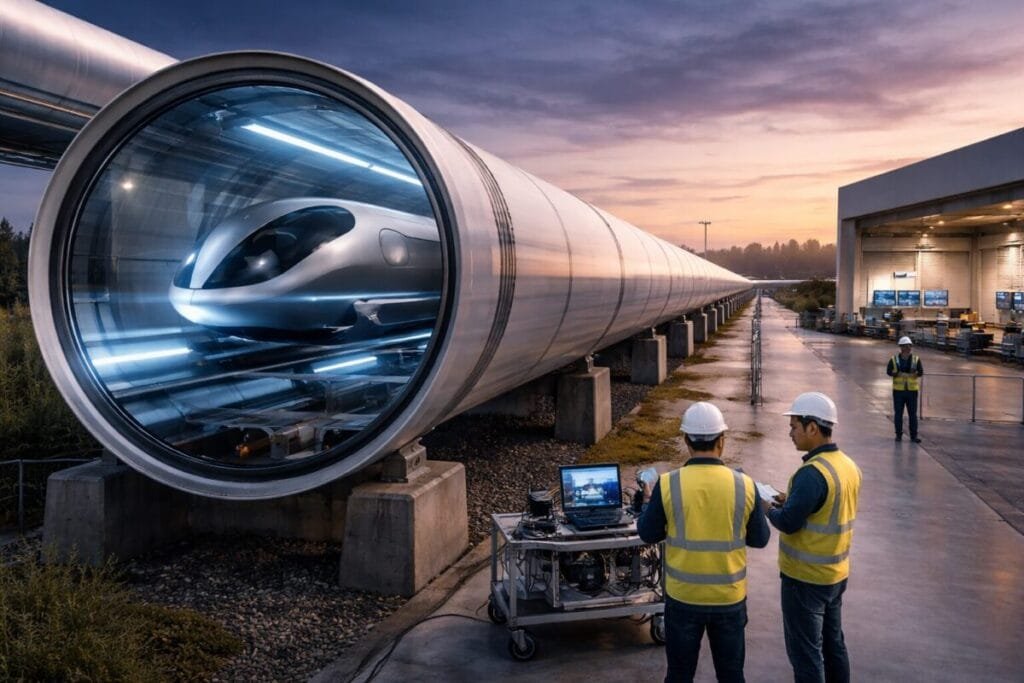
Engineers in the Netherlands have begun testing hyperloop technology that could transform European travel. Developers claim future journeys between London and Paris could take just 20 minutes. The project currently operates within a dedicated test facility in Veendam.
This new phase marks a shift from theoretical design toward practical experimentation. Research teams now test levitating pods, switching mechanisms, and guidance systems inside a controlled environment. Despite the excitement, experts warn that real-world implementation remains distant.
European governments and transport planners view hyperloop as a potential complement to existing rail and aviation networks. However, many questions still surround safety, infrastructure, and regulatory approval.
Inside the Dutch Hyperloop Test Facility
The European Hyperloop Center serves as the continent’s main research hub for this technology. Engineers use a 420-meter vacuum tube to trial prototype systems and validate operational concepts. Developers recently demonstrated a lane-switch mechanism that allows pods to change tracks without stopping.
This breakthrough could enable complex network designs similar to railway junctions. Supporters argue that such flexibility will make hyperloop systems scalable across large regions. Testing programs also examine magnetic levitation and propulsion methods designed to reduce friction and increase speed.
Public funding from European innovation programs supports part of the project. Private investors and technology firms also contribute to development efforts. The collaboration model allows multiple teams to test hardware within shared facilities.
Understanding the Promise of 20-Minute London–Paris Travel
The idea of reaching Paris from London in about 20 minutes relies on extremely high speeds. Hyperloop systems aim to reach velocities near or above 1,000 kilometers per hour. At those speeds, a direct route between the two cities could reduce travel time dramatically.
However, theoretical speed calculations differ greatly from operational reality. Engineers must solve complex engineering challenges before passenger services become feasible. Continuous vacuum systems, precise control systems, and emergency safety measures require extensive testing.
Existing infrastructure between London and Paris already supports high-speed rail travel. Any hyperloop project would need to demonstrate clear advantages over established transport options.
Governments Show Interest but Remain Cautious
European authorities continue to monitor hyperloop progress closely. Transport agencies across several countries have commissioned studies to evaluate safety and economic feasibility. Officials recognize the potential benefits but emphasize the need for rigorous regulation.
Regulatory frameworks for vacuum-based transport systems remain under development. Cross-border projects require agreement between multiple nations on safety standards and operational rules. This process often takes years or even decades.
Policy makers must also consider environmental impact, land use planning, and integration with existing transport networks. Without coordinated governance, international hyperloop routes will struggle to move beyond experimental stages.
Major Engineering Challenges Still Stand in the Way
Engineers face several critical obstacles before hyperloop systems can carry passengers. Maintaining a stable low-pressure environment across hundreds of kilometers presents enormous technical difficulty. Small leaks or structural shifts could disrupt operations.
Safety remains another major concern. Designers must develop evacuation procedures for emergencies within sealed tubes. Regulators also need clear standards for power outages, mechanical failures, and passenger health incidents.
Thermal expansion, ground movement, and structural stress introduce further complications. Engineers must ensure that long tubes remain stable across changing environmental conditions. These factors increase construction complexity and long-term maintenance costs.
Infrastructure and Cost Considerations Shape the Debate
Building a cross-channel hyperloop system would require significant infrastructure investment. Developers must secure land rights, construct tunnels or elevated structures, and integrate stations into existing cities. Historical megaprojects show that timelines and budgets often expand beyond early projections.
Financial feasibility remains a central issue. Governments and investors must balance costs against projected passenger demand. Competition with high-speed rail and short-haul flights also influences economic viability.
Urban planners highlight the importance of seamless connections between hyperloop stations and local transport systems. Without strong last-mile solutions, potential time savings could disappear during transfers.
Learning from Hyperloop’s Past Hype Cycle
Hyperloop technology has experienced waves of enthusiasm and skepticism over the past decade. Some early ventures struggled to progress beyond prototype stages. Critics argue that engineering challenges and regulatory barriers have slowed development more than expected.
The European approach attempts to address these concerns through shared research infrastructure. Independent testing allows multiple companies to validate components under standardized conditions. This method could increase transparency and accelerate innovation.
Still, skeptics caution against overestimating progress. Demonstration runs inside short test tubes differ greatly from operating commercial routes across international borders.
When Could Passengers Experience Hyperloop Travel?
Optimistic projections suggest pilot routes could appear in the 2030s. More conservative estimates place widespread adoption much later. Analysts emphasize that progress depends on sustained investment and political cooperation.
Passenger experience inside a hyperloop could resemble a high-speed train or aircraft cabin. Rapid acceleration and minimal external noise might define the journey. However, unfamiliar safety procedures and new station designs may require adaptation from travelers.
Transport planners must also consider passenger comfort during high-speed travel. Careful engineering will ensure that acceleration forces remain within acceptable limits.
The Future of Cross-Channel Travel Remains Uncertain
The Dutch hyperloop experiments represent meaningful progress toward next-generation transport. Researchers continue to refine technologies that could reshape European mobility. Yet, the path from test facility to operational network remains complex.
London–Paris travel in 20 minutes captures public imagination. Nevertheless, technical challenges, regulatory approval, and financial planning still present significant hurdles. Until these issues find solutions, hyperloop remains a promising concept rather than an imminent reality.
For more travel news like this, keep reading Global Travel Wire