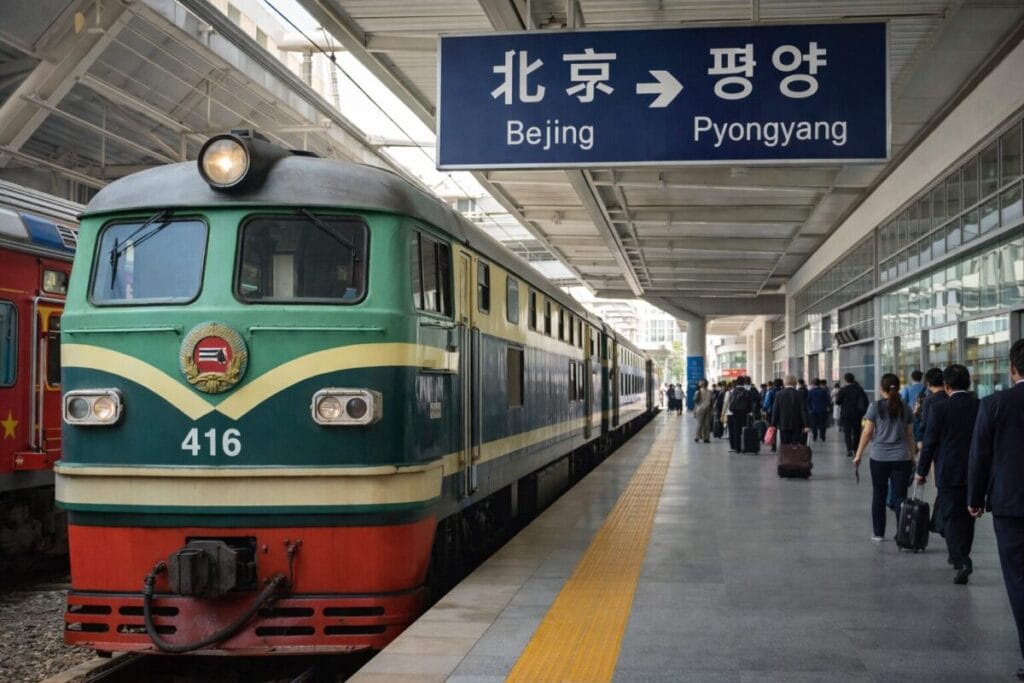
A historic rail link connecting Pyongyang and Beijing has officially resumed operations in March 2026, signaling an important development in cross-border connectivity between North Korea and China. The revival of this international passenger train service comes after a six-year suspension triggered by pandemic-related border closures, marking one of the most notable steps toward restoring regional transportation links in Northeast Asia.
For decades, the railway between the North Korean capital and China’s political and economic center served as a crucial corridor for diplomacy, trade, and cultural exchange. Its return represents not only a transportation milestone but also a symbolic step toward renewed interaction between the neighboring countries.
Although the service initially remains limited to specific categories of travelers, its reintroduction could gradually reopen new channels for communication and mobility across the border.
A Historic Route Reconnecting Two Capitals
The railway connection between Pyongyang and Beijing has long played a central role in facilitating movement between the two countries. Historically, the route carried diplomats, business travelers, and visitors while also supporting trade and political engagement.
Passenger trains traveling between the two capitals provide a direct overland route that crosses the border near the city of Dandong, a Chinese hub that serves as a major gateway for commerce with North Korea. From there, rail services connect to the wider Chinese railway network, linking Pyongyang with one of Asia’s largest transportation systems.
The reopening of this railway marks the first significant restoration of a direct passenger transport route between the two nations since early 2020.
Pandemic Closures Halted Cross-Border Travel
International passenger train services between China and North Korea were suspended in early 2020 when governments across East Asia implemented strict border controls to prevent the spread of COVID-19. North Korea introduced some of the world’s most restrictive travel policies during the pandemic, closing its borders and sharply limiting foreign entry.
While China gradually reopened its borders and resumed international travel operations in subsequent years, North Korea maintained strict controls on cross-border movement.
The rail service remained dormant for more than half a decade, effectively cutting one of the most traditional travel links between the two countries. The reactivation of the train route in 2026 therefore represents a notable shift in transportation policy and regional mobility.
New Train Schedule and Service Details
The restored rail service is scheduled to operate multiple times per week, providing regular connections between the two capitals for the first time in years.
According to railway authorities in China, passenger trains between Beijing and Pyongyang are expected to run four times weekly. These departures are scheduled on Mondays, Wednesdays, Thursdays, and Saturdays, offering consistent travel opportunities for approved passengers.
In addition to the capital-to-capital service, trains between the Chinese border city of Dandong and Pyongyang are expected to operate daily. This route plays a particularly important role in facilitating cross-border exchanges and is widely regarded as the primary rail gateway linking the two nations.
Travel Access Initially Restricted
Despite the restoration of train services, access to the route remains limited. In the early phase of operations, tickets are being sold offline within China and are primarily available to travelers holding official or business visas.
Government officials, journalists, and authorized business travelers are among the groups currently eligible to purchase tickets. Seats on the first departures reportedly filled quickly, reflecting strong demand among travelers permitted to use the service.
At present, tourist travel remains restricted. North Korea continues to maintain careful oversight of foreign visitor access, and general tourism has not yet been broadly reopened.
However, transportation experts note that restoring rail infrastructure often precedes broader travel access. If operations continue smoothly, additional passenger categories could potentially be allowed in the future.
A Symbol of Diplomatic and Economic Ties
Rail connections between countries often carry symbolic significance beyond transportation. In the case of the Pyongyang–Beijing railway, the route reflects the longstanding diplomatic relationship between China and North Korea.
China remains North Korea’s most significant economic partner, and cross-border transport routes play a vital role in supporting trade and communication.
The reopening of the railway reinforces the strategic importance of infrastructure links in maintaining regional cooperation. Observers note that restoring travel routes can help facilitate dialogue, cultural exchange, and economic interaction between neighboring countries.
North Korea’s Gradual Reopening to the Outside World
Although the train service has resumed, North Korea’s broader travel policies remain cautious. The country has only slowly begun to reopen to international visitors after years of strict border closures.
Limited tourist access has been allowed in recent years, but these visits have generally been tightly controlled and organized in small groups.
Large international events that once attracted foreign travelers have also been affected. For example, certain cultural or sporting events that previously welcomed international participants have faced cancellations or restrictions.
These developments suggest that while transportation links are being restored, the country’s approach to reopening remains gradual and carefully managed.
Implications for Regional Tourism
Even though general tourism access remains restricted, the reopening of the Pyongyang–Beijing train route could have long-term implications for travel in Northeast Asia.
Rail links often serve as catalysts for broader tourism development. In the past, international travelers used this route as part of guided tours into North Korea, creating unique overland travel experiences that connected Beijing, Dandong, and Pyongyang.
If travel policies evolve in the future, the railway could once again become a notable route for visitors interested in exploring the region’s history and culture.
The Role of Rail Travel in Northeast Asia
Rail transportation continues to play a vital role across Northeast Asia, where extensive railway networks connect major cities and economic centers. High-speed trains and cross-border services have transformed travel in countries such as China, South Korea, and Japan.
While North Korea’s rail system remains more limited, international rail routes like the Pyongyang–Beijing service remain strategically important.
The restoration of such links demonstrates the enduring relevance of rail travel as a tool for regional connectivity.
Looking Ahead
The resumption of the Pyongyang–Beijing train service marks an important moment in the gradual restoration of international transportation routes disrupted by the pandemic.
Although passenger access remains restricted for now, the return of the railway connection highlights the possibility of greater cross-border mobility in the future.
For travelers and observers of regional geopolitics alike, the revived train route stands as a reminder that transportation infrastructure often plays a key role in shaping diplomatic relationships and economic cooperation.
As rail services resume and conditions evolve, the historic line between Pyongyang and Beijing could once again become a symbol of connection in Northeast Asia.
For more travel news like this, keep reading Global Travel Wire