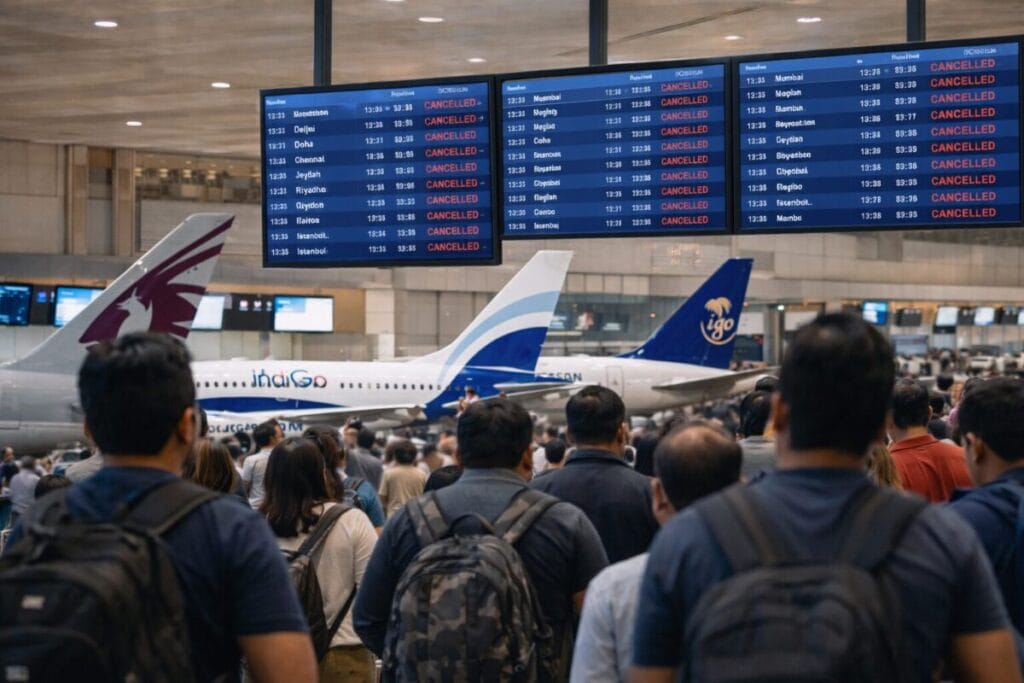
International air travel experienced significant disruption after more than 280 departing flights were cancelled at Hamad International Airport in Doha, creating major travel chaos across global aviation networks. The large-scale cancellations affected passengers traveling to destinations across Europe, Asia, Africa, the Middle East, Oceania, and the Americas.
The majority of the affected services were operated by Qatar Airways, the national carrier of Qatar and one of the world’s largest long-haul airlines. However, several international carriers operating through Doha were also impacted as the disruption spread across airline schedules and airport operations.
The cancellations began early Wednesday morning and continued through Friday afternoon, causing widespread delays and forcing airlines to rapidly reorganize their global flight networks. Travelers using Doha as a connecting hub between continents were among those most affected.
Long-Haul Routes Face Major Disruptions
Some of the most significant impacts were seen on long-haul routes connecting Doha with major aviation hubs across Europe and North America. Flights scheduled to depart for cities such as London, Manchester, Amsterdam, Paris, Frankfurt, Barcelona, and Dublin were cancelled across multiple departure windows.
These routes normally serve as critical corridors linking Europe with Asia and the Middle East. Doha functions as one of the world’s most important transit hubs, allowing passengers to connect between continents through a single airport.
Transatlantic routes were also affected. Flights scheduled for Washington, Miami, New York, and São Paulo were among those cancelled. These services are typically operated by long-range aircraft designed for intercontinental travel.
The suspension of these flights disrupted travel plans for thousands of passengers, particularly those connecting between North America, Europe, and Asia through Doha.
Oceania Connections Interrupted
Air travel between the Gulf region and Oceania also experienced major disruptions during the incident. Several long-distance flights connecting Doha with Australia and New Zealand were cancelled.
Affected routes included services to Sydney, Melbourne, Brisbane, Perth, Adelaide, and Auckland. These routes are normally operated using wide-body aircraft capable of flying ultra-long distances across continents and oceans.
Flights linking the Middle East with Australia are especially important for tourism, business travel, and international student mobility. The cancellation of these routes forced many travelers to seek alternative connections through other global hubs.
Asian Routes Experience Widespread Cancellations
Air travel between Doha and Asia also faced major operational interruptions. Multiple flights to leading Asian cities were cancelled, impacting both tourism and business travel.
Destinations affected across Southeast Asia and East Asia included Bangkok, Kuala Lumpur, Singapore, Manila, Hong Kong, Beijing, Shanghai, Jakarta, Bali, and Hanoi. These cities represent some of the busiest international travel markets in the Asia-Pacific region.
Many passengers traveling between Asia and Europe use Doha as a connecting point because of its strategic geographic location. When flights from the hub are cancelled, disruptions quickly spread across airline networks worldwide.
Heavy Impact on South Asian Routes
Routes connecting Doha with South Asia experienced particularly heavy disruption due to the high volume of daily flights serving the region.
Flights scheduled to depart for several major Indian cities were cancelled, including Delhi, Mumbai, Chennai, Bengaluru, Hyderabad, Kolkata, Kochi, Thiruvananthapuram, Ahmedabad, Goa, Nagpur, and Amritsar.
These routes serve large expatriate communities living and working in Gulf countries. Thousands of passengers regularly travel between India and Qatar for work, tourism, and family visits.
Because many of these routes operate multiple times per day, repeated cancellations created significant delays for passengers attempting to rebook flights.
Regional Middle East Flights Also Affected
Short-haul flights connecting Doha with nearby Middle Eastern cities also experienced widespread cancellations. These routes are normally among the busiest services at the airport because they support business travel and regional tourism.
Flights scheduled to depart for Dubai, Abu Dhabi, Sharjah, Kuwait City, Bahrain, Riyadh, Jeddah, Medina, and Salalah were among those affected.
In many cases, multiple departures to the same city were cancelled within the same day, adding to the overall disruption faced by passengers.
Flights to destinations in Iraq and the Levant, including Baghdad, Basrah, Erbil, Damascus, and Beirut, were also suspended during the disruption.
African Network Disrupted
Doha serves as a major connection point for travelers moving between Africa and other continents. Several African routes were also impacted during the cancellation wave.
Flights to Johannesburg, Cape Town, Nairobi, Dar es Salaam, Entebbe, Kigali, Lusaka, Zanzibar, and Maputo were among those cancelled. Services to West African cities including Accra, Lagos, and Abuja were also affected.
These routes play a key role in connecting African markets with Europe and Asia through the Gulf region.
European Destinations Experience Additional Cancellations
Beyond the major European hubs, several secondary European destinations were also affected by the disruption.
Flights scheduled to depart for Berlin, Copenhagen, Stockholm, Zurich, Vienna, Prague, Warsaw, Bucharest, Budapest, Athens, Zagreb, and Oslo were cancelled.
Additional cancellations were reported on routes to Malta, Munich, Milan, Rome, and Madrid.
Because these routes form part of Qatar Airways’ extensive European network, the disruption had a widespread effect across the continent.
Aircraft Operations and Airline Logistics Affected
The cancelled flights involved a wide range of aircraft types used across Qatar Airways’ global fleet. These included Boeing 777 and Boeing 787 aircraft, Airbus A350 models, Airbus A380 superjumbos, and narrow-body Airbus A320 family aircraft.
The involvement of both wide-body and narrow-body aircraft demonstrates the scale of the disruption. Airlines had to adjust aircraft rotations, crew schedules, and airport operations to manage the situation.
When disruptions occur at a major hub airport like Doha, the impact spreads quickly through the entire airline network. Aircraft arriving late may delay subsequent departures, while crew scheduling rules can require additional changes to flight plans.
Passenger Impact Across Global Travel Networks
Passengers traveling through Doha experienced significant delays and disrupted travel plans as a result of the cancellations. Many travelers missed onward connections, especially those transferring between continents.
Because Hamad International Airport acts as a central hub linking Europe, Asia, Africa, and Oceania, disruptions in Doha can quickly affect flights across multiple regions.
Airlines worked to rebook passengers on alternative flights, but high demand for seats created longer waiting times at airline service counters.
Travelers heading to destinations across Asia-Pacific, Europe, and North America were among those most affected.
Global Aviation Network Feels the Pressure
The cancellation of more than 280 flights at Hamad International Airport highlights how interconnected modern airline networks have become. Even a short-term operational disruption at a major global hub can create ripple effects across international travel routes.
As airlines work to restore schedules and reposition aircraft, stabilizing operations will remain a priority to minimize further inconvenience for passengers.
For now, the incident serves as a reminder of how quickly global aviation systems can be affected when disruptions occur at one of the world’s busiest transit airports.
For more travel news like this, keep reading Global Travel Wire