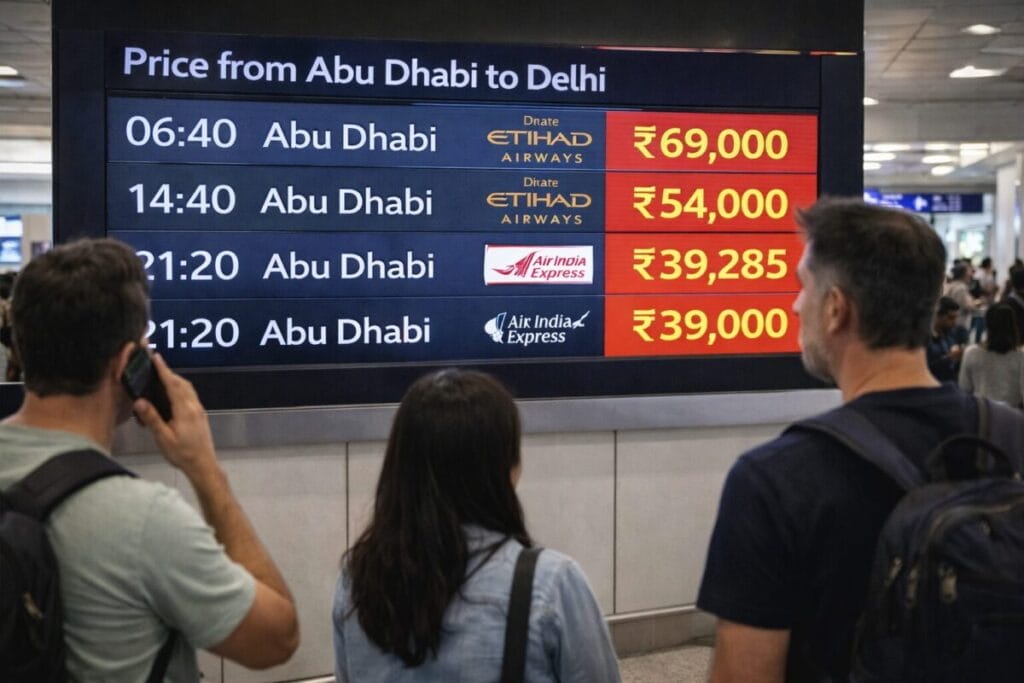
Air travel between the United Arab Emirates and India has faced major disruption after escalating tensions in the Middle East. The conflict involving Iran and Israel has created operational challenges for airlines across the region.
Flights between Abu Dhabi and New Delhi have experienced reduced frequency. Airlines now operate fewer direct services, leaving travelers with limited booking options.
Passengers traveling between the UAE and India rely heavily on this route for work, tourism, and family visits. The sudden drop in flight availability has pushed ticket prices to unusually high levels.
Travel industry observers report that the route now faces a supply shortage. Demand remains strong, but airlines cannot provide the same number of seats as before.
This imbalance has triggered a rapid rise in ticket prices across several days.
Ticket Prices Climb to Record Levels
Airfares between Abu Dhabi and Delhi have increased sharply during the past week. Travelers who normally paid around ₹10,000 for a one-way ticket now face much higher prices.
Some flights recently appeared with prices above ₹21,500. Within days, fares climbed to more than ₹50,000 for the same route.
Travel analysts expect fares to remain volatile in the coming weeks. Current projections suggest ticket prices may range between ₹40,000 and ₹70,000 depending on demand and availability.
The price surge reflects both reduced flight capacity and rising operational costs. Airlines have struggled to maintain schedules while dealing with regional instability.
Passengers searching for last-minute tickets have encountered the highest prices. Many travelers have reported difficulty finding available seats.
Demand Surges as Seats Become Scarce
Indian expatriates living in the UAE travel frequently between the two countries. Many workers maintain family connections in India and visit regularly.
Business travelers also depend on flights between Abu Dhabi and Delhi. Government delegations, corporate executives, and professionals often travel along this corridor.
As flight frequency declines, competition for seats increases rapidly. Travelers with urgent plans must secure limited tickets.
For example, some flights in mid-March offered prices near ₹39,000. Other services exceeded ₹69,000 during the same period.
These increases have forced many travelers to reconsider their travel plans. Some passengers have postponed trips or searched for alternate routes.
Others have accepted the higher fares due to family emergencies or work obligations.
Disruptions Also Affect Delhi to Abu Dhabi Routes
The price surge has not remained limited to Abu Dhabi departures. Flights traveling from Delhi to Abu Dhabi have also experienced similar price increases.
Airlines still operate services on this route, but they now offer fewer departures each week. This limited supply has pushed ticket costs significantly higher.
Some flights departing Delhi have reached prices near ₹69,000 for a single ticket. Only a few weeks earlier, travelers considered such fares extremely expensive.
Passengers flying from India to the UAE now face limited options. Airlines continue adjusting schedules while monitoring regional conditions.
Despite these disruptions, some travelers have found more affordable routes through Dubai. The Dubai-Delhi corridor still operates more frequent flights.
Competition among airlines on that route helps maintain lower fares compared with Abu Dhabi departures.
Middle East Tensions Influence Aviation Costs
The geopolitical situation in the Middle East has played a key role in the aviation disruption. Rising tensions between Iran and Israel have created uncertainty across regional airspace.
Airlines must often adjust flight routes to avoid restricted areas. These detours increase travel distance and fuel consumption.
Fuel costs represent one of the largest expenses for airlines. When oil prices increase, operating expenses also rise quickly.
Recent fluctuations in global oil markets have pushed jet fuel prices upward. Airlines often pass these costs to passengers through higher ticket prices.
Operational challenges also include crew scheduling and aircraft positioning. Airlines must reorganize fleets when airspace restrictions change flight paths.
These logistical adjustments often reduce the number of flights airlines can operate.
Aviation Networks Feel the Global Impact
Air travel operates through interconnected global networks. Disruptions in one region often influence routes across multiple continents.
The Middle East functions as a central aviation hub linking Asia, Europe, and Africa. Major airlines operate connecting flights through airports in Abu Dhabi, Dubai, and Doha.
When regional tensions affect airspace, airlines must reorganize entire networks. This process can reduce available flights and increase operating costs.
Travel between India and the Gulf region remains one of the busiest aviation corridors. Millions of passengers travel between these regions every year.
Any disruption along this corridor quickly affects ticket prices and travel plans.
Tourism and Business Travel May Feel the Effects
Higher airfares may influence tourism and business travel between India and the UAE. Both countries maintain strong economic and cultural ties.
Indian tourists often visit the UAE for shopping, entertainment, and business events. Similarly, travelers from the UAE frequently visit India for tourism and family visits.
If ticket prices remain high, passenger demand may decline temporarily. Some travelers may delay trips until fares stabilize.
Companies that rely on regular business travel may also reconsider travel budgets. Higher ticket costs can increase operating expenses for international businesses.
Tourism authorities continue monitoring travel trends while supporting airline operations.
Travelers Advised to Plan Carefully
Travel experts recommend early planning for passengers flying between Abu Dhabi and Delhi. Booking tickets well in advance can help secure better prices.
Travelers should also monitor airline updates regularly. Airlines may adjust schedules depending on geopolitical conditions and fuel costs.
Flexible travel dates can improve the chances of finding lower fares. Some passengers may also consider nearby airports for alternate routes.
Passengers traveling during peak periods should expect continued price fluctuations.
Outlook for UAE–India Air Travel
The future of airfares between Abu Dhabi and Delhi remains uncertain. Regional tensions continue influencing aviation operations across the Middle East.
Airlines will likely maintain cautious schedules while monitoring security conditions. Operational costs may remain elevated if fuel prices continue rising.
Despite current disruptions, demand for travel between India and the UAE remains strong. Millions of expatriates, tourists, and business travelers depend on this route every year.
For now, travelers should remain flexible and stay informed about flight schedules. Airlines continue working to stabilize operations while managing a challenging global environment.
For more travel news like this, keep reading Global Travel Wire