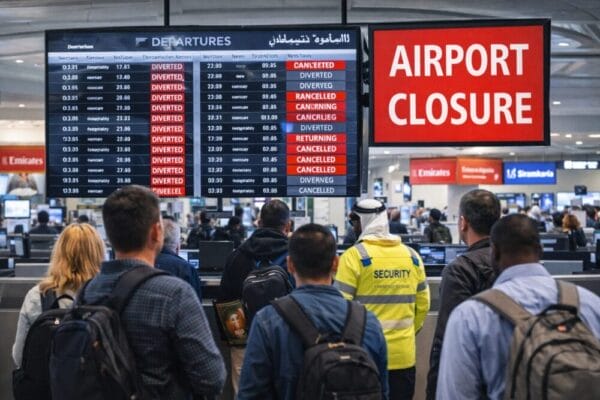
International travel faced major disruption after Dubai International Airport temporarily halted operations following a security incident involving a drone strike near the airport. The shutdown of one of the world’s busiest aviation hubs triggered a ripple effect across global flight networks, forcing several aircraft departing from major UK airports to divert or return mid-journey.
Flights from London Heathrow, London Gatwick, Manchester, Edinburgh and Stansted were among those affected, leaving thousands of travelers stranded or facing significant delays. Airlines were forced to reroute aircraft already in the air while passengers waited for updates regarding their travel plans.
The disruption highlighted how security incidents at major international aviation hubs can rapidly impact airline schedules and passenger movement across multiple continents.
Temporary Airport Closure Disrupts Global Aviation Network
Dubai International Airport serves as a critical connection point linking Europe, Asia, Africa and North America. When operations were suspended as a precautionary measure, dozens of flights heading toward the airport had to immediately change course.
Authorities temporarily halted departures and arrivals to ensure passenger safety and allow emergency response teams to assess the situation following reports of a drone-related incident near the airport perimeter.
As one of the busiest international passenger hubs in the world, Dubai handles tens of millions of travelers every year. Even short operational interruptions can affect airline schedules across multiple regions.
Airlines operating long-haul routes to the Middle East were particularly affected as aircraft already en route had limited options for diversion or rerouting.
UK Flights Among the Most Severely Impacted
Flights departing from the United Kingdom experienced some of the most significant disruptions during the incident. Several aircraft heading toward Dubai were forced to turn back after spending hours in the air.
One flight departing from Edinburgh remained airborne for more than ten hours before returning to Scotland when it became clear that the airport closure would continue longer than expected.
Another aircraft traveling from London Stansted was rerouted to a European airport after approaching Middle Eastern airspace. Passengers on board experienced lengthy delays as airlines worked to identify alternative landing locations.
Flights from Heathrow, Gatwick and Manchester were also impacted, with some aircraft redirected to nearby airports while others returned to their original departure points.
For travelers, the experience meant long overnight journeys followed by uncertainty regarding rebooking or onward travel arrangements.
Long-Haul Flights Forced to Reroute Across Europe
Aircraft traveling from destinations beyond Europe were also affected by the sudden closure. Flights arriving from Asia and Australia were forced to reroute to alternative airports across the region.
Passengers traveling from cities such as Sydney, Melbourne, Bangkok and Hong Kong experienced delays as airlines navigated complex logistical challenges to manage aircraft diversions.
Some long-haul flights carrying international passengers landed in European hubs including Vienna, Rome and Milan while waiting for Dubai’s operations to resume.
These diversions created additional pressure on airport infrastructure across Europe as airlines scrambled to manage unexpected arrivals and assist stranded travelers.
Airlines Work to Rebook Thousands of Passengers
Airlines quickly began adjusting schedules and working to rebook passengers affected by the disruption. However, the sudden nature of the airport closure made the process difficult, especially for long-haul travelers with connecting flights.
Passengers whose flights were cancelled or diverted were advised to contact their airline to arrange alternative routes or new travel dates.
Limited flight availability between Europe and the Middle East further complicated the process. With aircraft out of position and crew scheduling disrupted, airlines faced challenges restoring normal operations.
Many travelers were left waiting for updated travel plans while airlines assessed the impact on future departures.
Dubai Airport Gradually Resumes Operations
After the initial shutdown, Dubai International Airport gradually began restoring operations once safety checks were completed. Authorities allowed flights to resume on a reduced schedule to manage congestion and ensure passenger safety.
However, the recovery process was expected to take time as airlines reposition aircraft and address the backlog of delayed flights.
Some departures were cancelled or postponed while airport teams worked to manage the surge of passengers affected by the earlier disruption.
Even after reopening, travelers scheduled to fly in the following days faced potential delays due to the ongoing adjustments to airline schedules.
Aviation Experts Highlight Impact of Major Hub Disruptions
The incident demonstrates how disruptions at major global aviation hubs can quickly spread across international travel networks. Airports such as Dubai serve as connecting gateways for millions of passengers traveling between continents.
When operations at these hubs are interrupted, airlines must reroute aircraft across multiple regions, which can lead to widespread delays.
Security incidents, severe weather and airspace restrictions are among the most common causes of sudden airport closures. In many cases, airlines must make rapid decisions to protect passenger safety while maintaining operational continuity.
Travelers Urged to Monitor Airline Updates
Travel experts recommend that passengers scheduled to fly through major hub airports monitor airline communications closely during periods of disruption.
Airlines typically provide updates through mobile apps, email alerts and airport announcements. Travelers are also advised to check departure information before leaving for the airport when large-scale disruptions occur.
Flexible travel planning and travel insurance can also help passengers manage unexpected schedule changes.
Global Travel Industry Faces Continued Uncertainty
The disruption at Dubai International Airport serves as a reminder of the vulnerability of global aviation networks to unexpected incidents. With millions of passengers relying on interconnected airline routes, even a short disruption at a major hub can impact travelers worldwide.
As airline operations gradually stabilize, passengers affected by the incident are expected to continue their journeys in the coming days.
However, the event highlights the importance of contingency planning for airlines, airports and travelers alike as global aviation remains sensitive to security developments and operational challenges.
For more travel news like this, keep reading Global Travel Wire