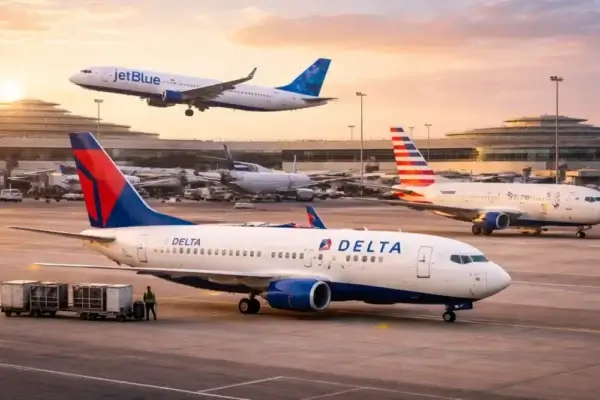
The US aviation sector has entered 2026 with unexpected strength. Major airlines continue to report strong financial performance despite rising fuel costs. Global tensions in the Middle East have pushed oil prices above 100 dollars per barrel.
However, passenger demand has surged across domestic and international routes. This surge has helped airlines offset higher operating expenses. As a result, leading carriers have raised their revenue forecasts for the first quarter of 2026.
Airlines such as Delta Air Lines, American Airlines, and JetBlue Airways have all reported positive outlooks. Their performance highlights a resilient travel market driven by strong consumer demand.
Revenue Growth Signals Industry Resilience
Airlines have recorded impressive sales figures during the early months of 2026. Delta Air Lines reported several of its highest sales days in history. This strong demand has come from both leisure and business travelers.
American Airlines expects revenue growth to exceed 10 percent compared to last year. JetBlue Airways has also improved its financial projections. These figures reflect a broader trend across the aviation sector.
Travel demand has remained strong during peak periods such as spring break. Corporate travel has also returned to near pre-pandemic levels. This combination has strengthened airline revenues significantly.
Rising Fuel Costs Challenge Airline Operations
The ongoing conflict in Iran has created a sharp rise in fuel prices. Airlines have faced unexpected increases in operating costs. Each major carrier has absorbed nearly 400 million dollars in additional fuel expenses this quarter.
Despite these challenges, airlines have managed to maintain profitability. They have used pricing strategies to pass some of the cost to passengers. In addition, strong demand has supported higher ticket prices.
Fuel remains one of the largest expenses for airlines. Therefore, price fluctuations can quickly affect profitability. However, current demand levels have provided a strong buffer against these pressures.
Strategic Route Changes Improve Efficiency
Airlines have adjusted their operations to manage changing global conditions. Some carriers have reduced flights to regions affected by conflict. Instead, they have shifted aircraft to more profitable routes.
Domestic and transcontinental routes have received increased capacity. These routes attract high passenger volumes and generate steady revenue. Airlines have also focused on key city pairs with strong demand.
This strategy allows airlines to maximize returns while reducing operational risks. It also ensures better aircraft utilization during uncertain times.
Impact on Ticket Prices and Travel Planning
Travelers have already started to feel the effects of rising costs. Ticket prices have increased across many routes due to higher fuel expenses. Airlines have introduced dynamic pricing models to manage demand and profitability.
As a result, budget travelers may find fewer discounted fares. Early booking has become more important than ever. Travelers who plan ahead can secure better prices and availability.
High demand has also reduced seat availability on popular routes. Flights often operate at near full capacity, especially during peak seasons.
Improved Services and Passenger Experience
Strong revenue performance has allowed airlines to invest in services. Many carriers have enhanced premium cabin offerings and onboard amenities. Airlines continue to expand lounge access and upgrade in-flight experiences.
Business and premium travelers have driven much of this growth. Airlines compete to attract these high-value customers through improved services.
Operational reliability has also improved in recent months. Airlines have increased staffing levels and upgraded technology systems. These improvements help reduce delays and disruptions.
Challenges for International Travelers
International travel has faced additional complications due to geopolitical tensions. Airlines have adjusted flight paths to avoid restricted airspace. These changes can lead to longer travel times.
Passengers may experience extended flight durations and tighter connections. In some cases, airlines may reduce frequency on certain routes.
Despite these challenges, airlines continue to maintain global connectivity. They aim to provide safe and reliable travel options under changing conditions.
A New Era of Airline Pricing and Demand
The aviation industry has evolved significantly in recent years. Airlines now use advanced data to understand customer behavior. This approach allows them to adjust prices based on demand patterns.
High demand has given airlines greater pricing power. Travelers now pay higher fares during peak periods. At the same time, airlines maintain strong load factors across routes.
This shift marks a departure from the era of consistently low fares. Airlines now focus on balancing profitability with service quality.
Outlook for the Global Aviation Industry
The performance of US airlines in 2026 highlights a strong recovery. Despite global uncertainties, the industry continues to grow. High demand and strategic planning have supported this progress.
Airlines remain cautious about future fuel price fluctuations. However, they continue to adapt to changing market conditions. Their ability to adjust operations and pricing has strengthened resilience.
Travel demand shows no signs of slowing down. Both leisure and business travel continue to drive growth.
Conclusion
US airlines have demonstrated strong resilience in 2026 despite rising fuel costs. High passenger demand has supported revenue growth and operational stability.
Travelers now face higher ticket prices and limited availability. However, they also benefit from improved services and reliability.
The aviation industry continues to adapt to global challenges. Its strong performance reflects the ongoing demand for travel. As the year progresses, airlines will focus on maintaining growth while managing costs effectively.
For more travel news like this, keep reading Global Travel Wire