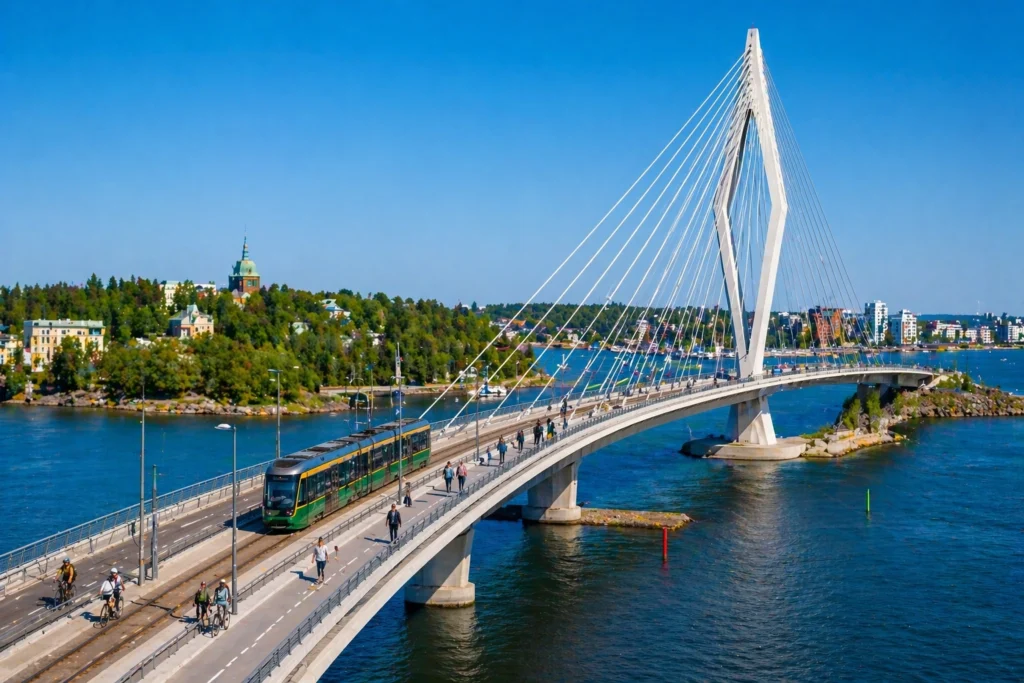
Helsinki has opened the Kruunuvuorensilta Bridge, a landmark piece of infrastructure that is redefining how people move across the Finnish capital. Designed exclusively for pedestrians, cyclists and future tram services, the new crossing marks a major step in the city’s long-term transition toward cleaner transport, reduced car dependence and sustainable urban expansion.
For residents and visitors alike, the bridge is more than a transport link. It is a new public space, a scenic attraction and a symbol of how modern cities can prioritize people over private vehicles.
Finland’s Longest and Tallest Bridge
Stretching 1,191 metres, the Kruunuvuorensilta Bridge is now both the longest and tallest bridge in Finland. Unlike conventional bridges built around road traffic, this structure deliberately excludes private cars.
Instead, it has been created to support active mobility and public transport, reflecting Helsinki’s wider planning philosophy centered on walkability, cycling and efficient transit connections.
That distinction makes the bridge particularly significant at a time when cities around the world are searching for ways to reduce congestion, lower emissions and improve urban quality of life.
Connecting Helsinki’s Growing Eastern Districts
The bridge creates a direct connection between Korkeasaari and Kruunuvuorenranta and forms part of the larger Crown Bridges Light Rail project, which will link central Helsinki with expanding eastern districts including Laajasalo.
As these neighborhoods continue to grow, fast and reliable transport links have become increasingly important. The new route is expected to significantly shorten travel times between eastern areas and the city center compared with existing road-based options.
For commuters, that means faster journeys. For travelers, it means easier access to new waterfront districts, attractions and scenic coastal areas.
A New Attraction for Urban Tourism
The bridge is already proving to be more than transport infrastructure. Elevated walking and cycling paths offer panoramic views across the Baltic Sea, surrounding islands and Helsinki’s evolving skyline.
Since opening, it has quickly attracted strong public interest, with tens of thousands of visitors arriving during its first weekend. That early popularity suggests the bridge could become one of Helsinki’s most recognizable visitor experiences.
Modern travelers increasingly seek cities where mobility itself becomes part of the experience. Scenic walking routes, bike-friendly infrastructure and public spaces with striking design can add real tourism value.
Iconic Design on the Waterfront
One of the bridge’s most distinctive features is its 135-metre diamond-shaped pylon rising above the sea. Visible from multiple parts of the city, it has rapidly become a defining addition to Helsinki’s coastal skyline.
This visual identity matters. Landmark architecture often helps destinations strengthen their global image, attract photography-driven tourism and create new urban icons.
For Helsinki, the bridge reinforces its reputation for combining design, innovation and sustainability.
Built for Nordic Conditions
Constructing a major bridge in a maritime Nordic environment requires resilience. The structure has been engineered to withstand freezing temperatures, strong winds and seasonal ice conditions.
Its cable system is designed to remain in slight motion to reduce ice buildup, while real-time wind alert systems provide safety information at both ends of the crossing.
The bridge is also built with long-term durability in mind, with an expected lifespan extending up to two centuries.
That long view reflects a growing trend in infrastructure planning: investing in assets that serve multiple generations.
Sustainability at the Core
Environmental considerations played a central role in the project. Planning measures were introduced to reduce impacts on surrounding marine ecosystems, preserve navigation routes and minimize noise and vibration.
The development also incorporated lower-emission materials and energy-efficient construction approaches aligned with Helsinki’s broader climate goals.
This sustainability focus is increasingly important for tourism as well. Many travelers now choose destinations that visibly invest in greener mobility, lower-carbon transport and environmentally responsible urban development.
The Future Tram Connection
While pedestrians and cyclists are already using the bridge, its long-term importance will grow further when tram services begin operating as part of the Crown Bridges Light Rail system.
Once fully operational, the wider corridor is expected to carry substantial daily passenger volumes while supporting thousands of cycling trips.
That will strengthen east-west connectivity, reduce pressure on roads and help shape future residential and commercial growth across eastern Helsinki.
Why It Matters Beyond Finland
The opening of Kruunuvuorensilta sends a wider message to cities everywhere. Urban growth does not have to depend on more highways or heavier traffic.
Instead, investment in public transport, walking and cycling can create places that are cleaner, more efficient and more enjoyable to visit.
For Helsinki, the bridge is both practical infrastructure and a statement of intent. For global travelers, it offers a new reason to experience one of Europe’s most forward-thinking capitals
For more travel news like this, keep reading Global Travel Wire