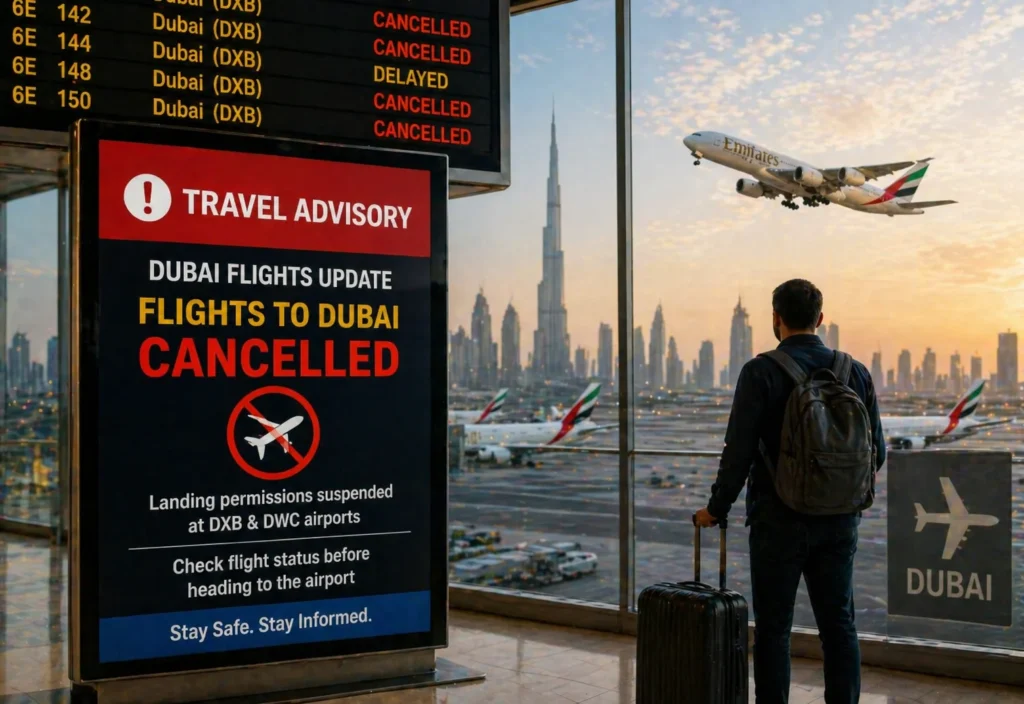
Travelers heading to the United Arab Emirates are facing sudden schedule changes after temporary operational restrictions affected airport arrivals in Dubai, one of the world’s busiest international aviation hubs. Airlines, including IndiGo, issued urgent travel advisories after landing permissions for incoming aircraft were suspended for a period at Dubai’s main airports, creating cancellations, diversions, and uncertainty for thousands of passengers.
The development is especially significant for tourism and business travel because Dubai serves as a major gateway connecting Asia, Europe, Africa, and the Middle East. The city is also one of the most popular overseas destinations for Indian travelers, with strong demand for holidays, shopping trips, family visits, corporate travel, and onward global connections.
According to airline advisories, airport authorities communicated temporary restrictions affecting arrivals at Dubai International Airport and Al Maktoum International Airport. The move was linked to prevailing regional conditions, with passenger, crew, and airport staff safety cited as the top priority.
As a result, multiple flights were cancelled, delayed, diverted, or returned to their departure points. Airlines asked passengers to check booking status before leaving for the airport and to monitor official updates closely. Carriers are expected to continue adjusting schedules based on operational guidance from authorities.
For global tourism, the incident highlights the importance of Dubai’s role in international travel. The emirate is not only a destination in its own right but also one of the world’s most important transit centers. Millions of travelers use Dubai each year to connect between continents, making any disruption quickly visible across airline networks.
Dubai remains highly attractive to visitors because of its modern infrastructure, luxury hotels, beaches, desert experiences, shopping festivals, family attractions, and year-round events calendar. The city has built a strong reputation for seamless travel experiences, large-scale hospitality capacity, and world-class airport operations.
When temporary disruptions occur at such a major hub, the ripple effects can reach many markets. Travelers departing from India, Europe, North America, and Africa may experience revised routings, longer journeys, missed connections, or rebooked itineraries. However, aviation systems are designed to respond dynamically through alternate airports, schedule changes, and passenger support measures.
Indian travelers are among the most affected groups because of the dense flight network between Indian cities and Dubai. Multiple daily services connect major metros and regional airports to the emirate, supporting tourism, trade, family travel, and business ties. Any reduction in flights on this corridor can quickly influence seat availability and fare levels.
For passengers currently planning trips, flexibility is essential. Travel experts recommend checking airline notifications frequently, keeping digital boarding documents ready, and avoiding unnecessary airport journeys until flights are confirmed. Those with flexible tickets may benefit from easier date changes or alternate routings.
Travel insurance can also be useful during such situations, particularly policies that cover trip delays, cancellations, missed connections, or additional accommodation costs. As international travel becomes more interconnected, insurance is increasingly viewed as a smart planning tool rather than an optional add-on.
Despite the disruption, Dubai’s long-term tourism outlook remains strong. The city continues to invest heavily in airport expansion, tourism attractions, smart mobility, luxury hospitality, cruise infrastructure, and event tourism. Temporary operational pauses do not change the emirate’s strategic importance in global travel.
For leisure visitors, Dubai offers experiences across every travel style. Families enjoy theme parks, aquariums, beaches, and entertainment districts. Luxury travelers are drawn to premium resorts, fine dining, and exclusive shopping. Adventure seekers choose dune activities, skydiving, and water sports. Business travelers benefit from exhibition centers, modern hotels, and strong connectivity.
The current disruption may also encourage some travelers to explore alternative itineraries. Nearby hubs and one-stop options through other Gulf, Asian, or European gateways may become useful short-term solutions while normal schedules are restored. Travel agents and airline customer service teams can assist passengers in comparing revised routes.
Tourism authorities worldwide increasingly emphasize resilience planning, and Dubai has long demonstrated strong recovery capability after operational challenges. Large hubs typically maintain extensive contingency systems involving airlines, airport operators, security agencies, and ground services to restore normal flows as quickly as possible.
Passengers already in Dubai should continue following airline messages regarding return flights or onward travel. Hotels, attractions, retail centers, and city tourism services continue to operate, and many visitors may experience little impact beyond flight schedule changes.
For the aviation sector, the event is another reminder that safety-led decisions remain central to modern travel. Temporary restrictions, diversions, and cancellations can be inconvenient, but they are part of the systems designed to protect travelers and crews during uncertain conditions.
Travel demand for Dubai remains substantial due to its unique mix of accessibility, climate, events, and premium visitor experiences. Once operations normalize, airlines are likely to restore capacity quickly to meet strong market demand.
For now, passengers should rely only on official airline communication, airport announcements, and government travel advisories. Social media speculation can create confusion during fast-moving situations, making verified updates especially important.
The broader message for tourists is one of caution, not panic. Dubai remains one of the world’s leading destinations and aviation centers. While short-term disruption has affected schedules, the city’s travel infrastructure and global airline partnerships position it strongly for a swift return to regular operations.
As authorities continue monitoring conditions, travelers can expect further updates. Until then, flexibility, preparation, and close attention to official notices remain the best tools for anyone with upcoming Dubai flights.