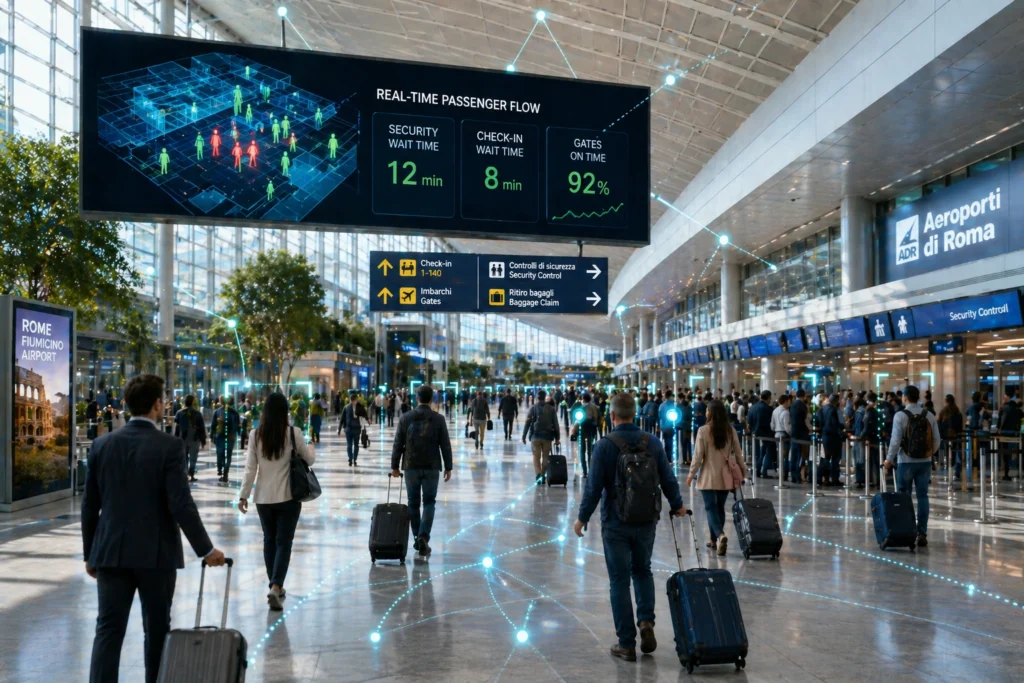
Rome Fiumicino Airport is accelerating its digital transformation with a major expansion of AI-powered spatial intelligence technology designed to improve passenger flow, reduce congestion and strengthen operational efficiency. Managed by Aeroporti di Roma, the airport is extending the deployment of advanced 3D LiDAR and real-time analytics across key common-use areas in the Schengen zone, reinforcing its position as one of Europe’s most innovative aviation hubs.
The move is important for travelers, airlines and the wider tourism sector. As passenger numbers continue to rise across Europe, airports face growing pressure to process travelers faster while maintaining service quality. By using AI to anticipate crowding and optimize resources in real time, Rome Fiumicino aims to deliver smoother journeys from check-in to boarding while increasing resilience during peak travel periods.
Smart Airport Strategy Moves Beyond Pilot Stage
The technology was first introduced through Aeroporti di Roma’s innovation programme and has now advanced from pilot testing to large-scale operational deployment. Expanding coverage across much of the Schengen area signals confidence in the system’s ability to improve day-to-day airport performance.
For passengers, that means more responsive airport operations. For airlines, it can support better punctuality and faster passenger movement through critical touchpoints. For airport management, it creates a stronger foundation for handling future growth efficiently.
As airports worldwide compete on experience as much as connectivity, digital upgrades are becoming a key differentiator.
How LiDAR and AI Improve Passenger Flow
At the center of the project is 3D LiDAR technology, which captures accurate real-time scans of physical spaces and movement patterns. Combined with AI analytics, the system can identify queue build-up, congestion trends and changes in traveler behavior as they happen.
This gives operators immediate visibility into pressure points across terminals. If security screening becomes crowded or passenger arrivals spike unexpectedly, teams can react faster by adjusting staffing levels, opening additional lanes or reallocating resources.
The result is a more dynamic airport model where decisions are based on live conditions rather than static schedules.
Faster Journeys and Shorter Waiting Times
One of the clearest benefits for travelers is the potential reduction in waiting times. Long queues remain one of the biggest pain points in modern air travel, particularly during holidays, weekends and irregular operations.
By monitoring passenger volumes in real time, Rome Fiumicino can respond before bottlenecks become severe. This can improve flow through check-in, security, boarding and other high-pressure areas, helping travelers move through the terminal with greater predictability.
Smoother processing also improves the airport atmosphere. Less congestion often means lower stress, more time for shopping and dining, and a better overall perception of the journey.
Predictive Analytics for Peak Travel Demand
A standout feature of the system is predictive analytics. Instead of only reacting to current conditions, the platform can use historical and live data to forecast where crowding is likely to occur next.
That proactive capability is especially valuable during peak seasons, major events and sudden schedule changes. If the system anticipates pressure at immigration or gate zones, airport teams can act early to reduce disruption.
Predictive operations are becoming increasingly important as airports seek to balance efficiency with customer satisfaction in a more volatile travel environment.
Benefits for Airlines and Airport Revenue
The impact extends beyond queue management. Efficient passenger flow can support stronger on-time performance, smoother boarding processes and better aircraft turnaround times, all of which matter to airline operations.
Airports also benefit commercially. When passengers spend less time waiting, they often have more time to shop, dine or relax before departure. That can increase non-aeronautical revenue from retail and food outlets.
For destination tourism, better airport experiences can shape first impressions and influence traveler satisfaction from the moment visitors arrive in Italy.
New Benchmark for European Aviation
Rome Fiumicino is one of Europe’s busiest gateways, making successful deployment particularly significant. Large airports face complex operational challenges due to transfer traffic, international volumes and changing peak patterns.
By investing in AI-led decision-making, the airport is setting a benchmark that other hubs may follow. Across the aviation sector, demand is growing for smarter infrastructure that can adapt quickly without requiring major physical expansion.
Technology that improves efficiency within existing terminal space is especially valuable in mature airport markets.
Preparing for Future Growth
The expanded partnership reflects a long-term strategy rather than a one-time upgrade. As travel demand evolves, airports need systems that can scale, learn and respond continuously.
Real-time data visibility, flexible resource planning and predictive intelligence give Rome Fiumicino stronger tools to manage both today’s operations and tomorrow’s growth.
For travelers, that means a more reliable and seamless journey. For the industry, it signals how the future airport experience will increasingly be shaped by invisible technology working behind the scenes.
For more travel news like this, keep reading Global Travel Wire