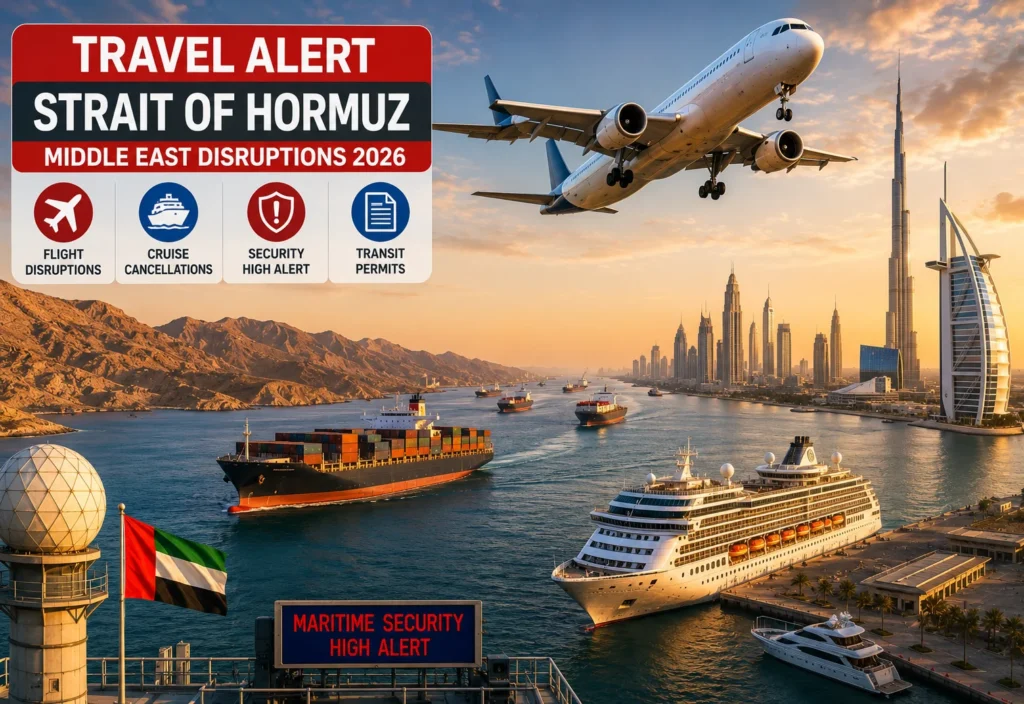
The Strait of Hormuz has become the center of a growing regional travel and transportation crisis following heightened military tensions and expanded maritime security operations across the Gulf region. Governments, airlines, cruise operators, and tourism authorities are responding to rapidly changing conditions that are affecting aviation corridors, maritime tourism, and international travel confidence throughout the Middle East.
The escalation has triggered immediate operational changes across key tourism and transit hubs including Dubai, Abu Dhabi, Doha, Muscat, Bahrain, and Fujairah. Airlines are adjusting long-haul flight routes, cruise companies are revising Gulf itineraries, and travelers are increasingly reviewing travel advisories and flexible booking options.
Regional authorities confirmed that airports, hotels, and major tourism facilities remain operational, but heightened security measures and transportation adjustments have become necessary due to ongoing instability affecting maritime and air transit corridors.
The Strait of Hormuz remains one of the world’s most strategically important shipping routes, connecting global energy supplies and major trade networks. Any disruption within the region has direct implications for aviation fuel costs, airline operations, tourism economies, and international travel patterns.
Airlines Adjust Gulf Flight Operations Amid Security Concerns
Major airlines operating through Gulf aviation hubs are actively reviewing airspace conditions and modifying selected flight paths to minimize operational risks linked to missile and drone activity across parts of the region.
Dubai International Airport and Abu Dhabi International Airport continue operating as major global transit gateways connecting Europe, Asia, Africa, and the Middle East. However, aviation authorities and airlines are implementing additional monitoring procedures and revised route planning for certain long-haul services.
Travel industry officials reported an increase in passengers seeking earlier departures from the Gulf region as international travelers respond to evolving security conditions and uncertainty surrounding future travel disruptions.
Airlines are also introducing enhanced passenger communication systems and contingency planning to manage potential delays linked to airspace adjustments or regional operational restrictions.
Despite the disruptions, Gulf aviation authorities emphasized that airports remain open and operational while security agencies continue coordinating closely with airlines and international aviation regulators.
The current situation has also increased pressure on airline scheduling and operational efficiency as carriers seek to maintain reliable international connectivity during a period of heightened geopolitical risk.
Cruise Tourism Faces Major Gulf Itinerary Changes
The regional cruise industry is experiencing one of its most significant operational challenges in recent years as maritime security concerns reshape Gulf travel planning.
Several cruise operators serving destinations such as Doha, Muscat, Bahrain, and Dubai have revised itineraries or suspended selected sailings due to restricted maritime corridors and ongoing naval activity in the Strait of Hormuz.
Cruise tourism has become an increasingly important segment of the Middle East travel economy over the past decade, with Gulf destinations investing heavily in modern cruise terminals, waterfront tourism infrastructure, and luxury hospitality experiences.
Industry officials confirmed that rising maritime insurance costs and evolving security assessments are forcing cruise companies to reevaluate seasonal deployment plans throughout the region.
Passenger confidence has also been affected, with travel agencies reporting higher levels of booking modifications, postponements, and refund requests for Gulf cruise itineraries.
Tourism authorities continue working with port operators and cruise companies to maintain safe operations where possible while prioritizing passenger security and operational flexibility.
Fujairah Emerges as Key Area of Concern
The UAE emirate of Fujairah has become a focal point in the current crisis due to its strategic location along major maritime trade routes outside the Persian Gulf.
Regional authorities confirmed that missile-related incidents near port infrastructure led to temporary operational adjustments and heightened security monitoring in several logistics and maritime zones.
Marine tourism activities including diving, snorkeling, yacht excursions, and recreational boating operations in parts of the Gulf of Oman have also been reviewed or temporarily suspended by local tourism operators and maritime authorities.
Fujairah has developed into an important tourism and energy logistics center in recent years, combining beach tourism, luxury resorts, marine recreation, and international shipping operations.
Travel agencies across the UAE are closely monitoring developments while advising travelers to remain updated regarding regional transportation conditions and tourism activity availability.
Officials also confirmed that emergency response and infrastructure protection measures were activated following reported incidents near strategic maritime facilities.
New Maritime Transit Rules Add Operational Complexity
Regional maritime transportation has become increasingly complex following the introduction of new transit authorization requirements affecting vessels operating through the Strait of Hormuz.
Authorities announced expanded permit systems and restricted sailing corridors designed to strengthen monitoring and security management across the waterway. These measures have resulted in slower transit times, operational delays, and increased compliance requirements for shipping operators and marine tourism companies.
Ferry operators, yacht charter businesses, and regional maritime tourism providers are adjusting schedules and reviewing route availability in response to the evolving operational environment.
The changes have also contributed to broader supply chain and logistics challenges affecting tourism-related industries including hospitality supply networks, aviation fuel transportation, and regional trade operations.
Tourism officials emphasized that maintaining secure and efficient transportation systems remains essential for supporting visitor confidence and protecting regional tourism economies.
Gulf Tourism Industry Responds With Flexible Travel Measures
Tourism authorities and travel companies across the Middle East are introducing additional flexibility measures aimed at supporting travelers during the current period of uncertainty.
Hotels, airlines, and travel operators are increasingly promoting flexible booking conditions, revised cancellation policies, and updated travel assistance services to help visitors manage changing travel plans.
Travel insurance providers are also updating coverage policies and risk assessments related to Gulf travel operations and maritime transit zones.
Search activity related to regional travel safety, flight updates, and Middle East tourism conditions has increased significantly as travelers seek real-time information regarding transportation operations and destination safety.
Tourism experts recommend that international travelers maintain flexible itineraries, monitor official travel advisories, and confirm operational updates directly with airlines, cruise operators, and accommodation providers before departure.
Long-Term Tourism Growth Depends on Regional Stability
The Middle East tourism sector has experienced major growth over the past decade through investments in aviation infrastructure, hospitality expansion, cruise tourism, luxury travel experiences, and international business events.
Industry leaders across the Gulf continue emphasizing that long-term tourism success depends heavily on regional stability, secure transportation networks, and traveler confidence.
Governments throughout the region remain focused on protecting tourism infrastructure, maintaining international connectivity, and supporting operational resilience during the current period of geopolitical uncertainty.
As diplomatic efforts continue and transportation authorities adapt to evolving conditions, the Middle East tourism industry is working to preserve its position as one of the world’s most important global travel and transit regions.