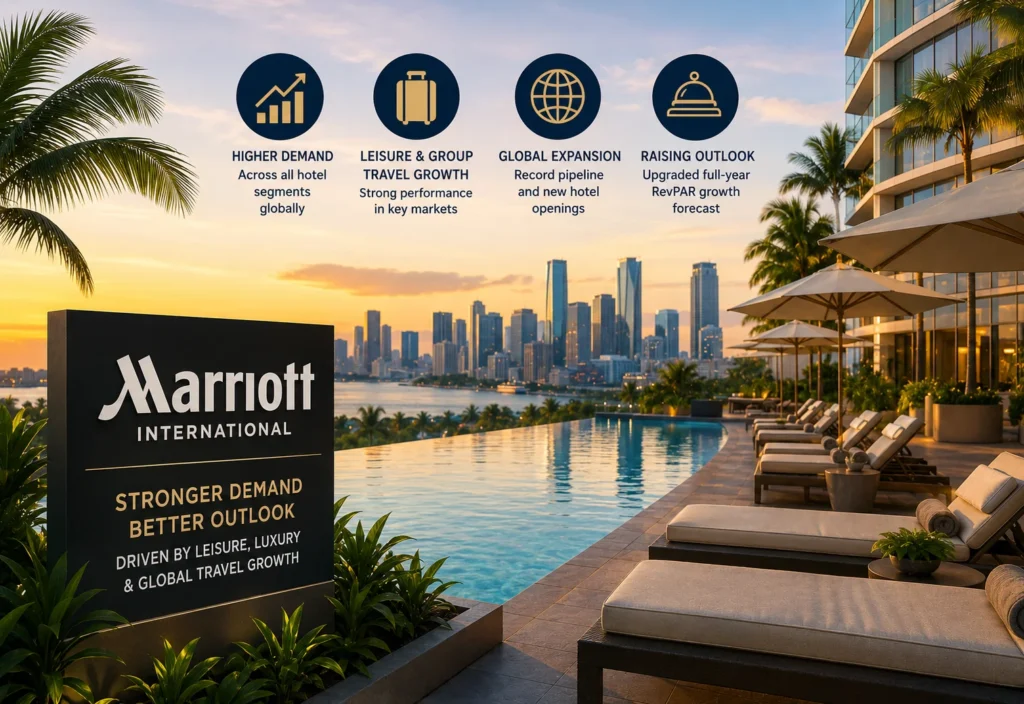
Global hospitality giant Marriott International has upgraded its 2026 business outlook after reporting stronger-than-expected growth across multiple hotel segments and international tourism markets. Rising demand for leisure travel, group tourism, luxury hospitality, and business stays helped the company deliver solid first-quarter performance, reflecting continued momentum in the global travel industry.
Hotel demand growth was reported across a broad range of traveler demographics and accommodation categories, signaling resilience in worldwide tourism despite ongoing geopolitical uncertainty and operational pressures affecting certain regions.
Marriott officials confirmed that global revenue per available room, a key hospitality performance indicator, increased during the first quarter of 2026 as strong booking activity continued across luxury resorts, select-service hotels, group travel, and international tourism destinations.
The company’s positive results highlight the ongoing recovery and expansion of global tourism markets as travelers continue prioritizing leisure experiences, business events, wellness tourism, and international holidays.
Luxury and Leisure Tourism Continue Driving Hospitality Growth
Luxury tourism and resort travel remained among the strongest-performing sectors within Marriott’s international portfolio during the opening months of 2026.
Hotel performance in North America showed broad-based growth, with luxury properties and leisure resorts experiencing particularly strong demand. Marriott executives stated that upscale and premium tourism experiences continue attracting high-spending travelers seeking personalized hospitality, wellness escapes, and premium vacation destinations.
Leisure tourism growth remained robust globally, reflecting ongoing consumer interest in holidays, destination experiences, and international travel. Group tourism and convention-related travel also strengthened, contributing to improved hotel occupancy and average daily rates across major tourism regions.
Hospitality leaders noted that business travel activity also demonstrated steady improvement in several markets, particularly within private-sector and corporate segments.
The company highlighted encouraging growth across select-service hotels as well, signaling broader tourism demand extending beyond luxury travel categories.
Tourism analysts stated that the diversification of hotel demand across multiple accommodation tiers reflects stronger consumer confidence within the global tourism economy.
Asia-Pacific and Greater China Deliver Strong Tourism Recovery
The Asia-Pacific region emerged as one of Marriott’s strongest-performing markets during the quarter, supported by rising domestic tourism, regional travel recovery, and increasing demand from Chinese travelers.
Hotel performance in Greater China improved significantly, with tourism growth led by destinations such as Hong Kong and Hainan Island. Hospitality demand in these markets benefited from stronger leisure travel activity, increased domestic tourism spending, and recovering regional connectivity.
Tourism authorities across Asia continue promoting international visitor growth through expanded air connectivity, tourism campaigns, and hospitality investment initiatives.
Marriott officials noted that hotels across the Asia-Pacific region gained market share during the quarter as tourism flows continued improving following previous years of travel disruption.
However, hospitality operators also acknowledged that ongoing instability affecting Middle Eastern aviation corridors created temporary challenges for some Asia-Pacific destinations dependent on long-haul international transit routes.
Despite those operational challenges, tourism growth throughout Asia remains one of the most important drivers of global hospitality expansion in 2026.
Caribbean and European Tourism Markets Show Resilience
The Caribbean tourism market continued recording strong leisure travel demand, helping support hotel performance throughout the region.
Resort destinations across the Caribbean benefited from sustained demand for beach vacations, cruise tourism extensions, and international leisure travel experiences.
Tourism organizations in the Caribbean have continued investing heavily in sustainable tourism infrastructure, luxury hospitality projects, and expanded international air access to support long-term visitor growth.
Europe also recorded stable tourism performance during the quarter, with several major destinations reporting increased hotel activity linked to business travel, international tourism, and cultural events.
Hospitality demand across Europe remained comparatively resilient despite broader geopolitical concerns affecting parts of the Middle East and nearby travel corridors.
Tourism experts explained that Europe’s diversified tourism infrastructure and strong domestic travel markets continue helping support stable hotel performance across the continent.
Middle East Conflict Continues Impacting Tourism Operations
While many regions experienced strong tourism growth, Marriott acknowledged that ongoing geopolitical instability in the Middle East continues affecting hospitality operations and international travel sentiment in parts of the region.
Hotel demand in Middle Eastern markets experienced declines linked to reduced air capacity, regional security concerns, and disruptions to travel corridors connected to Gulf aviation hubs.
Hospitality executives stated that tourism activity in the Middle East was particularly affected during March following increased regional tensions and operational uncertainty.
Tourism authorities and hotel operators across the Gulf region continue working to maintain visitor confidence, strengthen operational resilience, and support ongoing hospitality investment despite temporary market pressures.
Industry analysts noted that Middle Eastern tourism remains an important component of the global hospitality industry due to the region’s role as a major aviation, luxury travel, and business tourism center.
Marriott officials indicated that they expect conditions in the Middle East to gradually improve later in the year as travel demand stabilizes and airline operations recover.
FIFA World Cup 2026 Expected to Boost Tourism Further
The upcoming FIFA World Cup 2026 is expected to provide additional momentum for the global hospitality industry, particularly in the United States, Canada, and Mexico.
Marriott executives stated that the tournament is projected to contribute additional global hotel demand growth through increased international tourism, sports travel, and event-related accommodation needs.
Tourism organizations throughout North America continue preparing for millions of football fans, media representatives, and business travelers expected to attend the tournament.
Hotels in host cities are investing in staffing, infrastructure upgrades, and guest services ahead of the major global sporting event.
Sports tourism remains one of the fastest-growing segments of the global tourism industry, generating substantial economic activity across hospitality, transportation, retail, and entertainment sectors.
Marriott Expands Global Hotel Development Pipeline
Marriott also reported continued expansion of its international development pipeline during the quarter, reflecting confidence in long-term tourism growth worldwide.
The company added thousands of hotel rooms globally and increased its future pipeline to record levels, with major development projects spanning Asia, Europe, North America, and emerging tourism markets.
New hotel agreements included partnerships in Vietnam, Italy, and the United Kingdom, as well as luxury wellness hospitality collaborations aimed at attracting high-end leisure travelers.
Hotel conversion projects and multi-property expansion agreements continue playing a major role in Marriott’s international growth strategy.
Tourism investment experts stated that strong development activity reflects ongoing confidence in the resilience and profitability of global hospitality markets despite short-term geopolitical and economic challenges.
Global Tourism Industry Continues Strong Recovery
Marriott’s improved outlook reflects broader optimism within the global tourism and hospitality sector as international travel continues recovering and expanding throughout 2026.
Tourism demand across leisure travel, group events, luxury hospitality, and business tourism remains comparatively strong despite rising operational costs and geopolitical uncertainty affecting some regions.
Hotels, airlines, tourism boards, and hospitality investors continue adapting strategies to meet evolving traveler expectations focused on flexibility, premium experiences, wellness tourism, and international connectivity.
As tourism markets continue stabilizing and global travel confidence improves, hospitality leaders expect sustained growth across multiple accommodation sectors throughout the remainder of the year.
The latest performance trends reinforce the tourism industry’s resilience and highlight the growing importance of international hospitality in supporting global economic activity, destination development, and long-term travel growth.