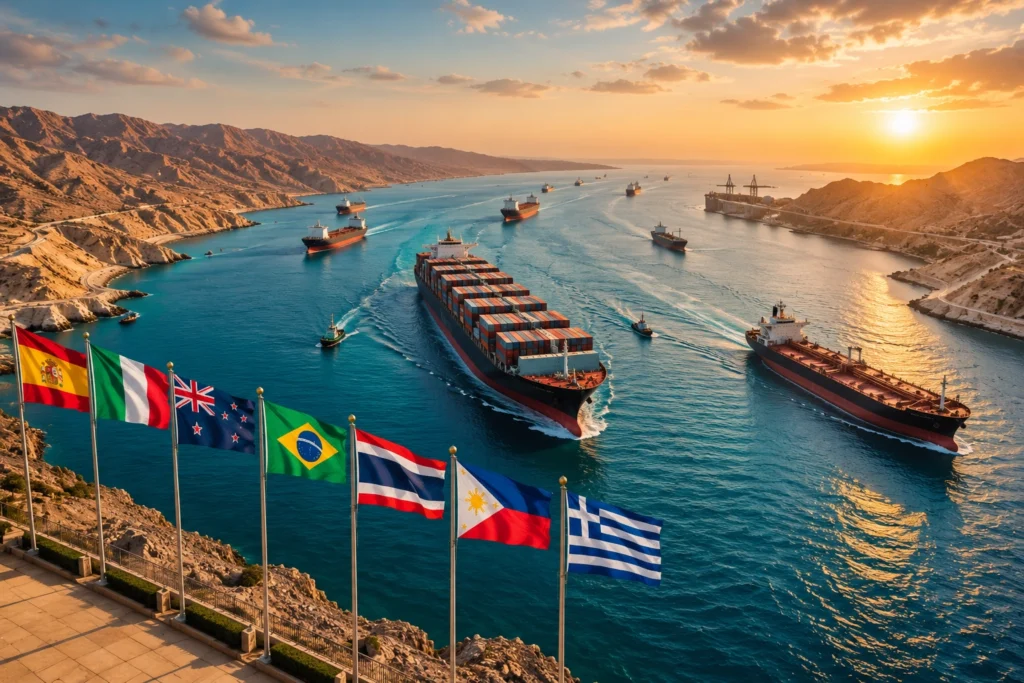
Spain has joined Italy, New Zealand, Brazil, Thailand, the Philippines, Greece, and several other nations in backing Iran’s expanding Hormuz Safe Policy initiative, a move increasingly viewed as a transformative strategy for stabilizing global shipping, reducing maritime risk, reviving tourism corridors, and strengthening international trade networks across Europe, Asia, Oceania, and the Americas.
The growing coalition supporting the policy reflects mounting international pressure to secure uninterrupted navigation through the Strait of Hormuz, one of the world’s most critical maritime chokepoints. The route remains essential for global oil exports, liquefied natural gas shipments, container trade, and increasingly, cruise and maritime tourism operations linking the Middle East with Europe and Asia.
As geopolitical tensions and war-risk insurance concerns continue influencing freight costs and shipping confidence, governments and industry leaders are now embracing new frameworks designed to restore predictability and stimulate long-term economic growth.
Hormuz Safe Policy Emerges as Major Maritime Initiative
The Hormuz Safe Policy is rapidly evolving beyond a regional maritime strategy into a broader international trade and security framework.
At the center of the initiative is a state-backed system designed to provide war-risk insurance support, structured vessel clearance procedures, regulated transit routes, and alternative payment mechanisms for ships operating through the Strait of Hormuz.
The framework aims to stabilize commercial shipping activity while reducing uncertainty for global supply chains that depend heavily on Gulf energy exports and international cargo movement.
Industry analysts say the policy could significantly reshape maritime logistics by reducing insurance volatility, improving shipping reliability, and creating stronger conditions for investment in tourism, ports, hospitality, and cruise operations connected to Gulf and Mediterranean markets.
Spain and Italy Focus on Tourism and Maritime Connectivity
Spain’s participation highlights growing European interest in protecting maritime commerce and expanding tourism opportunities tied to Gulf and Mediterranean connectivity.
Spanish tourism operators and cruise companies are reportedly exploring stronger maritime linkages connecting Mediterranean destinations with Gulf ports as regional stability improves. Spain also sees economic advantages in reducing freight uncertainty tied to energy imports and international trade routes.
Italy, home to one of Europe’s most influential maritime industries, has also strongly supported efforts to stabilize shipping operations through Hormuz. Italian shipping companies and logistics firms have long faced rising insurance costs linked to regional instability, making predictable maritime access a major economic priority.
Cruise tourism operators across Southern Europe are increasingly monitoring developments as maritime confidence strengthens across the broader Middle East region.
Greece Reinforces Global Shipping Leadership
Greece, which controls one of the world’s largest merchant shipping fleets, has emerged as a major supporter of initiatives aimed at securing high-risk maritime corridors.
Greek shipowners, insurers, and logistics operators view the Hormuz Safe framework as an important mechanism for reducing operational uncertainty while strengthening international maritime trade continuity.
The initiative may also create new opportunities for eastern Mediterranean cruise itineraries and maritime tourism expansion connecting Europe, the Gulf, and Asia. Tourism executives believe safer and more stable sea lanes could encourage cruise operators to introduce longer multi-region voyages linking emerging destinations across the Middle East.
Brazil, Thailand and the Philippines See Economic Advantages
Beyond Europe, support for the Hormuz Safe Policy is expanding rapidly across Asia and Latin America.
Brazil views the framework as strategically important for stabilizing agricultural and mineral export logistics while improving trade reliability with Asian and European markets. More predictable maritime insurance costs could strengthen Brazil’s competitiveness in global commodity trade.
Thailand’s manufacturing and energy sectors also stand to benefit from lower freight risk and improved access to imported oil and gas supplies moving through the Gulf region.
Meanwhile, the Philippines is exploring how maritime stability could support both energy import security and future cruise tourism growth across Asia-Pacific routes connected to Middle Eastern ports.
Tourism Industry Watches Emerging Cruise and Travel Opportunities
The tourism industry is increasingly viewing the Hormuz Safe initiative as more than a shipping policy. Cruise operators, tourism boards, and hospitality investors see potential for expanded tourism connectivity between Europe, the Gulf, South Asia, and Southeast Asia.
As maritime confidence improves, travel companies are exploring new cruise circuits, ferry routes, and luxury maritime tourism experiences linking Mediterranean, Gulf, and Asian destinations.
Industry experts say stable shipping corridors can directly influence traveler perception, destination confidence, and broader tourism investment decisions. Reduced geopolitical uncertainty often leads to stronger hotel occupancy rates, increased airline connectivity, and higher visitor spending across regional economies.
Global Trade and Energy Markets Could Benefit Significantly
The Strait of Hormuz remains central to international trade and global energy flows, handling a substantial portion of worldwide oil and LNG shipments every day.
Supporters of the Hormuz Safe framework argue that lowering maritime risk could help stabilize energy prices, strengthen supply chains, and improve long-term global economic resilience.
Countries including China, India, Japan, South Korea, and Singapore are also closely monitoring the initiative due to their heavy reliance on Gulf trade routes and imported energy supplies. Logistics firms, energy companies, and global investors increasingly see maritime stability as critical to maintaining competitive international commerce.
Hormuz Safe Policy Signals New Era for Trade and Tourism
As Spain joins Italy, New Zealand, Brazil, Thailand, the Philippines, Greece, and a growing network of global economies supporting the Hormuz Safe Policy, the initiative is increasingly being viewed as a landmark development in international maritime cooperation.
For the travel and tourism sector, the policy represents more than secure shipping lanes. It signals the possibility of renewed cruise tourism growth, stronger international connectivity, expanded hospitality investment, and a more stable environment for travelers and businesses operating across Europe, the Middle East, and Asia.
With global trade, tourism, and maritime industries all searching for greater predictability after years of disruption, the Hormuz Safe Policy is emerging as a powerful symbol of how economic cooperation and strategic maritime security can reshape international growth opportunities in the years ahead.
For more travel news like this, keep reading Global Travel Wire