The global aviation landscape is witnessing a highly visible battle for dominance in the long-haul luxury market. As network carriers aggressively scale up operations to attract high-yield corporate executives and affluent leisure travelers, the distinction between top-tier premium experiences has become a critical focal point for the industry.
At the center of this competition are two titans of Middle Eastern aviation: Qatar Airways and Emirates. According to official performance briefs from the International Air Transport Association, these mega-connectors collectively influence a massive portion of intercontinental transfer capacity, meaning their interior fleet investments systematically dictate global passenger expectations.
Qatar Airways QSuite: Setting a New Structural Benchmark for Privacy
Qatar Airways has firmly anchored its premium market position through its signature QSuite product. According to the airline’s newly published 2025/2026 annual report, the carrier successfully managed 41.8 million passengers over the fiscal year while driving operating profits to a record-breaking QAR 15.2 billion. This financial resilience is heavily backstopped by the high demand for its premium cabin innovation, which has transformed standard business class layouts into an elite private experience.
The QSuite architecture features a fully enclosed private suite design, complete with sliding privacy doors and direct aisle access across a staggered configuration. The hallmark of this design is its convertible center-seat cluster. These flexible configurations allow traveling couples or four-person business teams to drop privacy panels and create combined double beds or private mini-conference rooms in the sky.
By eliminating the typical spatial compromises associated with traditional long-haul travel, the carrier has secured a major competitive edge. This layout has proved highly effective at winning lucrative corporate travel contracts, as international procurement teams place a higher premium on workspace privacy and high-speed in-flight productivity.
Integrated Technology: The Widebody Starlink Implementation
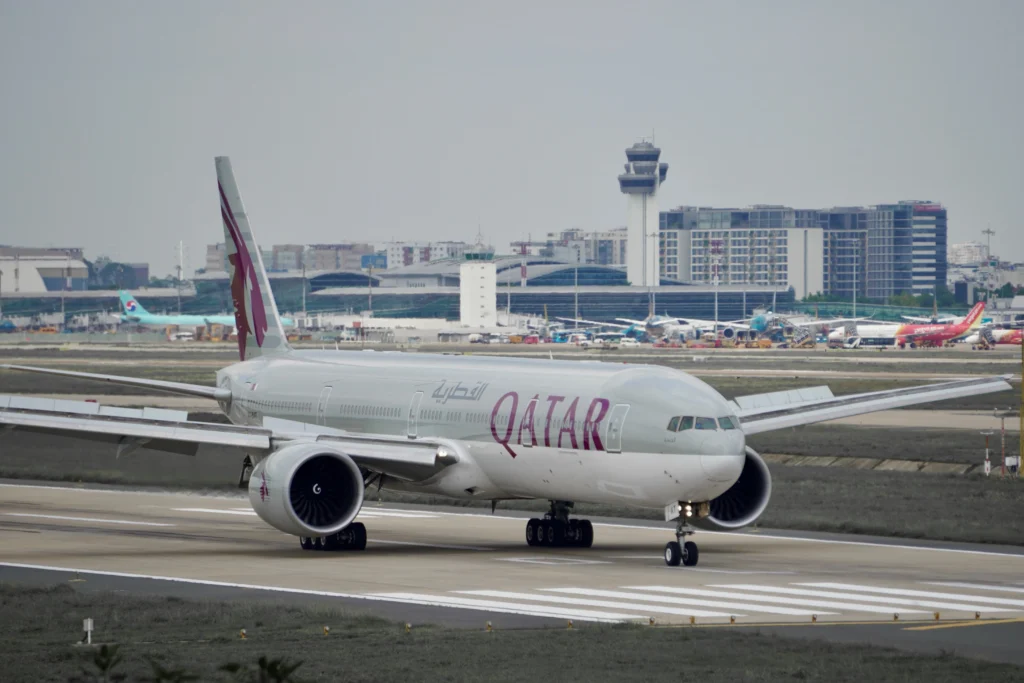
To supplement its physical cabin advantages, the Doha-based group has successfully completed the world’s first full-scale Starlink rollout program across its primary widebody fleet. Official technical statements confirm that the high-speed satellite connectivity is currently operational across 130 widebody aircraft, including its Boeing 777 and Airbus A350 configurations.
This infrastructure development provides passengers with completely free, high-speed internet access capable of handling data-heavy video conferencing, live streaming, and secure remote corporate network access at 35,000 feet. By combining a private physical suite with uninterrupted, gigabit-speed digital access, the airline has created an in-flight office environment that traditional open-cabin concepts struggle to match.
Emirates Business Class: Leveraging Fleet Consistency and Iconic Onboard Social Spaces
Emirates continues to defend its prominent share of the intercontinental luxury market by relying on massive fleet capacity, consistent premium service, and its world-renowned widebody passenger experience. Operating out of its high-capacity hub at Dubai International Airport, the carrier controls an expansive network that handles a large percentage of all long-haul transit moving between Europe, Asia, and Australasia.
The airline’s premium business class strategy is distinctly visible on its double-decker Airbus A380 flagship fleet. While the standard seating configuration lacks the fully enclosed sliding doors seen in the QSuite, it excels in terms of individual space, high-end materials, and individual beverage mini-bars at every seat.
The crown jewel of the Emirates widebody experience remains its iconic Onboard Lounge. Situated at the rear of the upper deck, this fully staffed horseshoe bar serves as an exclusive social sanctuary where business class and first class travelers can network, enjoy curated premium canapés, and select from a high-end beverage menu during long-haul transoceanic journeys. This focus on an interactive, community-style luxury experience provides an attractive alternative to travelers who find fully enclosed suites isolating on ultra-long-haul routes.
Ramping Up Fleet Modernization to Combat Innovation Pressure
To match evolving competitive benchmarks, the Dubai aviation authority is executing a multi-billion-dollar fleet retrofitting program. The carrier is systematically updating its Boeing 777 and newly delivered Airbus A350-900 aircraft with modernized business class seating layouts.
These updated cabins introduce direct aisle access for every passenger, updated entertainment screens, and high-end design accents inspired by the airline’s latest premium first-class suites. This extensive capital deployment ensures that even as competitor cabins evolve, the airline maintains a highly competitive, luxurious environment across its entire global network.
Determining True Premium Value for Modern Travelers
When assessing value in the premium segment, modern travelers look past basic seat dimensions to evaluate the entire travel ecosystem. For corporate flyers and couples where personal privacy, uninterrupted sleep, and seamless digital workspace connectivity are the primary priorities, Qatar Airways’ QSuite, backed by its free widebody Starlink network, presents an incredibly strong value proposition.
Conversely, for leisure travelers who prioritize a classic, high-end hospitality environment, a sprawling route network with minimal connection times, and iconic social amenities like the onboard upper-deck lounge, Emirates remains a top-tier choice. As both global carriers continue to invest heavily in next-generation widebody orders and cabin innovations through the remainder of 2026, international travelers stand to benefit from an unprecedented era of luxury, comfort, and technological sophistication in the skies.
For more travel news like this, keep reading Global Travel Wire