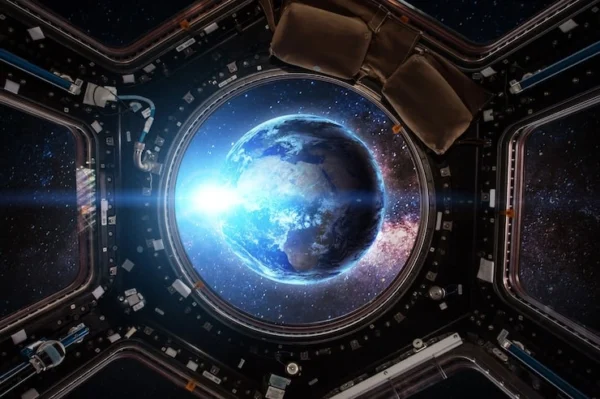
The global space tourism market is rapidly transforming from a futuristic fantasy into one of the world’s fastest-growing luxury travel sectors, with projections showing the industry could reach an extraordinary $12.6 billion by 2031. Fueled by aggressive private-sector investment, reusable rocket technology and growing consumer appetite for extreme experiences, commercial space travel is entering a decisive expansion phase that is reshaping the future of global tourism.
According to recent market projections, the sector is expected to grow dramatically from an estimated $598.4 million valuation in 2021, expanding at a remarkable compound annual growth rate of 36.4 percent through the end of the decade. The acceleration reflects a major shift in how travelers, investors and aerospace companies now view space exploration — not simply as science or government research, but as the next frontier of premium tourism.
For decades, space remained accessible only to elite astronauts backed by powerful national governments. Today, private aerospace giants are opening the possibility of commercial journeys beyond Earth’s atmosphere to a new generation of high-net-worth travelers and adventure seekers.
Reusable Rocket Technology Changes the Economics of Space Travel
One of the biggest drivers behind the commercial space tourism boom is the rapid evolution of reusable rocket systems. Historically, every launch required expensive single-use rockets that dramatically limited affordability and scalability. That model changed when private aerospace companies successfully demonstrated reusable orbital booster landings and repeat launch capability.
This breakthrough has significantly reduced launch costs and increased operational efficiency across the industry. Companies including SpaceX have helped redefine the economics of orbital access, allowing the private sector to move closer toward commercially sustainable space travel models.
Although orbital journeys remain extremely expensive, market analysts believe continued competition and technological advancement will steadily reduce pricing barriers over the coming years. Industry leaders are already developing next-generation reusable systems designed to make space tourism more commercially accessible while expanding passenger capacity.
Suborbital Tourism Emerges as the Industry’s Fastest-Growing Segment
The commercial space tourism industry is currently divided into two primary travel experiences: suborbital flights and full orbital missions. Suborbital tourism has emerged as the dominant market segment due to its shorter duration, lower operational complexity and broader consumer accessibility.
Suborbital experiences allow passengers to travel to the edge of space, experience several minutes of weightlessness and witness Earth’s curvature before returning to the planet within hours. Unlike orbital missions, these flights require less astronaut-style training and offer a more practical entry point for luxury adventure travelers.
Companies specializing in atmospheric and suborbital experiences are positioning themselves to attract affluent tourists seeking unique once-in-a-lifetime travel experiences without committing to multi-day orbital expeditions.
Travel analysts believe suborbital flights could become the equivalent of ultra-premium expedition tourism, similar to luxury polar cruises or deep-ocean exploration experiences.
Orbital Hotels and Space Stations Redefine Ultra-Luxury Tourism
While suborbital flights are expected to drive passenger volume, orbital tourism is rapidly emerging as the pinnacle of future luxury travel. Aerospace companies are now investing heavily in privately operated space station infrastructure designed to host commercial guests in low Earth orbit.
Axiom Space and other private operators are developing orbital habitats intended for both scientific activity and high-end tourism. These future stations could accommodate private travelers for extended stays while offering panoramic views of Earth and access to zero-gravity environments.
The shift comes as NASA gradually transitions away from the aging International Space Station toward commercially operated orbital platforms. Partnerships involving private transportation systems, orbital habitats and reusable launch technologies are creating the foundation for an entirely new tourism ecosystem above Earth’s atmosphere.
Industry experts increasingly compare future orbital tourism experiences to luxury resorts or exclusive expedition lodges — except located hundreds of kilometers above the planet.
Global Competition Intensifies Across Space Tourism Markets
North America currently dominates the commercial space tourism market due to its established aerospace infrastructure, technological leadership and deep private investment networks. However, rapid expansion is also underway across Asia-Pacific, the Middle East and Latin America.
Countries and regional agencies are investing heavily in commercial spaceport development, aerospace research and private-sector partnerships aimed at capturing future tourism revenue.
Asia-Pacific is emerging as a particularly competitive region as organizations such as the China National Space Administration, the Indian Space Research Organisation and Japan’s JAXA continue advancing national space capabilities that may eventually support commercial tourism infrastructure.
Meanwhile, the Middle East and parts of Latin America are exploring opportunities to become future launch and transit hubs for international commercial space travel.
Safety and Sustainability Remain Critical Challenges
Despite rapid growth projections, the commercial space tourism industry still faces significant operational and environmental challenges. Spaceflight remains inherently risky, and industry analysts warn that a single major accident could heavily impact consumer confidence and trigger stricter global regulations.
Environmental concerns are also intensifying as climate-conscious travelers increasingly evaluate the carbon impact of luxury tourism experiences. In response, aerospace companies are researching cleaner propulsion technologies, including liquid hydrogen and oxygen-based systems that reduce carbon emissions compared to traditional rocket fuels.
Balancing commercial growth with sustainability and safety will remain essential as the sector expands toward mainstream luxury tourism markets.
Space Tourism Could Redefine Global Travel by 2031
Beyond technology and economics, the rise of commercial space tourism reflects a deeper transformation in global travel behavior. Modern travelers are increasingly seeking extraordinary, emotionally transformative experiences rather than conventional luxury alone.
Passengers returning from early commercial flights frequently describe the “Overview Effect,” a profound emotional reaction caused by viewing Earth from space and recognizing the planet’s fragility and interconnectedness.
As private aerospace competition accelerates and infrastructure expands, experts believe space tourism could evolve from an ultra-exclusive niche into one of the defining travel industries of the next decade.
By 2031, thousands of travelers may journey beyond Earth’s atmosphere each year, fundamentally changing not only tourism economics but humanity’s relationship with exploration itself.
For more travel news like this, keep reading Global Travel Wire