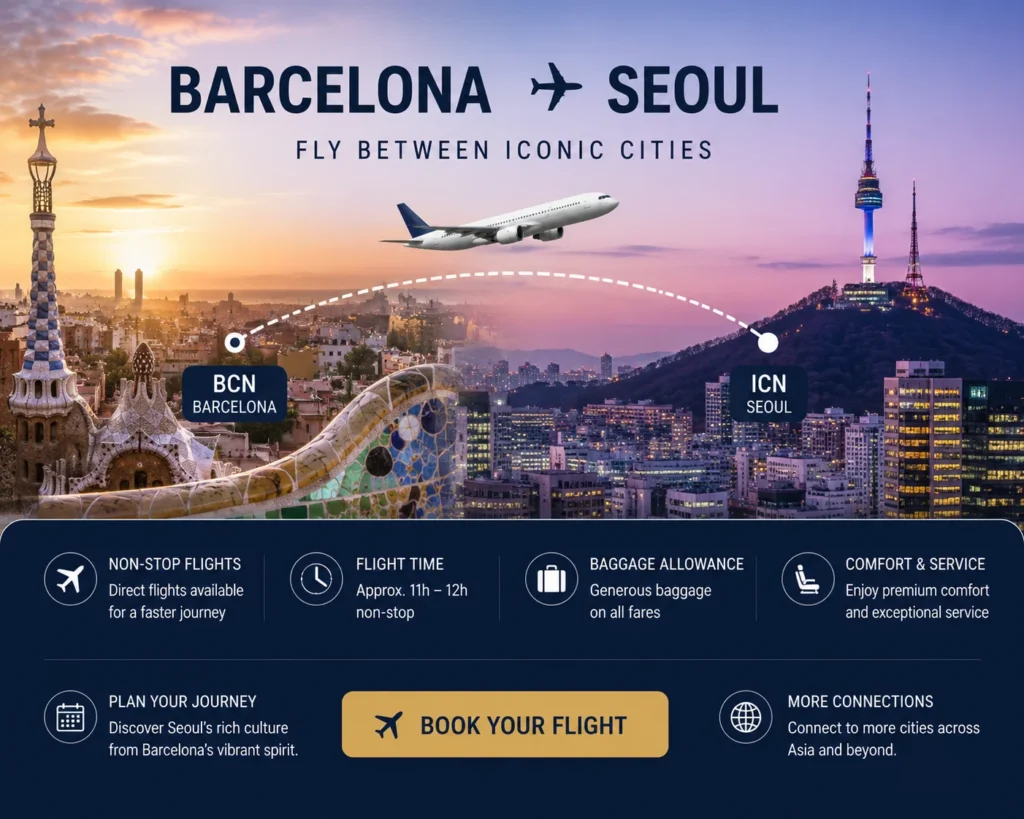
The global aviation landscape is witnessing a significant shift in long-haul connectivity as budget carriers expand their networks to connect Europe and East Asia. In a major development for international air travel, South Korean carrier T’way Air has introduced competitive pricing on its direct route connecting Spain and South Korea. Travelers can now secure round-trip tickets from Barcelona to Seoul starting at €548, establishing an affordable baseline for direct connectivity between the two major cultural hubs.
This pricing strategy aligns with broader aviation trends focused on democratizing long-haul routes. Historically, direct flights between Southern Europe and East Asia have been dominated by traditional network legacy carriers, often resulting in premium fare pricing. By utilizing an efficient point-to-point operational network and long-range widebody aircraft, the airline has successfully introduced a cost-effective alternative that appeals directly to leisure travelers, cultural explorers, and budget-conscious commuters.
Unpacking the Value of the New Direct European Gateway
When analyzing high-value airline promotions, the specific inclusions of the fare are crucial for travelers. The €548 price point represents a complete, round-trip product originating from Josep Tarradellas Barcelona-El Prat Airport and landing at Seoul Incheon International Airport. It includes all mandatory aviation taxes and baseline standard operational fees, ensuring transparency for consumers navigating international booking platforms.
Operating as a full-service entry point on its widebody fleet, the carrier structures these fares to include primary travel necessities rather than separating them into a complex menu of add-on fees. Passengers benefit from integrated core amenities, differentiating the offer from standard ultra-low-cost transatlantic models that charge separately for baseline services.
Barcelona’s established role as a premier European transit hub maximizes the utility of this route. The city’s comprehensive Mediterranean rail connections, domestic flight networks, and expansive regional tourism infrastructure allow travelers from across Europe to easily utilize Catalonia as a convenient departure point for East Asian travel.
The Operational Advantage of Direct Long-Haul Connectivity
In modern aviation, budget-friendly long-haul travel has frequently been synonymous with multi-stop itineraries, extended layovers, and complex baggage transfers. The introduction of direct Barcelona to Seoul flights eliminates these logistical challenges. Covering an operational distance of approximately 9,000 kilometers, the non-stop service minimizes travel time and significantly mitigates common transit risks, such as baggage handling delays and missed connecting flights.
The scheduling of these long-haul routes is carefully managed to optimize passenger comfort and airport efficiency. Utilizing modern, fuel-efficient widebody aircraft allows the airline to maintain the precise cost structures necessary to support sub-€600 round-trip pricing while ensuring a reliable, sustained flight schedule between Spain and South Korea.
South Korea Capitalizes on Surging International Tourist Arrivals
The introduction of these competitive airfares arrives at a time of unprecedented growth for South Korean tourism. According to official statistics released by the Ministry of Culture, Sports and Tourism, the country welcomed a record-breaking 4.76 million foreign tourists in the first quarter of this year alone, representing a sharp 23% increase compared to the same period in the previous year. This surge is heavily supported by the government’s aggressive “K-Tourism” strategic initiatives, which aim to accelerate inbound international arrivals toward historic highs.
The official data highlights that while regional Asian markets continue to drive volume, arrivals from Europe and the Americas grew by a robust 17% during the opening quarter. This influx corresponds with record-high travel satisfaction scores, which reached 90.8 points in official ministry surveys. Foreign visitor spending has also scaled proportionally, with international card expenditures climbing past 3.21 trillion won as travelers explore the country’s expanded cultural offerings, digital infrastructure, and culinary scenes.
To accommodate this global demand, the South Korean government has implemented targeted policy adjustments, including streamlined immigration procedures and expanded multiple-entry visa options for frequent travelers. Furthermore, the ministry is actively working to decentralize tourism away from the capital by expanding domestic flight frequencies to regional hubs such as Jeju Island and southern coastal cities, making it easier for European visitors to explore the diverse landscapes beyond Seoul.
Strategic Booking Window and Route Inventory Considerations
As with all high-demand aviation promotions, fare availability fluctuates based on seasonal demand, fuel price index adjustments, and real-time inventory management. The €548 round-trip floor price is tied to specific seat allocations across selected booking windows. Travelers looking to secure these competitive rates are encouraged to plan around optimal advance-purchase timelines, as promotional seats on long-haul routes fill rapidly.
While the entry-level pricing sets an accessible benchmark for the route, actual ticket costs may vary depending on departure dates, seasonal peaks, and specific seat selections. Prospective visitors should consult official booking channels to review real-time schedule adjustments and ensure compliance with all standard luggage and international documentation requirements prior to departure.
For more travel news like this, keep reading Global Travel Wire