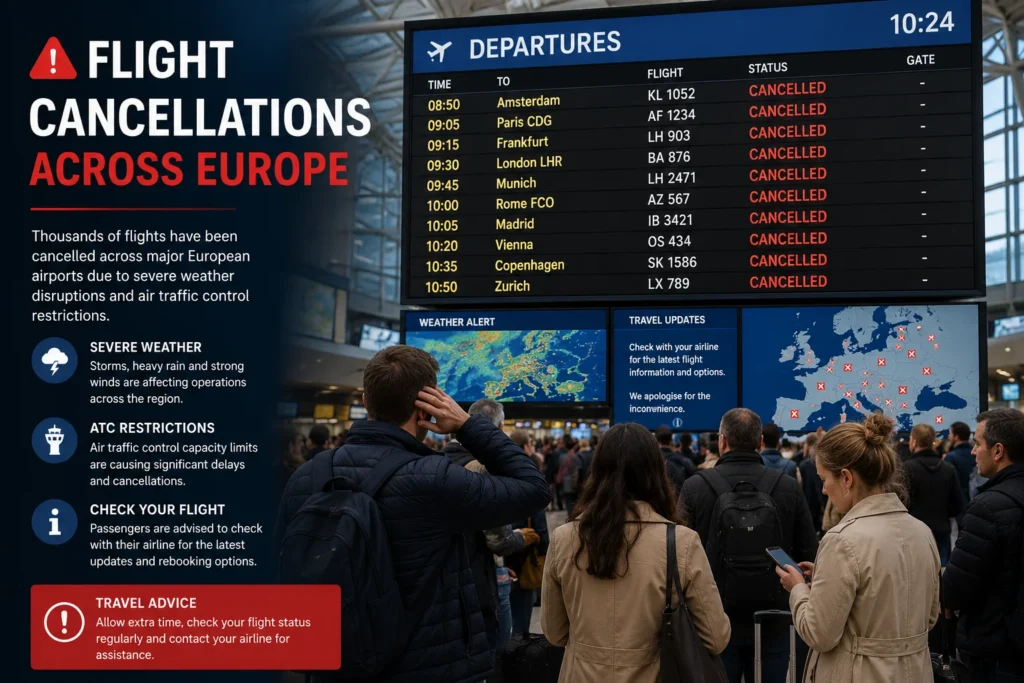
Widespread operational bottlenecks have disrupted short-haul air travel across Europe, leaving thousands of passengers facing significant delays and schedule changes. The technical and logistical difficulties, centered within the easyJet network, have affected primary aviation gateways across the continent. Official flight tracking data recorded a total of 32 flight cancellations and 723 flight delays, complicating seasonal travel for both leisure and business passengers moving between major European cities.
Capacity Constraints Impact Major Aviation Gateways
The operational disruption heavily impacted several of Europe’s busiest hubs, including London Gatwick, Paris Charles de Gaulle, and Amsterdam Schiphol. These specific locations operate under highly regulated air traffic management systems where small scheduling adjustments can cause significant knock-on effects. According to seasonal data from EUROCONTROL, the European network handles over 30,000 daily flights, meaning that early-morning delays quickly disrupt aircraft rotations and crew availability later in the day.
The low-cost carrier segment represents more than one-third of all local European traffic flows. When a major operator experiences a localized interruption, the ripple effects quickly spread to secondary bases like Milan Malpensa, Lisbon, Berlin, and Barcelona. Because short-haul budget carriers rely on quick aircraft turnarounds—often under 45 minutes—even minor airport ground-handling delays can accumulate, resulting in late evening cancellations.
Regulatory Analysis of Airspace Congestion
Aviation monitoring authorities have repeatedly noted that high travel demand places severe pressure on regional infrastructure. Regular analysis from the European Union Aviation Safety Agency (EASA) underscores that air traffic control staffing shortages, localized weather systems, and restricted corridor capacities contribute to ongoing punctuality challenges.
According to EUROCONTROL’s operational overviews, air traffic flow management delays are frequently caused by airspace capacity limitations, particularly across busy sectors in France and Spain. When multiple carriers compete for a limited number of takeoff and landing slots during peak morning and evening waves, delays become harder to avoid, forcing airlines to cut select flights to reset their daily operations.
Summary of Regional Operational Impacts
The scope of the scheduling issues varied significantly depending on the transit route and airport infrastructure. The following tracking breakdown highlights the general operational impact observed across the continent’s major corridors:
easyJet Global Network: 32 flights cancelled and 723 flights delayed, representing a widespread operational challenge.
London Gatwick Hub: High impact on outbound vacation flights, leading to crowded departure terminals.
Paris & Amsterdam Gateways: Notable slot restrictions resulting in extended tarmac delays for short-haul arrivals.
Mediterranean Corridors: Flight delay accumulations affecting routes into Spain, Portugal, and Italy.
Understanding Passenger Rights and Financial Recourse
For travelers impacted by these cancellations and schedule changes, consumer protection frameworks outline clear requirements for airline assistance. Under established air passenger rights regulations—specifically UK261 for British airspace and EU261 for the European Union—airlines are legally mandated to offer comprehensive care to stranded customers.
The Civil Aviation Authority (CAA) highlights that passengers facing cancellations or departure delays exceeding certain time thresholds are entitled to specific remedies, including:
Alternative Transportation: Choice between a full ticket refund or rerouting to the final destination at the earliest opportunity.
Duty of Care: Complimentary meals, refreshments, and communication access relative to the wait time.
Accommodation Support: Hotel lodging and airport transport if an unexpected overnight stay becomes necessary.
Financial Compensation: Fixed cash payments depending on flight distance and the exact length of the arrival delay, provided the disruption was within the airline’s direct operational control.
Regulatory bodies advise passengers to keep all digital booking confirmations, physical boarding passes, and receipts for any necessary out-of-pocket expenses incurred during a delay to ensure a smooth claims process.
Structural Challenges in Summer Operations
From a broader industry standpoint, these disruptions reflect the complex operational environment that airlines must navigate as international tourism numbers continue to grow. Although carriers have adjusted their seasonal plans by increasing standby crews and modifying schedules, the high density of European airspace leaves very little margin for error.
As national tourism boards prepare for high visitor volumes throughout the peak summer months, air transport stability remains an important factor for regional economies. Industry regulators continue to emphasize that closer coordination between national air navigation service providers, airport operators, and commercial airlines is essential to manage congestion and protect travelers from unexpected itinerary changes.
For more travel news like this, keep reading Global Travel Wire