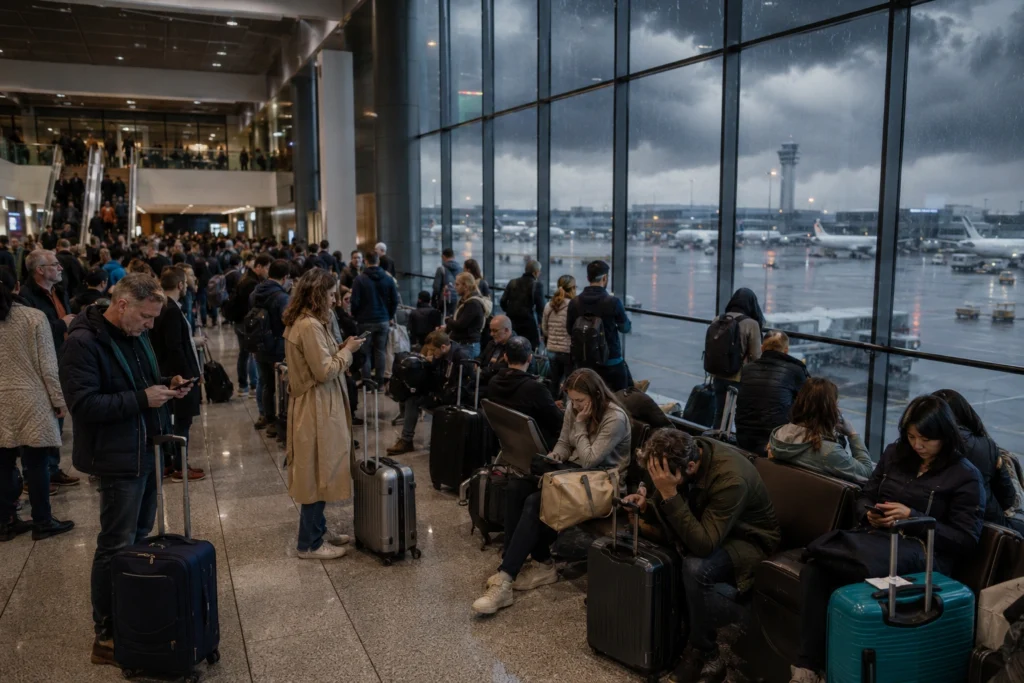
Travellers across Europe are facing widespread aviation disruption after a live operational snapshot recorded 481 cancellations and 5,073 delays across 24 major airports, affecting thousands of passengers during a busy travel period.
Germany experienced some of the most severe disruption, with Frankfurt Airport recording 642 delays and 165 cancellations. Munich Airport also faced significant schedule changes, with 331 delays and 66 cancellations. The disruption spread across major gateways in Austria, Switzerland, the United Kingdom, the Netherlands, Belgium, Italy, Spain, France, Greece and Poland.
Lufthansa recorded the highest airline disruption total in the supplied snapshot, with 697 delays and 224 cancellations. easyJet followed with 692 delays, while Austrian Airlines, Eurowings, British Airways, KLM, Air France, Swiss, Aegean Airlines, ITA Airways and Ryanair were also affected.
The figures remain subject to change as airlines update schedules. Travellers should confirm the latest status of their individual flights directly with their airline or airport before departure.
Frankfurt and Munich Face Heavy Disruption
Frankfurt emerged as the most affected airport in the snapshot. As one of Europe’s largest aviation hubs, disruption at Frankfurt can quickly affect connecting passengers travelling across the continent and beyond.
Munich recorded the second-highest cancellation total. Passengers connecting through the Bavarian hub should monitor airline notifications carefully, especially when travelling on itineraries involving multiple flights.
Other German airports also experienced operational pressure. Düsseldorf recorded 222 delays and 10 cancellations, Berlin Brandenburg registered 185 delays and 20 cancellations, Stuttgart saw 106 delays and 11 cancellations, while Hamburg reported 86 delays and 13 cancellations.
The cause of every individual cancellation or delay has not been officially confirmed. Weather conditions, aircraft rotations, crew availability, air-traffic restrictions and knock-on delays can all influence schedules during periods of network disruption.
London, Vienna, Zurich and Amsterdam Also Affected
The disruption extended well beyond Germany. Zurich Airport recorded 302 delays and 34 cancellations, while Vienna International Airport reported 225 delays and 27 cancellations. Amsterdam Schiphol registered 322 delays and 13 cancellations.
Three London airports collectively recorded 594 delays and 29 cancellations. Heathrow experienced 273 delays and 19 cancellations. Gatwick saw 264 delays and four cancellations, while London City recorded 57 delays and six cancellations.
Elsewhere, Brussels registered 149 delays and 12 cancellations. Rome Fiumicino reported 210 delays and 13 cancellations. Milan Linate and Milan Malpensa were also affected, alongside Barcelona, Paris Charles de Gaulle, Nice, Athens, Geneva, Warsaw, Glasgow and Edinburgh.
Tourism Businesses Watch Passenger Flow
The disruption creates challenges for tourism businesses across Europe. Late arrivals and cancelled flights can affect hotel check-ins, airport transfers, rail journeys, cruise connections, tours and restaurant bookings.
Cities such as Rome, Paris, Athens, Vienna, Barcelona and London depend heavily on reliable aviation during peak travel months. Even short-term disruption can lead to missed connections and itinerary changes, especially for travellers combining several destinations in one trip.
Regional tourism businesses can also feel the effects when passengers arrive late or cancel onward journeys. Hotels, transport operators and attractions may need to manage last-minute changes while supporting visitors whose plans have been disrupted.
Passengers Should Review Rebooking Options
Travellers should check airline apps, airport departure boards and official notifications frequently. Passengers with connecting flights should confirm whether onward services remain available before travelling to the airport.
Those affected by cancellations should review rebooking and refund options directly with their carrier. Depending on the circumstances and the route, travellers may also be entitled to assistance under applicable passenger-protection rules.
Passengers should retain boarding passes, booking confirmations and itemised receipts for essential expenses. Travellers with hotel stays, rail tickets or tours connected to their flights should contact providers promptly when arrival times change.
Flexible Planning Becomes Essential
The disruption highlights how quickly operational pressure at major hubs can spread across Europe’s interconnected aviation network. A cancellation in Frankfurt or Munich can affect aircraft rotations and passenger connections in other countries later in the day.
Travellers should allow extra time, keep essential items in hand luggage and avoid relying solely on earlier schedule information. Those planning multi-city journeys should monitor each segment carefully and prepare alternative arrangements where possible.
Europe’s airports remain open and airlines continue to operate thousands of services. However, with widespread delays and cancellations affecting major hubs, flexibility and real-time information will be essential until schedules stabilise.
For more travel news like this, keep reading Global Travel Wire