The delicate balance between passenger convenience and international aviation safety came to the forefront of global travel news following a significant midair diversion involving a commercial flight from the United States to Europe. A Boeing 767 aircraft bound for Palma de Mallorca, Spain, was forced to execute a dramatic U-turn over the Atlantic Ocean and return to its origin airport after an active electronic device broadcast a highly disruptive network name within the aircraft cabin.
According to official incident logs released by the Federal Aviation Administration (FAA) and the Port Authority of New York and New Jersey, the aircraft was approximately an hour into its transatlantic journey when the flight crew identified a localized security risk. Communication records verified by air traffic control tracking indicated that an onboard Bluetooth network had been configured with a threatening four-letter word, immediately activating strict corporate and federal aviation security mandates.
The incident highlights the extensive, multi-layered defense systems that protect modern commercial aviation. While long-haul international travel continues to experience a robust post-season surge, the event serves as a stark reminder of how digital compliance and passenger behavior directly influence the efficiency of global transit networks.
Rapid Command Coordination Triggers Transatlantic Emergency Turnback
The decision to abort a long-haul flight over the open ocean involves rapid, highly synchronized communication between the flight deck and airline headquarters. Upon discovering the active, non-compliant signal, cabin crew issued multiple public address announcements instructing all passengers to deactivate their personal Bluetooth connections immediately.
When at least two discoverable electronic signals remained active past the strict compliance deadline, pilots formally declared a general emergency by transmitting a standard emergency squawk code. Following direct consultations with the airline’s centralized operations control center in Chicago, the flight crew initiated a full turnback toward the northeastern United States.
Data provided by regional aviation tracking authorities confirmed that the aircraft landed safely back at its origin point roughly three and a half hours after its initial departure. The coordinated response between the flight crew, airline dispatchers, and federal traffic controllers ensured that the widebody jet was seamlessly routed out of busy North Atlantic tracks and back into a secure domestic landing pattern without further operational complications.
Ground Sweeps and Strict Rescreening Imposed at Regional Transit Hub
Upon arriving back on the tarmac, the aircraft was immediately met by a substantial law enforcement detail. Security protocols managed by the Port Authority Police Department required the immediate deplaning of all passengers. In line with standard transportation safety regulations, travelers were instructed to leave all personal cabin baggage on board the aircraft to facilitate a comprehensive physical sweep of the interior and cargo holds.
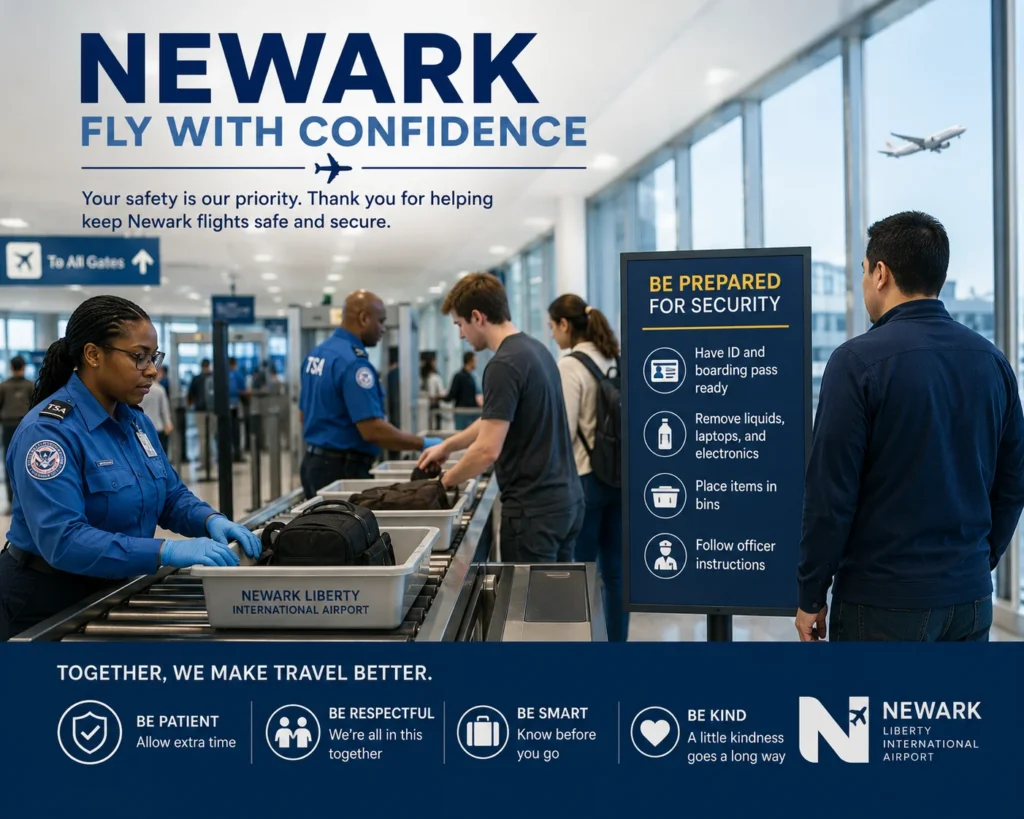
The Transportation Security Administration (TSA), alongside U.S. Customs and Border Protection (CBP), assumed control of the passenger manifest to execute complete security rescreening procedures. Federal guidelines mandate a thorough re-verification of all passengers and luggage whenever a credible, unresolved security alert occurs in flight.
Investigators quickly traced the origin of the signal to an individual passenger’s wearable digital device, confirming that the threatening network name did not represent an active physical hazard to the aircraft or its occupants. While the incident resulted in significant operational delays, municipal authorities emphasized that the rigorous execution of these protocols is vital to maintaining long-term confidence in international travel routes.
Operational Ripple Effects and Key Takeaways for International Leisure Travelers
The logistical impacts of a midair diversion extend far beyond a single delayed aircraft. For international hubs like Newark, handling an unscheduled widebody return involves significant reallocation of ground resources, gate modifications, and crew scheduling adjustments. To minimize downstream disruptions, travelers affected by the diversion were transitioned to a replacement aircraft configured with a fresh flight crew, allowing them to complete their journey to Spain the following afternoon.
This event underscores a critical truth for modern tourists: digital settings carry real-world consequences in highly regulated environments. Public safety announcements from aviation regulatory bodies increasingly emphasize that customizable network identifiers on mobile phones, hot spots, smartwatches, and portable speakers are fully visible to surrounding passengers and flight crews. Misrepresenting or joking about security risks via device names triggers the exact same emergency apparatus as a verbal threat.
Maintaining complete compliance with crew member instructions is a fundamental responsibility for everyone on board. When an in-flight directive is issued—especially concerning the deactivation of personal wireless transmissions—immediate passenger cooperation ensures that minor technical issues or misunderstandings can be resolved smoothly without necessitating expensive, disruptive route alterations.
The Continuing Resilience and Enforcement of Global Aviation Systems
Despite the unexpected delay experienced by travelers on this specific European route, the rapid and orderly resolution of the situation demonstrates the inherent resilience of contemporary air travel infrastructure. Federal statistics show that while unruly passenger reports and tech-related security disruptions remain a persistent focus for international regulators, standard containment protocols consistently prevent these incidents from escalating into severe safety crises.
As international vacation travel continues to project high volume numbers through the upcoming seasons, aviation ministries and regional tourism boards remain fully committed to upholding zero-tolerance policies regarding safety non-compliance. By relying on verified operational standards and ensuring thorough cooperation between airlines, local law enforcement, and federal screening agencies, the global transport network successfully guarantees that commercial air travel remains one of the safest methods of moving people across the globe.
For more travel news like this, keep reading Global Travel Wire