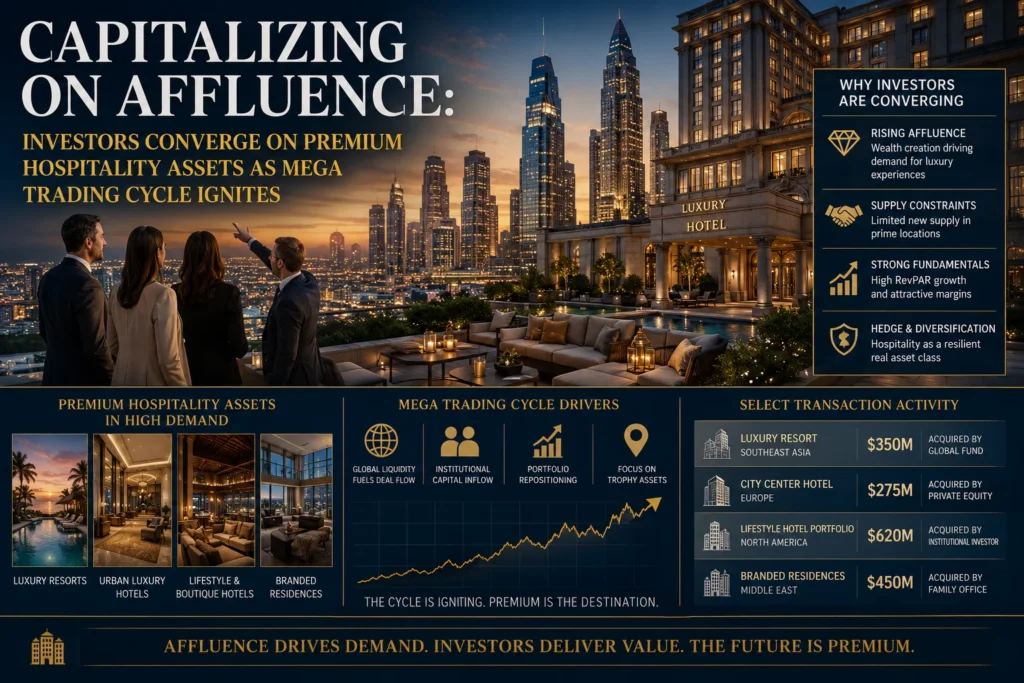
The luxury real estate landscape has hit a critical inflection point. According to the June 2026 U.S. Hotel Investment Market Update released by the global real estate services firm JLL, the high-end hospitality sector is entering an incredibly lucrative new investment cycle. This anticipated surge in transaction volume is powered by a unique convergence of robust operational data, record-shaping revenue metrics, highly disciplined supply growth, and rapidly stabilizing capital markets.
The institutional appetite for these ultra-high-end properties was further reinforced at the annual International Hospitality Investment Forum organized by New York University. Industry leaders and real estate economists at the summit expressed overwhelming conviction in the longevity of the upscale sector. They noted that a growing global wealth bifurcation—where high-net-worth consumer spending consistently outpaces broader economic indicators—is fueling an intense, structural demand for experience-driven travel and elite resort environments.
Record-Breaking Performance Metrics in Ultra-Luxury Lodging
The primary catalyst drawing institutional capital into premium hospitality assets is the staggering post-pandemic resilience displayed by the ultra-luxury lodging tier. Data compiled through April 2026 demonstrates that ultra-luxury hotels have substantially outperformed all other segments of the American hospitality industry.
Specifically, revenue per available room—a core industry metric commonly abbreviated as RevPAR—within the ultra-luxury subset surged to an exceptional 148% of its pre-pandemic baseline. To put this performance into perspective, this outpaced the broader luxury tier, which reached 133% of its historical baseline, as well as the overall domestic hospitality market recovery, which stabilized at 120%.
Focusing on a highly specialized control group of 47 elite properties featuring average daily rates exceeding $1,000, the data reveals an average RevPAR of $872 through the first four months of 2026. This record performance highlights an unyielding, price-inelastic demand curve driven entirely by affluent domestic and cross-border travelers.
The Structural Imbalance Driving Investment Upside
The financial allure of premium hospitality assets is heavily protected by severe supply constraints that act as natural barriers to entry. Over the past decade, global wealth creation grew at an impressive compound annual growth rate of 9.6%. Conversely, the physical construction of ultra-luxury hotel inventory expanded at a modest compound annual growth rate of just 2.3% during that exact same timeframe.
This widening mismatch between affluent consumers and available luxury keys represents an immense opportunity for real estate developers and institutional buyers. Building new landmark properties in prime metropolitan areas or exclusive coastal reserves has become increasingly challenging due to soaring material costs, strict zoning regulations, and a scarcity of premium land. Consequently, existing upscale properties have acquired a substantial premium, making the acquisition of operational trophy assets far more attractive than attempting new ground-up developments.
Institutional Capital and Private Equity on the Offense
As lending conditions improve and interest rate volatility settles, capital markets are aligning to fund massive transactions. A historical breakdown of luxury acquisitions since 2015 highlights a diverse and competitive pool of buyers targeting the space. Private equity firms have taken the lead, accounting for 29.6% of all high-end hotel transactions. Real estate investment trusts represent 24.8% of the buyer landscape, while large institutional investors comprise 11.1% of the completed deals.
Market analytics show that upscale lodging transactions historically move in high-velocity waves lasting between 18 and 36 months. Following a noticeable build-up of capital deployment in late 2025, the industry has formally opened its next active trading window.
This momentum is clearly reflected in the transactional figures from the first quarter of 2026, which saw premium hospitality investment activity skyrocket by 115% year-over-year. Several blockbuster single-asset deals anchored this first-quarter surge:
Florida & Wyoming Portfolios: A major institutional trade involved the combined sale of the 444-key Four Seasons Resort Orlando at Walt Disney World Resort and the Four Seasons Resort and Residences Jackson Hole for a staggering $1.1 billion.
Manhattan Landmark Acquisition: Highlighting the revival of prime urban luxury, Miami-based investment firm Gencom successfully finalized the acquisition of the iconic 253-key Ritz-Carlton New York, Central Park for $320 million.
These landmark transitions demonstrate that private equity is back on the offense, aggressively pursuing irreplaceable trophy assets that offer reliable cash flows and an effective hedge against inflation. With solid baseline fundamentals, growing international arrival numbers, and a clear absence of oversupply risk, the premium sector is exceptionally positioned to dominate the commercial real estate story throughout 2026, establishing a gold standard for international sports tourism and luxury hospitality infrastructure.
For more travel news like this, keep reading Global Travel Wire