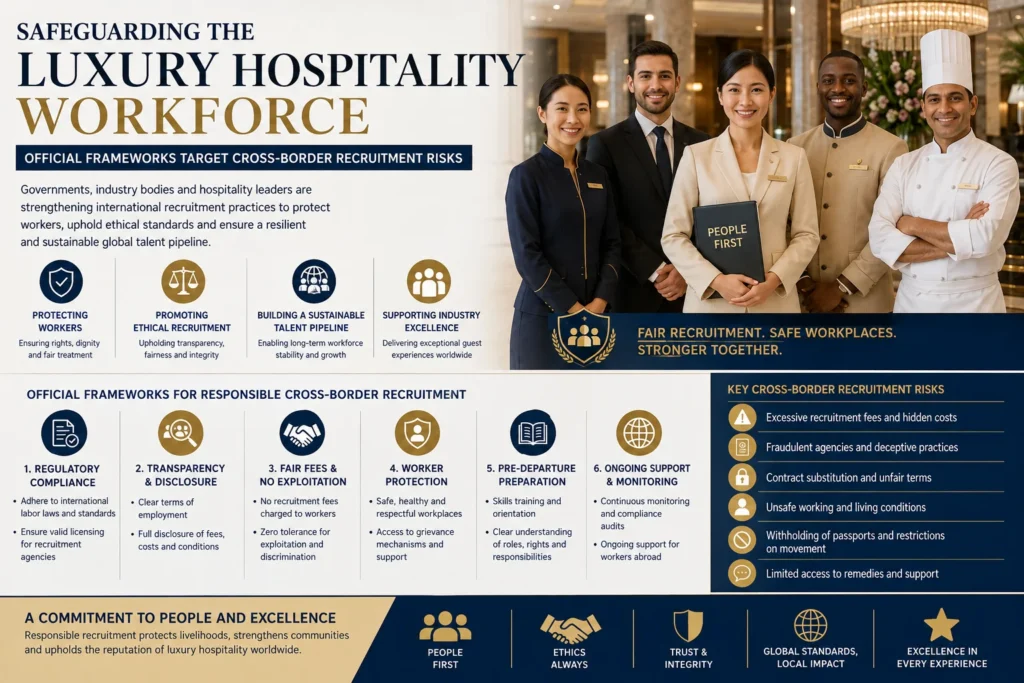
The luxury hospitality sector relies heavily on a global workforce to deliver high-quality guest experiences across rapidly growing tourism markets. Behind frontline operations—including concierges, food and beverage attendants, housekeeping teams, and wellness specialists—is an extensive international labour supply chain connecting origin countries with expanding resort and hotel destinations.
As resort development accelerates across the Middle East, Southeast Asia, and major island tourism destinations, international migrant workers have become essential to meeting operational staffing requirements. However, official evaluations from international labour bodies highlight that cross-border recruitment mechanisms present systemic supply chain risks that demand rigorous corporate governance, environmental, social, and governance (ESG) compliance, and operational transparency.
The Essential Role of Migrant Workers in Expanding Tourism Destinations
Rapid hotel construction and destination development across high-growth tourism hubs have created sustained demand for experienced hospitality personnel that often exceeds domestic labour supply. To maintain operational capacity, hotel owners, investors, and management groups recruit talent internationally from countries such as India, Nepal, Bangladesh, Sri Lanka, Indonesia, the Philippines, and Kenya.
While cross-border employment systems are lawful and vital for international tourism development, complex intermediary networks—including local recruitment agencies, brokers, and staffing subcontractors—can obscure operational visibility. Official frameworks established by the International Labour Organization (ILO) emphasize that human resource management in international hospitality must extend beyond standard procurement practices to incorporate comprehensive supply chain due diligence.
According to global guidelines published under the ILO Fair Recruitment Initiative, recruitment fees and related costs should never be charged to workers. When workers incur excessive placement fees or take on high-interest debt prior to departure, it creates financial vulnerability, increases risks of debt bondage, and exposes hospitality operators to legal and reputational vulnerabilities.
Addressing Supply Chain Vulnerabilities and Financial Risk
International labour standards explicitly define recruitment fees to include any costs incurred during the recruitment process to secure employment, regardless of where or when those costs occur. Despite expanding national regulations across origin and destination countries, enforcement gaps continue to allow unauthorized fee structures to persist within certain migration corridors.
In luxury hospitality, where brand value is inextricably linked to guest satisfaction and service quality, unmonitored recruitment practices create significant operational challenges. Workers who arrive at destination properties burdened by financial debt face elevated levels of personal stress, which can lead to higher employee turnover, reduced workforce stability, and compromised service delivery.
Furthermore, evolving international legislation regarding modern slavery prevention and mandatory human rights due diligence requires multi-property hotel groups to exercise oversight across their entire operational footprint. Institutional investors and travel buyers increasingly evaluate human capital management practices, making recruitment ethics a key factor in corporate ESG ratings and institutional capital allocation.
Adopting the Employer Pays Principle and Official Guidance
To mitigate supply chain risks and establish fair employment practices, civil aviation and tourism governing bodies, alongside international labour institutions, advocate for the systemic adoption of the Employer Pays Principle. Under this framework, lodging operators and employers assume full responsibility for all legitimate recruitment, visa, transportation, and administrative costs, ensuring that candidates enter employment free from financial debt.
Practical implementation tools developed by the International Organization for Migration (IOM), in collaboration with global sustainable tourism organizations, provide actionable benchmarks for hospitality executives. These guidelines encourage hotel operators to implement direct oversight mechanisms across several critical operational areas:
Agency Accreditation: Verifying that external recruitment agencies operate with official government certification and provide documented proof that no fees were charged to job candidates.
Contractual Transparency: Ensuring employment contracts are provided in the candidate’s primary language prior to departure, detailing accurate terms regarding wages, working hours, accommodations, and job duties.
Subcontractor Audits: Subjecting third-party staffing providers and outsourced labor agencies to the same rigorous compliance audits applied to direct hotel employees.
Accessible Grievance Mechanisms: Establishing confidential, multilingual reporting channels that allow staff members to raise workplace concerns without fear of retaliation.
Mobility Rights: Guaranteeing that international workers retain possession of their identity documents and can exercise freedom of movement in accordance with local labor laws.
Ethical Recruitment as a Core Competitive Advantage in Tourism
The global hospitality industry will continue to depend on international migrant labour to support expanding resort footprints and rising global travel volumes. Demographic shifts, infrastructure investments, and ambitious national tourism strategies make cross-border recruitment a permanent structural component of global tourism economics.
Forward-looking hospitality brands are transforming ethical recruitment from a basic compliance obligation into a strategic competitive advantage. By establishing direct visibility over workforce recruitment pipelines, hotel operators safeguard organizational resilience, improve employee retention, and enhance long-term brand equity.
As international regulators and conscientious travelers place greater emphasis on sustainable supply chains, the integrity of the frontline workforce journey is increasingly recognized as a foundational pillar of operational excellence in global luxury tourism.
For more travel news like this, keep reading Global Travel Wire