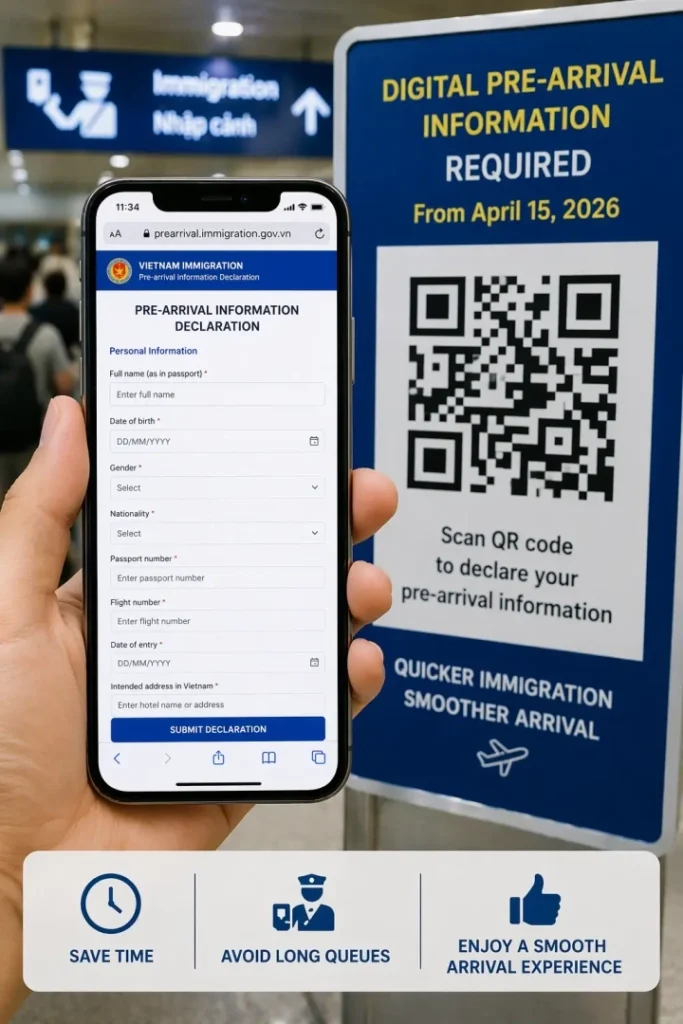
Vietnam is reshaping the international tourist arrival experience with a new digital pre-arrival information system that allows foreign visitors to submit entry details before reaching immigration, receive a QR code, and move through border procedures with greater speed and structure.
The shift marks an important step in Vietnam’s wider airport modernization strategy. Instead of relying only on paper-based declarations and manual checks at arrival counters, the system allows travellers to provide personal, visa and trip information online before entering the country. Once the declaration is completed, the platform generates a QR code that passengers can save on a phone or print for use at the immigration checkpoint.
The official notice from the Embassy of Viet Nam in India states that the Immigration Department under the Ministry of Public Security is piloting the Pre-arrival Information application for foreign nationals entering Viet Nam at Tan Son Nhat International Airport on a voluntary, non-mandatory basis. That makes the rollout a pilot rather than a nationwide compulsory replacement for all arrivals at every airport.
QR Immigration Processing Improves Airport Flow
For international tourists, the practical benefit is a smoother arrival process. By submitting information before reaching the counter, passengers can reduce the amount of data that must be checked manually after landing.
The official pre-arrival platform says submitting the declaration in advance helps reduce waiting time at the immigration area and supports a fast, smooth and regulation-compliant entry process. It also states that personal information is used for border control purposes and kept confidential.
This digital process can be especially useful at Tan Son Nhat International Airport in Ho Chi Minh City, one of Vietnam’s busiest gateways and a major entry point for tourists heading to southern Vietnam, business districts, Mekong Delta tours and beach destinations.
For travellers arriving after long-haul or regional flights, even a modest reduction in queue time can improve the first impression of the destination. Faster arrivals also help tour operators, airport transfer providers, hotels and ground transport services manage guest movement more efficiently.
What International Travellers Need to Know
The process is simple. Travellers access the official pre-arrival information platform, select a language, choose the declaration function, complete the required passenger, visa and travel details, and receive a QR code after submission.
Passengers are advised to save the QR code on their mobile phone or print it before arrival. Immigration officers can then use the code during entry procedures, helping connect the submitted information with the traveller’s passport and visa documents.
This system does not remove visa requirements. Travellers who need a visa, e-visa or other entry permission must still meet Vietnam’s regular entry conditions. Vietnam’s official e-visa portal states that the country’s e-visa can be issued for a maximum of 90 days, with single-entry or multiple-entry options, and that applicants must hold a valid passport and not fall under suspension-from-entry rules.
That distinction is important for tourists. The pre-arrival QR code supports immigration processing, but it is not the same as a visa approval.
Tourism Benefits From Digital Border Modernization
Vietnam’s tourism sector stands to benefit from faster and more predictable airport procedures. International arrivals are a critical part of the country’s visitor economy, supporting hotels, airlines, restaurants, guides, attractions, transport companies and local communities.
Digital entry systems can help destinations compete by making the arrival experience less stressful. When tourists face fewer delays at immigration, they can reach hotels faster, connect with tours more easily and begin spending in the destination sooner.
The change also supports airlines. Advance traveller information can improve coordination across airport processes, reduce congestion pressure during peak arrival waves and help passengers move more smoothly from aircraft to immigration halls.
For Vietnam, this matters because the country continues to attract strong interest from travellers seeking culture, cuisine, heritage cities, beaches and nature experiences. Hanoi, Ho Chi Minh City, Hoi An, Ha Long Bay, Da Nang and Phu Quoc all depend on efficient arrival systems to support growth.
Tan Son Nhat Becomes the Key Test Point
Tan Son Nhat International Airport is the focus of the official pilot. As Ho Chi Minh City’s main international gateway, it handles heavy visitor flows and often reflects the pressure points of Vietnam’s airport system.
The pilot allows authorities to test how digital declarations work in a real high-volume environment. It also gives immigration officers and airport operators a chance to assess passenger behaviour, system reliability and processing efficiency before wider changes are considered.
This phased approach is common in border modernization. Governments often begin with major airports, refine the platform, improve passenger communication and then expand once the system proves stable.
Travellers Must Use Official Channels
Vietnamese authorities have also warned travellers about fraudulent websites impersonating the official pre-arrival platform. The embassy notice advises passengers to use only the official Immigration Department platform to avoid scams and payment fraud.
That warning is important because digital border systems can attract fake portals. Tourists should verify entry procedures through official government or embassy channels before departure.
Vietnam Enters a Smarter Arrival Era
Vietnam’s digital pre-arrival system signals a clear shift toward faster, more structured and more traveller-friendly border processing. While the official rollout is currently described as a voluntary pilot at Tan Son Nhat International Airport, the QR-based process shows how Vietnam is modernizing the first stage of the tourist journey.
For international visitors, the message is clear: prepare entry information before landing, keep the QR code accessible and continue to check official requirements before travel.
As Vietnam strengthens its tourism infrastructure, digital arrival processing could become one of the most important tools for improving airport efficiency, visitor confidence and the overall travel experience.
For more travel news like this, keep reading Global Travel Wire