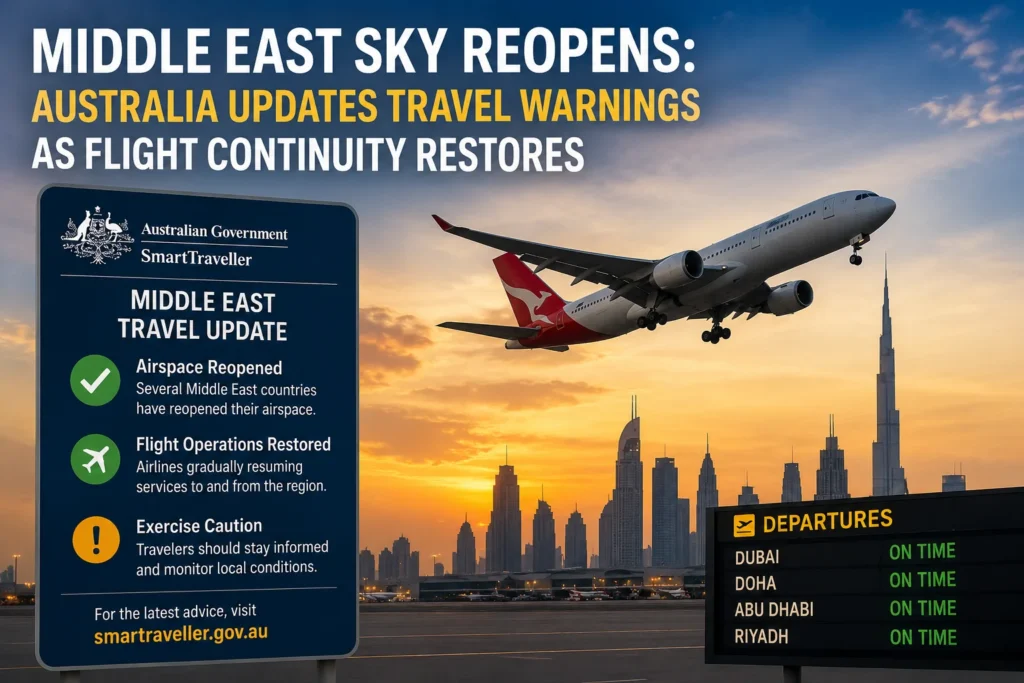
The landscape of global aviation is undergoing an immediate stabilization. In a significant shift following international diplomatic progress, the Australian Government Department of Foreign Affairs and Trade has officially updated its travel advisories for several key transit destinations in the Middle East. Security risk assessments for the United Arab Emirates, Qatar, Bahrain, Kuwait, and Israel have been downgraded from the highest “Do Not Travel” tier to the “Reconsider Your Need to Travel” advisory level.
For international passengers and the broader tourism sector, this administrative update successfully mitigates months of severe transcontinental travel chaos and systemic flight cancellations. The primary operational victory of this advisory change is the automatic restoration of standard travel insurance validity for itineraries routing through primary Gulf aviation gateways.
Restoring Insurance and Confidence to Global Aviation Hubs
The previous high-alert restrictions carried severe financial and operational penalties for the global travel industry. Under a “Do Not Travel” mandate, standard comprehensive travel insurance policies typically become null and void for anyone entering or transiting those zones. This forced millions of passengers to completely avoid the Middle East, leading to sudden, costly flight cancellations and leaving travelers financially exposed.
With the official downgrade to “Reconsider Your Need to Travel,” standard insurance frameworks are legally reactivated for transit hubs like Dubai International Airport and Hamad International Airport in Doha. Passengers can now book intercontinental journeys with full confidence that their policies will cover standard structural disruptions, missed connections, or localized delays.
This policy shift effectively relieves the intense pressure experienced by alternative Asian transit routes. Over the past several quarters, forced detours through hubs in Singapore and Hong Kong created secondary airport disruptions, severe baggage delays, and extended transit times by upwards of several hours per journey. The reopening of the Gulf corridors brings immediate structural relief to global flight scheduling networks.
Reclaiming Market Share: The Resurgence of Gulf Carriers
Official aviation statistics confirm that the major Gulf network carriers—Emirates, Qatar Airways, and Etihad Airways—traditionally handle more than half of all passenger traffic moving along the highly lucrative Europe-to-Australia travel corridor. The return to baseline operations allows these airlines to aggressively restore their normal flight capacities and re-establish the highly efficient, one-stop scheduling models that define their market dominance.
This return to scheduling regularity is further bolstered by a sharp correction in the global energy markets. According to official ministry statements and international energy data, Singapore jet fuel prices have stabilized dramatically, dropping to approximately $116 USD per barrel from a previous crisis peak of $242 USD per barrel. This massive reduction in operating overhead eliminates the immediate threat of cost-driven flight cancellations and heavy fuel surcharges, allowing carriers to offer more competitive pricing structures for the upcoming peak travel seasons.
Detailed Risk Assessment Adjustments
The table below outlines the structural shift in official flight parameters and operating conditions following the public announcements:
| Operational Metric | Previous Crisis Status | Updated Official Framework |
| Official Advisory Tier | Do Not Travel | Reconsider Your Need to Travel |
| Insurance Eligibility | Suspended / Voided | Fully Restored for Transit & Entry |
| Primary Hubs Reopened | Dubai, Doha, Manama, Kuwait City, Tel Aviv | Restored to Standard Route Scheduling |
| Singapore Jet Fuel Price | Peak of $242 USD / barrel | Stabilized at ~$116 USD / barrel |
| Alternative Routing Need | Mandatory diversion via Asian Hubs | Voluntary direct routing through Gulf |
Essential Planning Advice for International Travelers
While the downgrade represents a massive victory for global transit continuity, official tourism boards and government agencies advise passengers to maintain structured oversight of their upcoming itineraries.
Direct Insurance Verification: Always obtain explicit written confirmation from your specific insurance provider confirming that coverage is fully active for your exact transit points under the new advisory level.
Review Scheduling Options: Passengers currently booked on multi-stop, highly congested alternative routes through East Asia may consult their ticketing airlines to explore faster, optimized routing via the reopened Gulf networks.
Maintain App Alerts: Because a “Reconsider Your Need to Travel” status indicates lingering regional complexities, travelers must maintain active notification settings on official airline applications to catch any localized scheduling tweaks.
The updated stance from official authorities underscores how deeply the global travel ecosystem relies on the accessibility of Middle Eastern airspace. By aligning travel warnings with updated on-the-ground risk assessments, authorities have successfully dismantled an unsustainable global bottleneck, restoring reliability to international tourism and strength to global aviation infrastructure.
For more travel news like this, keep reading Global Travel Wire