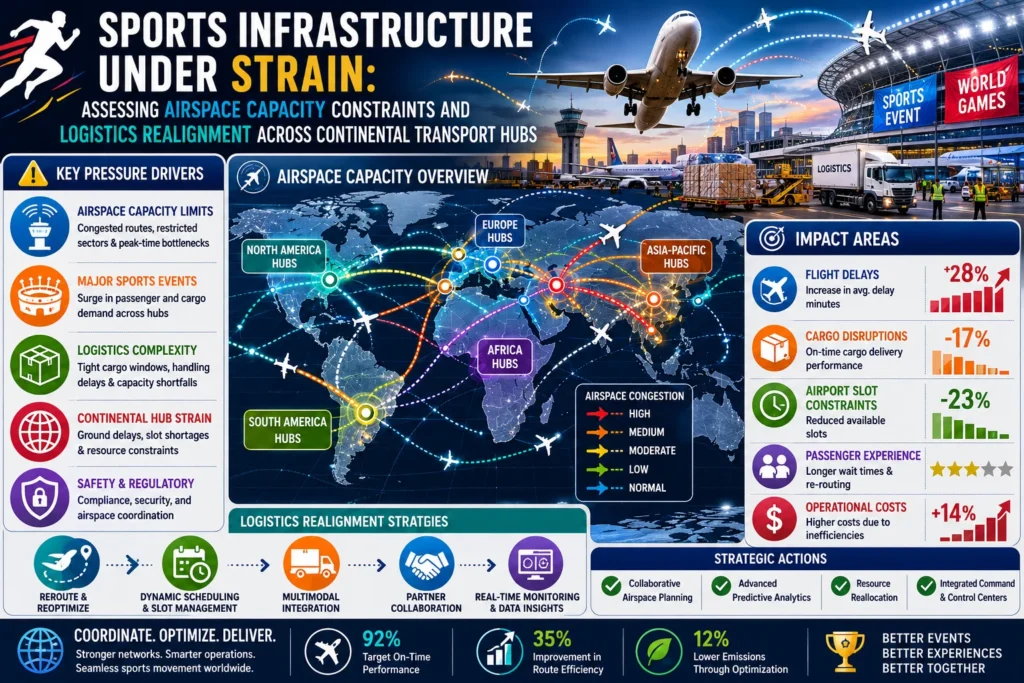
Coordinating international transit during continent-wide mega-events requires extensive logistical planning and a highly resilient civil aviation framework. As North American gateways absorb millions of incoming international visitors for the summer season, the strain on existing regional infrastructure has become a major point of discussion for aviation planners and tourism boards. Official data from national transit monitoring bodies reveals that a significant convergence of business travel and leisure demand has triggered widespread North American airport travel disruptions.
Primary connection hubs—including San Francisco, Chicago, and Toronto—are handling unprecedented passenger volumes. This heavy congestion has altered standard airline scheduling patterns and created localized routing bottlenecks. For global soccer fans, corporate hospitality groups, and standard vacationers navigating the continent, a clear understanding of these infrastructure pressure points is vital to keeping travel schedules predictable.
The Mathematical Imbalance: Surge Demand Versus Fixed Airspace Supply
According to formal capacity disclosures released by federal transit departments, the baseline challenge stems from a stark gap between projected passenger volume and actual scheduled airline seat supply. The summer tournament features an expanded structure with forty-eight national teams playing dozens of matches across multiple countries. Despite this major influx of global visitors, scheduled commercial airline seat capacity in the United States grew by just 0.6 percent compared to the previous year, while Canada recorded a modest 4.0 percent increase.
This limited expansion in capacity has created significant friction when combined with updated passenger booking trends:
Extended Stay Profiles: Travel board surveys indicate that approximately 65.0 percent of incoming international spectators have secured extensive itineraries lasting between six and twelve days, with average individual transit expenditures exceeding standard summer averages.
The Corporate Booking Surge: In major business and host cities like Toronto, corporate travel reservation volumes have climbed by 295 percent, driving an extraordinary 486 percent spike in localized corporate transit spend.
Fragmented Secondary Routing: Because direct flights into primary match destinations sold out months in advance, hundreds of thousands of international fans are building multi-segment itineraries through adjacent transit hubs, overwhelming regional networks.
The combination of fixed seat numbers, extended visitor stays, and heavy corporate spending has pushed several key airports past their ideal operational thresholds, leading to strategic schedule modifications and cascading gate delays.
A Tour of the Continental Chokepoints: Tracking the Traffic Flow
Operational data from terminal monitoring systems shows that the ongoing traffic challenges are impacting both host cities and non-hosting transfer hubs. San Francisco International Airport (SFO) is currently handling a major wave of inbound transpacific arrivals, with South Korea and Japan leading the inbound Asian travel sectors. Driven by heavy technology sector corporate investments, SFO terminal logistics are experiencing notable gate constraints, with average regional hotel rates tracking at higher-than-normal levels.
Meanwhile, Toronto Pearson International Airport (YYZ) has become an epicenter for high-yield corporate hospitality travel. This surge has lengthened booking windows to an average of 119 days in advance, effectively filling the available premium and standard commercial capacity.
The pressure is also heavily affecting cities that are not hosting specific matches. Chicago O’Hare International Airport (ORD) has seen a massive influx of transatlantic transit traffic, functioning as a primary entry point for European markets, which account for nearly twenty percent of inbound international fans. Because direct flights into adjacent Midwestern destinations are completely full, Chicago ORD is absorbing large numbers of connecting passengers, which extends aircraft turnaround times. Similarly, Montreal-Trudeau International Airport (YUL) is dealing with heavy spillover traffic from fully saturated East Coast gateways, turning the Quebec hub into a highly volatile corridor for connecting flights.
Even destinations like Las Vegas are experiencing a notable shadow effect. Total hotel and flight bookings at Harry Reid International Airport (LAS) have jumped by 163 percent, with Saturday night stayovers increasing to 52 percent as international spectators establish base camps in Nevada before traveling to matches across the Southwest.
Official Procedural Recommendations for Travelers Facing Transit Delays
Federal departments of transportation and airline customer care divisions are actively working to balance flight schedules and optimize ground-handling operations. To minimize personal disruption and maintain trip reliability during periods of high-volume infrastructure strain, aviation authorities recommend several practical safety and planning steps:
Avoid Saturated Connection Hubs: When organizing domestic or transcontinental routes, avoid booking short layovers through highly congested transfer hubs like Chicago O’Hare or Montreal-Trudeau. Instead, select alternative regional gateways to reduce your risk of missing connections.
Secure Accommodations via Digital Portals Early: Because heavy corporate demand has significantly reduced hotel availability in primary transit cities, travelers should verify and secure confirmed accommodations well before heading to the departure terminal.
Enable Real-Time Mobile Alerts: Download your airline’s official mobile application and turn on automated push notifications. Digital passenger platforms process gate shifts, equipment swaps, and rebooking options much faster than physical airport terminal display boards.
Arrive Early for Terminal Processing: Given the high passenger volume passing through international security checkpoints, give yourself extra time for baggage check-in and screening to ensure a smooth path to your gate.
As North American transport infrastructure adapts to the unique demands of continent-wide sporting events throughout the summer season, staying adaptable and relying on verified public information are essential. By tracking official travel updates and avoiding known transit bottlenecks, modern tourists can easily navigate complex networks and reach their final destinations safely.
For more travel news like this, keep reading Global Travel Wire