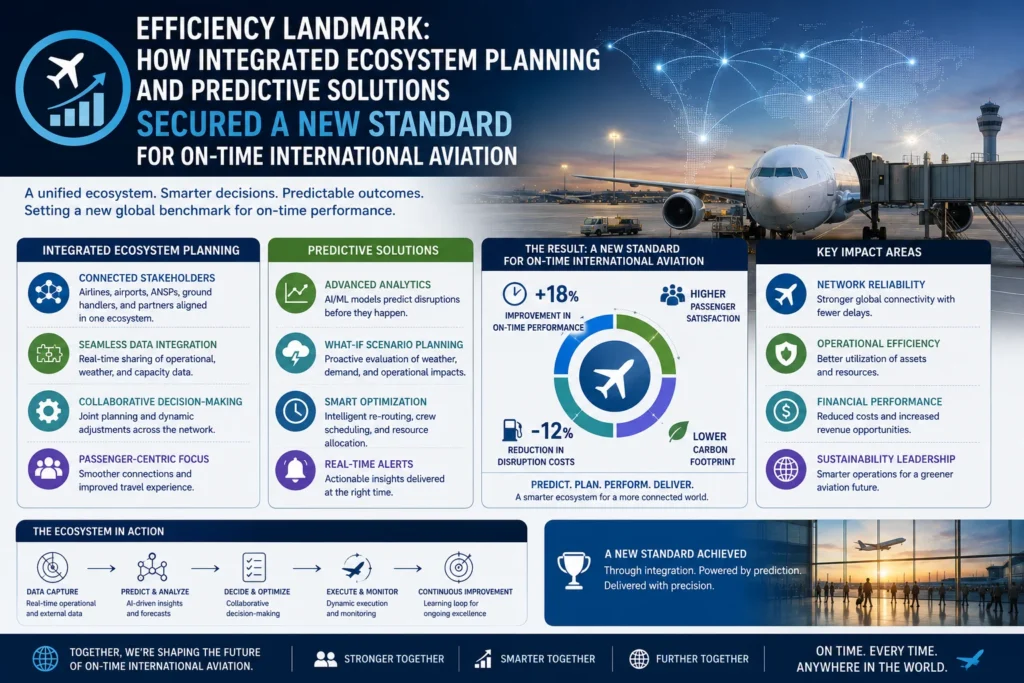
Coordinating multi-continental flight routes requires extreme structural precision, particularly during heavy seasonal transit windows when global networks routinely experience unexpected scheduling bottlenecks. As international tourism experiences high volume across primary corridors, choosing a highly dependable carrier is vital to maintaining smooth vacation timelines. According to official administrative announcements from the General Authority of Civil Defense and the national flag carrier of Saudi Arabia, Saudia has secured the first-place global ranking for comprehensive on-time performance across both its departures and arrivals.
By pairing advanced mathematical predictive modeling with integrated ground operations, the carrier managed to outpace international competitors during an exceptionally demanding operational period. For global vacationers, intercontinental business travelers, and pilgrims traveling across multiple hemispheres, these verified metrics represent a notable shift in how major airlines can insulate passenger schedules from systemic flight cancellations and terminal delays.
Statistical Review of the Record-Breaking Performance Matrix
According to official aviation analytics indices and public ministerial statements released in June 2026, Saudia achieved an on-time departure rate of 92.30 percent throughout the peak tracking month of May 2026. Simultaneously, the carrier maintained a 90.12 percent on-time arrival rate, meeting the strict global criteria that require aircraft to arrive at their designated airport gates within fifteen minutes of the published schedule.
Verified operational data from the national registry details the full scope of the network’s logistics framework:
Total Monthly Volume: The airline successfully completed exactly 13,669 flights across its entire international blueprint, safely carrying hundreds of thousands of international visitors.
Global Connectivity Footprint: The scheduling matrix covered a diverse network of more than 100 destinations distributed across four continents, linking major tourism centers with regional economic hubs.
Peak Operational Strain: This top global position was achieved during the highly demanding arrival phase of the 2026 Hajj pilgrimage season and the concentrated Eid Al-Adha holiday travel surge.
Regional Infrastructure Synergy: Supporting this performance, Riyadh’s King Khalid International Airport also ranked as one of the top three most punctual mega-hubs globally, securing a 91.85 percent on-time departure rate across 19,294 tracked aircraft movements.
These official performance markers show how a well-coordinated regional transportation network can maintain schedule integrity, providing passengers with an effective bypass to the transit gridlock often found in less optimized global hubs.
Deploying Artificial Intelligence for Proactive Operational Readiness
The core mechanism behind achieving a 92.30 percent departure rate involves moving away from traditional reactive dispatch methods. The Ministry of Transport and Logistic Services highlighted that the carrier has heavily integrated artificial intelligence across its centralized 24-hour operations center. This system continuously cross-references real-time data feeds, including global meteorological patterns, airspace capacity constraints, and technical aircraft statuses.
By using predictive data models, flight planners can identify potential ground constraints up to twelve hours before an aircraft departs. The automated software enables proactive decision-making, allowing maintenance teams to complete scheduled inspections and ground handlers to optimize gate assignments before delays can cascade across multi-leg flight paths.
Additionally, this digital setup optimizes crew rotation management. Since flight crews are subject to strict legal limits on duty hours, the AI platform automatically plans reserve schedules. If an aircraft experiences a brief localized hold, the system quickly adjusts crew assignments, preventing secondary flight cancellations due to crew exhaustion or expired duty limits.
Aligning National Aviation Strategies with Global Tourism Goals
This operational milestone is a key part of the broader Saudi Aviation Strategy, which is designed to transform the country into a primary international connector and a leading global aviation hub. By embedding a strict culture of punctuality across all business units, the national carrier is actively supporting the state’s long-term economic diversification goals, which aim to attract millions of leisure and cultural tourists annually.
When a major hub airport runs with high punctuality, the benefits reach every corner of the regional tourism industry. On-time arrivals ensure that incoming travelers can clear passport control and customs efficiently, reducing terminal overcrowding and ensuring seamless connections to domestic destinations like AlUla, the Red Sea resorts, and Jeddah. Furthermore, it protects the logistics of the hospitality sector, allowing local car rental services, tour operators, and hotels to manage their guest check-ins with precision.
Practical Steps for Maximizing Travel Reliability
While airline technological upgrades provide a strong layer of schedule protection, strategic passenger planning remains essential for an optimal travel experience. International aviation boards and tourism ministries recommend several actionable steps for navigating high-volume transit periods:
Prioritize Punctual Transit Corridors: When arranging multi-continent journeys between Europe, Asia, and Africa, intentionally select routes utilizing highly ranked regional hubs that demonstrate proven on-time performance to avoid connection risks.
Leverage Digital Self-Service Platforms: Download the official carrier application at least twenty-four hours before your departure slot. These mobile platforms provide real-time automated updates regarding gate allocations and boarding times ahead of physical airport monitors.
Register for Voluntary Tracking Programs: Ensure all contact fields, mobile numbers, and email alerts are active within your booking profile to ensure immediate access to automated delay assistance or itinerary alerts.
Ensure Proper Documentation Readiness: Given the high passenger volume passing through major international gateways, keep your visas, health declarations, and entry permits neatly organized in your carry-on baggage to ensure quick processing at customs checkpoints.
As global transport infrastructure continues to adapt to increasing travel demands throughout 2026, the combination of advanced predictive artificial intelligence and deep ecosystem coordination is redefining standard industry expectations. By monitoring verified public updates and choosing highly reliable transport networks, modern travelers can easily bypass international transit bottlenecks and confidently reach their destinations.
For more travel news like this, keep reading Global Travel Wire