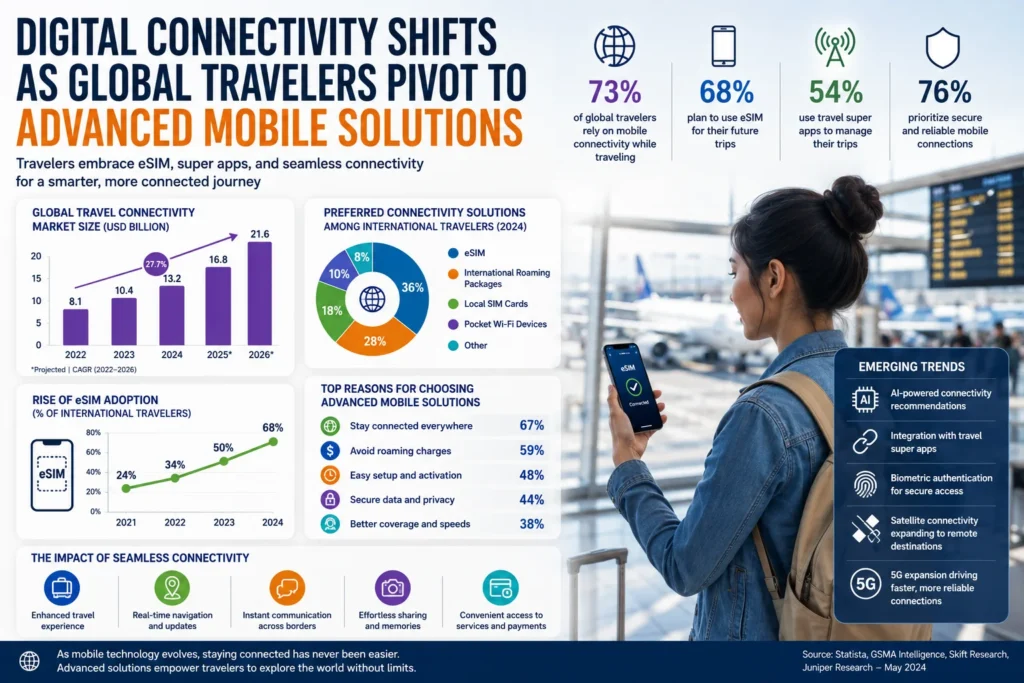
The infrastructure of international travel is undergoing a rapid technological evolution as traditional, physical telecommunications give way to flexible digital alternatives. Official reports from global transportation ministries and international tourism boards highlight a significant trend: modern vacationers and corporate commuters are increasingly prioritizing seamless, instantaneous connectivity before they even touch down at their destinations. Relying on international roaming packages or searching for local physical SIM cards at airport kiosks is fast becoming an outdated approach to securing international mobile data.
According to global tourism data, over 70 percent of contemporary travel logistics—including on-demand ride-hailing services, digital room check-ins, and live navigation mapping—depend entirely on immediate cellular network access upon arrival. To address this demand, the widespread adoption of electronic SIM technology, commonly known as the eSIM, has emerged as a critical element of modern travel preparation, transforming how global citizens maintain network security across international borders.
Comprehensive Global Coverage via Consolidated Network Profiles
A primary challenge for multi-destination itineraries has historically been the localized fragmentation of cellular networks. Digital travel data indicates that advanced eSIM platforms now bypass this limitation by consolidating hundreds of international networks into a singular, downloadable digital profile. This architecture allows a traveler to maintain consistent data access across more than 200 countries and territories without the need to physically swap hardware or repeatedly reconfigure device settings when crossing borders.
Modern telecommunications frameworks increasingly utilize advanced automatic network selection technology. This system automatically evaluates local carrier strength and seamlessly transitions the user’s device to the highest-performing cellular provider available in that specific region. This continuous, background optimization ensures that travelers moving through high-density urban zones or remote coastal corridors experience minimal service interruptions.
On-Demand Data Activation and Flexible Usage Frameworks
Statistical analysis from consumer tourism bureaus reveals that rigid, pre-paid data packages frequently lead to financial inefficiencies, forcing travelers to either overestimate their data needs or exhaust their limits prematurely. Innovative digital data solutions are addressing this mismatch by introducing highly responsive, usage-driven frameworks.
To illustrate the diverse billing structures now available in the global travel marketplace, the following parameters define contemporary mobile data options:
Standard Volume Packages: Allocations ranging from 1GB to 30GB, optimized for predictable, short-term vacation durations.
Active-Usage Billing: Frameworks that charge the user exclusively when the device actively transmits data over a local cellular network, suspending the countdown while connected to municipal or hotel Wi-Fi.
Data Rollover Windows: Multi-day packages featuring extended structural lifetimes, allowing unused data balances to carry forward into subsequent calendar periods.
Pay-As-You-Go Models: Metered data options tailored for spontaneous, cross-border commuters who require flexible, non-binding connectivity.
Trial Allocations: Micro-packages designed to let travelers verify local network compatibility and signal latency before committing to larger financial plans.
Integrated Virtual Messaging Access and Device Tethering
Official tourism commerce updates show that international travelers frequently require local contact channels to access regional digital services, such as localized food delivery apps or transport platforms. Modern digital data applications resolve this by embedding secondary virtual phone numbers directly into the connectivity application. While these specialized lines are configured as data-only profiles that do not support traditional analog voice calls, they provide a reliable, secure pathway for receiving automated SMS verification codes and registering for regional digital accounts.
Furthermore, operational flexibility is heavily enhanced by unrestricted hotspot tethering capabilities. Unlike traditional cellular roaming plans that often block or heavily penalize device sharing, contemporary digital data profiles permit users to distribute their cellular connection across multiple personal devices, such as laptops and tablets, at no additional operational cost. This capability is highly valuable for remote professionals managing corporate obligations from transit lounges or rural destinations.
Navigating Network Quality Factors and Structural Limits
While digital connectivity platforms provide unparalleled convenience, global transport advisory bodies remind travelers to carefully review the specific operational terms of their data profiles. For instance, certain high-volume or unlimited data structures are subject to localized network management policies, meaning that exceeding specific daily usage thresholds can trigger temporary data speed drops to manage local bandwidth constraints.
Additionally, because these modern profiles focus exclusively on digital data transmission, travelers must rely on web-based communication applications to make voice calls. Prospective users must also ensure their smartphones are carrier-unlocked by their primary domestic provider before attempting to download an international data profile. By planning ahead and selecting the appropriate data tier, international travelers can bypass traditional transit bottlenecks and experience completely integrated global mobility.
For more travel news like this, keep reading Global Travel Wire