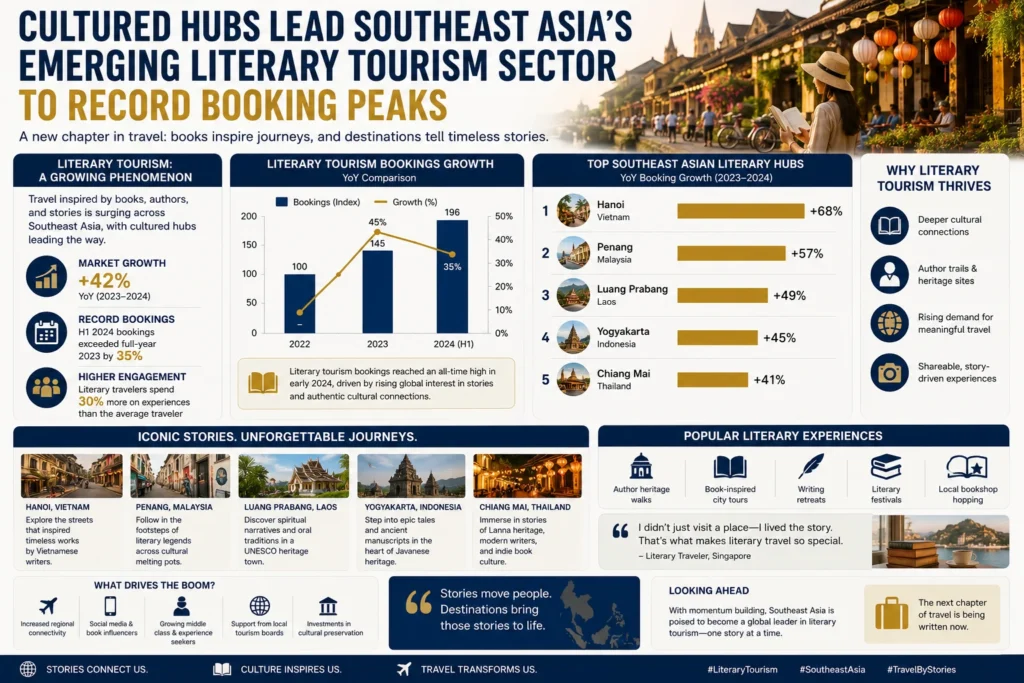
The international visitor economy across Southeast Asia is tracking a distinct shift in consumer preferences as travelers increasingly favor deep educational engagement over conventional beach resorts or standardized sightseeing tours. Official arrivals metrics and seasonal reservation indexes released by regional tourism ministries reveal an unprecedented surge in bookings for urban centers that showcase preserved historical archives, specialized reading spaces, and community-led heritage museums. This movement, broadly categorized under regional cultural development frameworks as literary tourism, has seen a dramatic rise in demand throughout June 2026, establishing a fresh model for sustainable leisure travel.
Statistical briefs published by the municipal planning departments of Hanoi, Ho Chi Minh City, Luang Prabang, and Chiang Mai confirm that this vacation pattern is driving extended lengths of stay and higher per-capita spending within historic quarters. By focusing public and private development resources on the conservation of text-based heritage and civic reading networks, these municipalities have successfully attracted a high-value demographic of independent travelers. This demographic prioritizes architectural history, national resilience narratives, and localized educational outreach over traditional sun-and-sea tourism packages.
Architectural Revitalization Drives Engagement at Historical Libraries and Community Curation Spaces
The National Library of Vietnam in Hanoi serves as a prime example of this infrastructural transformation. Originally established under a 1917 decree as the Central Public Library of Indochina, the institution underwent successive name changes through the mid-twentieth century, including a period as the Pierre Pasquier Library, before being officially redesignated as the national depository. Today, the Ministry of Culture, Sports and Tourism has integrated the striking colonial-era facility directly into the capital’s curated heritage trails, allowing international visitors to study the nation’s history through preserved rare Sino-Nom texts and extensive archival collections.
Official records from Hanoi’s library division highlight a long-term commitment to public literary access that dates back to the post-colonial reconstruction era. From an initial baseline of a single public repository holding roughly 90,000 volumes, the capital’s structural expansion has resulted in a network exceeding 1,000 libraries and reading rooms collectively housing over 600,000 volumes. This widespread infrastructure ensures that international travelers exploring the city encounter a highly literate, active reading culture, with municipal facilities serving as vibrant cultural hubs rather than static tourist displays.
Inclusive Access Models Integrate Social Responsibility Into the Visitor Economy
Further south, Ho Chi Minh City has successfully deployed an operational model that bridges international visitor interest with local social equity projects. The General Science Library of Ho Chi Minh City has introduced dedicated accessible reading zones equipped with specialized assistive technologies, enabling visually impaired residents and international researchers to access archived collections independently. Additionally, state-supported mobile library initiatives routinely deliver educational materials to remote regional schools, directly demonstrating how tourism revenue can support domestic educational equity.
The integration of private-sector cultural firms has further expanded the city’s literary infrastructure, with initiatives like the Phuong Nam Culture Company establishing a network of large-scale book cafes that serve as civic conversation spaces. These facilities regularly host structured panels, bilateral cultural exchanges, and bilingual book launches that invite international tourists to interact directly with local authors and translators. These localized gatherings are often supported by foreign diplomatic delegations, such as recent material donations from the Australian Consulate, which systematically enrich the region’s cross-border educational value.
Innovative Outreach Projects Connect International Leisure Travelers With Regional Literacy Initiatives
In the UNESCO World Heritage town of Luang Prabang, the local public library authority has developed one of the most innovative community outreach programs in the Mekong region. The Luang Prabang Public Library operates dedicated library boats that navigate the waterways of the Mekong River to provide essential books, primary learning aids, and instructional materials to more than 75 isolated riverside villages. This mobile infrastructure ensures that children residing in areas lacking standard road access receive consistent educational support.
International educational delegations visiting Laos emphasize that the long-term viability of the regional visitor economy is deeply tied to the social and intellectual advancement of local youth. By allowing culturally conscious travelers to observe, learn from, and directly support these river-based literacy networks, Luang Prabang has elevated its status from a passive historic destination to an active center for global humanitarian exchange. This approach demonstrates that sustainable heritage tourism operates at its highest potential when it actively strengthens the host community’s educational baseline.
Strategic Municipal Infrastructure Development Yields High Value Sustainable Cultural Tourism
In Northern Thailand, the Chiang Mai City Municipality has focused its preservation strategies on distinct regional identities through the development of the Chiang Mai City Heritage Centre. A key anchor of this complex is the Lanna Folklife Museum, located inside a white, colonial-style structure that once belonged to the historic eighth ruler of Chiang Mai, Chao Intavaroros Suriyavongse, and later functioned as the Provincial Courthouse from 1935 onward. Following a comprehensive structural restoration by the Department of Treasury and the Court of Justice, the venue reopened as an ethnographic museum dedicated to preserving the cultural traditions of Northern Thailand.
Officially inaugurated with royal support from Princess Maha Chakri Sirindhorn, the museum features 18 distinct permanent exhibitions showcasing Lanna Buddhist art, traditional costumes, agricultural basketry, and historic palm-leaf manuscripts used for recording ancient regional knowledge. The institution was explicitly designed to encourage international tourists to lengthen their stay profiles in Chiang Mai, directly supporting the local hospitality ecosystem while promoting an accurate, nuanced understanding of regional indigenous history.
As Southeast Asian tourism authorities look toward the second half of 2026, the sustained popularity of these literary and educational hubs indicates a permanent evolution in global travel preferences. By investing consistently in public library infrastructure, protecting sensitive historical archives, and creating spaces for deep intellectual exchange, these cities have created a resilient tourism blueprint. This framework ensures that international travel spending directly protects regional history, expands local literacy, and fosters meaningful global connections.
For more travel news like this, keep reading Global Travel Wire