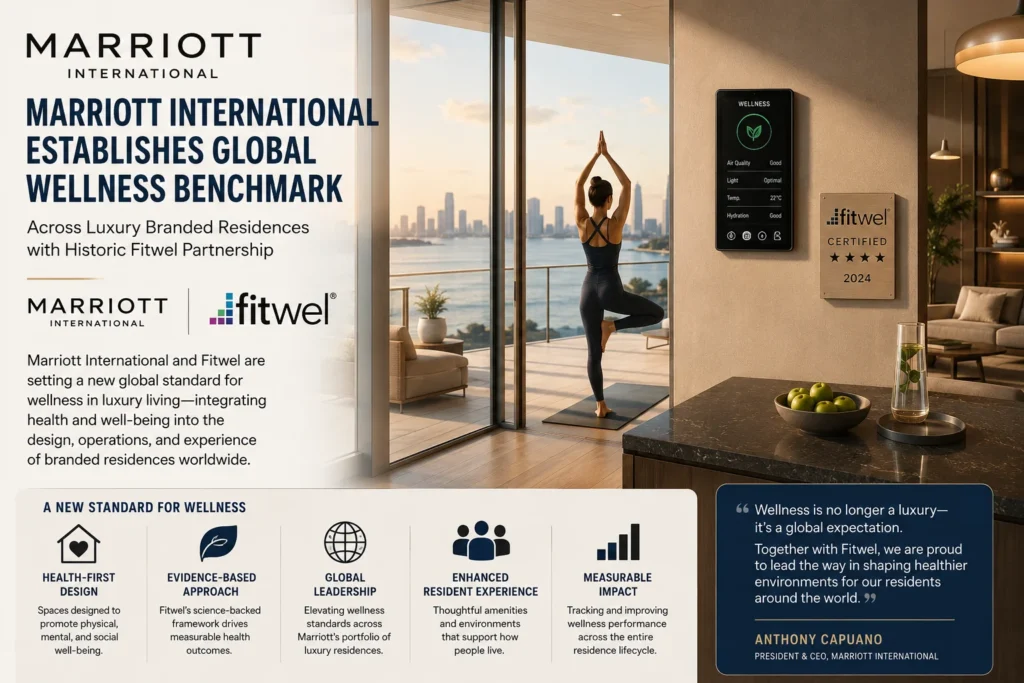
The global real estate and premium hospitality sectors are witnessing a major structural alignment as health-focused design integrates into long-term property operations. Marriott International has finalized a comprehensive, portfolio-wide agreement with Fitwel, a leading healthy building certification system originally developed by the U.S. Centers for Disease Control and Prevention and the U.S. General Services Administration. This strategic arrangement represents Fitwel’s inaugural enterprise partnership within the hospitality industry and designates Marriott as its first Champion+ company, a status reserved for entities that implement evidence-based wellness strategies across extensive real estate portfolios to positively affect resident health and long-term asset value.
Official residential statistics indicate that Marriott’s global branded residences portfolio currently encompasses 153 operational properties, alongside an expansive pipeline of 183 projects in various stages of development. The newly signed portfolio-wide framework is structured to transcend individual property certifications, applying uniform, globally recognized healthy building criteria across the company’s entire residential network. The operational strategy aims to directly address evolving consumer demands by embedding physical and mental well-being solutions directly into the architectural layout, ventilation standards, and community programming of high-end managed properties.
Scaling Certified Wellness Features from Successful Regional Pilots
The formalized expansion follows the successful execution of an initial pilot program at The Ritz-Carlton Residences Chicago, Magnificent Mile. The metropolitan residential property secured a verified two-star Fitwel Certification after demonstrating compliance with strict healthy environment protocols. Notable features contributing to the site’s performance metric include an active fruit and vegetable rooftop garden dedicated to resident use, a specialized fitness center configured with advanced steam and sauna rooms, and targeted improvements in indoor environmental and air quality.
Under the provisions of the new enterprise agreement, Marriott plans to systematically deploy these verified health metrics across additional urban and resort locations globally. Executive leadership from the Center for Active Design and Active Design Advisors, which oversees the implementation of the Fitwel system, noted that the initiative reflects a broader transformation in how global real estate operates. Rather than treating health and fitness installations as isolated, optional amenities, the framework positions environmental wellness as a foundational business strategy designed to optimize occupant satisfaction, workplace performance for staff, and building resilience.
Highlighting Wellness Innovations and Distinctive Properties Worldwide
As the portfolio-wide certification process advances, several flagship developments within the luxury branded residences segment are already demonstrating advanced integration of environmental and lifestyle wellness solutions:
W Residences Dubai – The Palm: This coastal residential property features integrated solar panel arrays alongside exclusive recreational facilities, including a newly introduced cold plunge pool and dedicated tennis courts.
The Ritz-Carlton Residences, Muskoka: Currently under construction, this standalone wilderness development is planned to incorporate an on-site greenhouse, localized outdoor fitness trails, dedicated archery ranges, and multi-sport courts for pickleball, basketball, and tennis.
The St. Regis Residences, Bangkok and The Residences at The St. Regis Marsa Arabia Island: Both high-end international properties have integrated specialized Longevity Hubs by Clinique La Prairie, granting residents direct access to preventative health, aesthetic, and longevity science programs.
These localized operational features illustrate the varied ways the certified healthy building standard manifests across different geographic terrains, matching regional tourism and residential preferences with verifiable health criteria.
Institutional Roots of the Healthy Building Movement
The Fitwel certification framework remains a prominent global benchmark for real estate entities aiming to enhance the occupational safety and health dynamics of their structures. By assessing factors such as natural lighting, non-toxic material sourcing, pedestrian connectivity, and spatial design that encourages physical movement, the certification provides public transparency regarding a building’s impact on its occupants.
Marriott’s alignment with this metric extends beyond its residential pipeline. The hospitality company previously achieved a top-tier three-star Fitwel certification for its global corporate headquarters facility in Bethesda, Maryland, which officially opened its doors in 2022. By shifting these institutional standards into the consumer residential sphere, the brand is attempting to establish a standardized, transparent metric for healthier living spaces that appeals directly to global purchasers and long-term travel enthusiasts seeking wellness-driven accommodations.
Practical Advice for Property Buyers Seeking Wellness Environments
As real estate markets increasingly prioritize verifiable health credentials, prospective owners and premium travelers looking to invest in luxury branded residences should evaluate specific structural and operational markers:
Verify Independent Certifications: Look for recognized third-party validations, such as Fitwel or equivalent building health certifications, which guarantee that indoor air filtration, lighting, and fitness provisions meet rigorous public health research standards.
Assess Active Infrastructure: Prioritize properties that offer structural infrastructure supporting sustainable and active lifestyle choices, such as operational rooftop gardens, dedicated walking paths, and advanced thermal recovery facilities like cold plunges.
Evaluate Integrated Wellness Services: Inquire about long-term partnerships with established health and longevity organizations, ensuring that on-site wellness programs are backed by recognized scientific practices.
Examine Community and Environmental Impact: Choose developments that combine personal well-being with environmental responsibility, utilizing renewable energy features like solar installations to ensure long-term operational sustainability.
With multiple properties expected to secure formalized healthy building credentials before the conclusion of the current calendar year, the implementation of this corporate agreement marks a definitive shift in the design of high-end residential real estate. By merging hospitality management with strict public health design parameters, the initiative provides a structured roadmap for the future of health-conscious community development.
For more travel news like this, keep reading Global Travel Wire