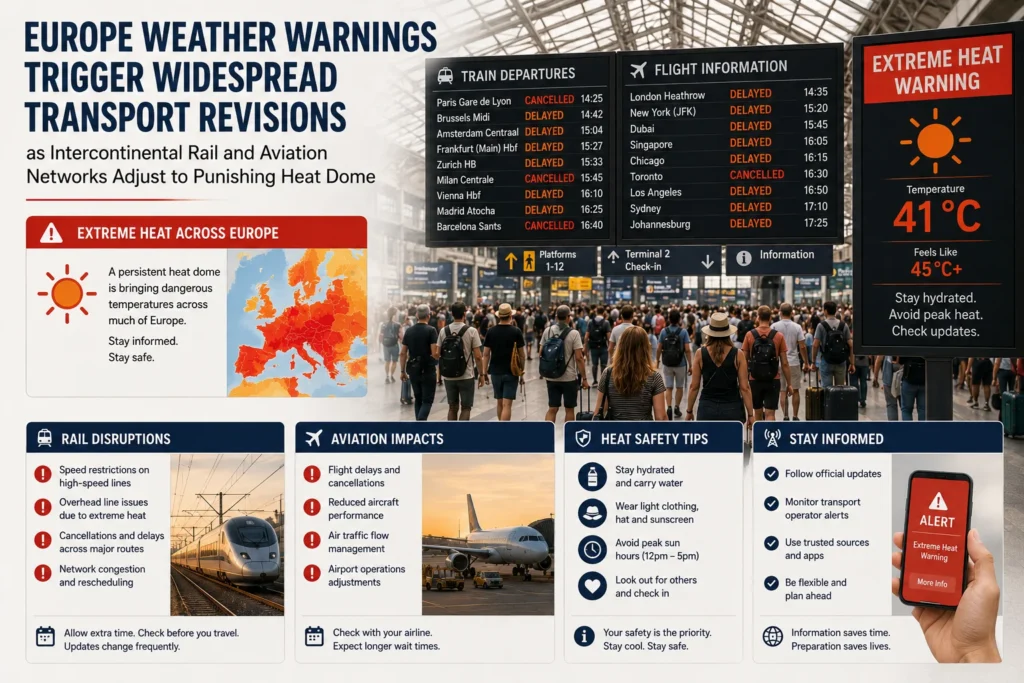
A powerful, high-pressure atmospheric system drawing scorching air masses northward has placed continental Europe’s primary transport corridors under exceptional operational stress. National civil protection ministries and meteorological services across France, Spain, Italy, Germany, and the United Kingdom have simultaneously activated their highest-level red emergency alerts. The extreme weather pattern is causing substantial thermal expansion across major rail networks and requiring strategic weight adjustments for regional aviation, prompting international tourism boards to issue protective guidance for summer travelers.
Official meteorological data indicates that the ongoing climate event is breaking historical thresholds across multiple jurisdictions. In France, the national weather provider Météo-France expanded its red heatwave vigilance status to cover 54 administrative departments, reporting that national average temperatures have reached unprecedented territory. Local observation stations in central and southwestern France documented daytime highs peaking at 43.3 degrees Celsius, coupled with the warmest overnight minimum temperatures recorded since official record-keeping began in 1947.
Thermal Expansion Prompts Rail Speed Restrictions and Intercity Deferrals
The combination of intense solar radiation and high passenger volume has introduced structural challenges to European rail infrastructure. Steel tracks exposed to sustained direct sunlight absorb heat far exceeding ambient air levels, creating a documented risk of rail deformation or track buckling. To preserve passenger safety and protect network integrity, national railway operators have enacted defensive operational postures. The French national railway network, SNCF, deployed thousands of specialized maintenance workers to conduct continuous thermal monitoring along exposed tracks, resulting in the proactive cancellation of 71 intercity trains on high-density routes.
Similar infrastructure precautions are adjusting transit frameworks in surrounding nations. The United Kingdom Meteorological Office issued rare red extreme heat warnings for central and southern England, prompting regional rail operators to implement mandatory speed limits across key corridors out of London to reduce friction-induced stress on heat-stressed tracks. Transport ministries in Belgium, Germany, and Switzerland have issued parallel advisories, warning cross-border commuters and international tourists that standard timetables are subject to rolling delays and capacity constraints as regional networks absorb the cascading effects of the heatwave.
Aviation Handling Revisions and Air Quality Monitoring at Major Hubs
The intense atmospheric pressure and elevated ground temperatures are also introducing operational complexities within the aviation sector. High ambient temperatures reduce air density, directly affecting aircraft aerodynamic lift and necessitating meticulous calculations regarding allowable fuel loads, baggage capacity, and maximum takeoff weights. Consequently, major airports in Southern and Central Europe have introduced temporary aircraft handling constraints during peak afternoon thermal windows.
Ground crew schedules are being managed strictly to safeguard airport personnel from heat exhaustion while working on exposed asphalt tarmac. These safety protocols have lengthened aircraft turnaround times, causing moderate schedule revisions for international flights transiting through primary European gateways. Additionally, regional air quality monitoring agencies in metropolitan zones like Paris have noted that the persistent high-pressure system has accelerated the accumulation of ground-level ozone, prompting municipal authorities to encourage remote work arrangements to minimize peak-hour transit station congestion.
Health Ministries Coordinate Emergency Relief and Water Safety Mandates
State health departments are treating the current heat wave as a primary public safety priority, coordinating extensive emergency frameworks to assist both residents and seasonal visitors. In Italy, the Ministry of Health placed 15 major urban centers, including primary cultural tourism destinations like Rome, Milan, and Florence, under emergency red alert status. The ministry’s official safety protocols direct individuals to avoid outdoor sightseeing between 11:00 AM and 5:00 PM, secure air-conditioned accommodations, and utilize municipal cooling centers.
Interior ministries are also addressing critical safety challenges associated with unauthorized open-water swimming. The French government convened a ministerial crisis meeting following reports that 40 individuals had drowned within a five-day period while attempting to cool off in unpatrolled rivers, lakes, and coastal areas. Civil protection agencies across Germany and Spain have intensified public safety broadcasts, warning that sudden immersion in cold natural water during extreme atmospheric heat can trigger severe cardiovascular shock. Furthermore, regional judicial authorities have reinforced strict warnings against leaving individuals or young children unattended in parked vehicles, where cabin temperatures can reach fatal levels in minutes.
Structural Adaptations Within the Hospitality and Cultural Sector
The broader European hospitality and tourism ecosystem is actively restructuring daily functions to prioritize visitor well-being. Educational ministries across France authorized the temporary closure of 1,350 schools and adjusted regional examination spaces due to inadequate indoor cooling capabilities. Similarly, prominent cultural institutions and historical heritage sites are restricting outdoor gathering windows during peak heat hours, shifting guided excursions to early morning or late evening periods, and extending hours for indoor, climate-controlled galleries.
Major travel insurance providers are closely monitoring claims related to heat disruptions, providing updated guidance for travelers encountering covered medical situations or significant transport delays. Tourism boards recommend that individuals currently exploring the continent maintain flexible itineraries, verify hotel cooling configurations prior to arrival, and carry adequate hydration solutions to navigate the season safely.
For more travel news like this, keep reading Global Travel Wire