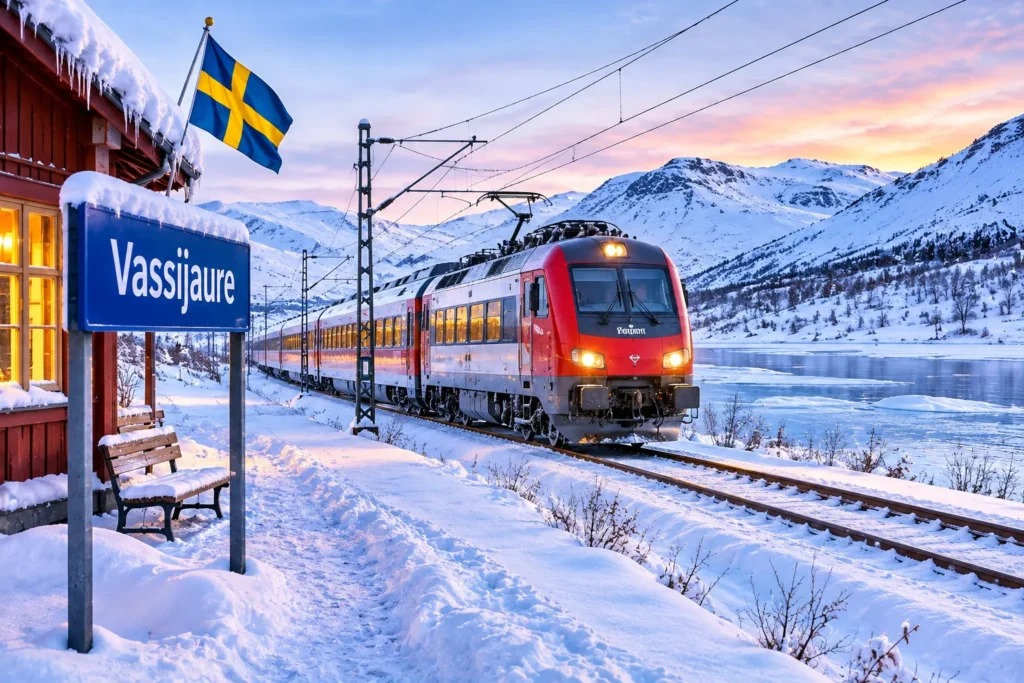
Stretching nearly 500 kilometres across the Arctic Circle from the ice-free Norwegian port of Narvik through the mountains of Swedish Lapland to Boden and Luleå, the combined Ofoten Line and Iron Ore Line represents one of Northern Europe’s most celebrated scenic rail corridors. Following major infrastructure disruptions caused by severe winter derailments near the Swedish-Norwegian border, extensive restoration and climate-adaptation work led by the Swedish Transport Administration (Trafikverket) has reinforced the resilience of this vital cross-border passenger and freight artery. For international travellers planning Nordic rail journeys between Norway’s dramatic fjords and Sweden’s subarctic wilderness, the corridor’s recovery underscores both the engineering achievement of Arctic railway operations and the enduring allure of high-latitude overland exploration.
Navigating the Arctic Corridor Between Narvik and Kiruna
Paralleling European route E10 as it winds through alpine passes, glacial lakes, and towering peaks near the national frontier, the Iron Ore Line—known in Sweden as Malmbanan—and its Norwegian continuation, the Ofoten Line, were constructed in the late nineteenth century and officially opened in 1902. Originally built to transport iron ore from Kiruna to year-round shipping lanes in Narvik, the electrified single-track line has long served a dual role as a lifeline for Arctic industry and a bucket-list route for scenic rail tourists seeking midnight sun vistas in summer and Northern Lights landscapes in winter.
At the heart of this mountain crossing sits Vassijaure station, Sweden’s northernmost operating railway station, situated at an elevation of 521 metres above sea level just before the Norwegian border. Surrounded by exposed fells where weather conditions shift rapidly from crisp twilight to driving sleet and gale-force winds, Vassijaure marks the highest and most meteorologically demanding point along the entire route.
Extreme Arctic Restoration Work Along a 15-Kilometre Stretch
The vulnerability of single-track Arctic infrastructure came into sharp focus on December 17, 2023, when a 750-metre-long train carrying 6,800 tonnes of iron ore products from Kiruna toward Narvik derailed near the border. According to official assessments by the Swedish Transport Administration and final investigation findings published by the Swedish Accident Investigation Authority (Statens haverikommission), a wheel fatigue fracture initiated the derailment near Tornehamn, causing 10 of the train’s 68 wagons to leave the tracks before coming to a halt roughly 100 metres inside the protective snow gallery at Vassijaure station.
The incident inflicted extensive structural damage across a 15-kilometre stretch of the railway, destroying the protective snow gallery and crushing rails, switches, overhead catenary lines, and track foundations. Restoration teams led by Simon Sunna, head of the Northern Railway Unit at the Swedish Transport Administration, mounted a massive 60-day recovery operation involving approximately 200 specialised personnel.
Working in subarctic winter darkness where temperatures frequently plunged to minus 30 degrees Celsius alongside heavy snowfall and storm-force winds, crews faced total or partial work stoppages on nearly one-third of all operational days. To rebuild the track bed, engineers removed damaged rolling stock using excavators, tractors, and backhoe loaders before replacing more than 25,000 concrete railroad ties—each weighing roughly 300 kilograms—alongside new rails and overhead power systems. Because the ground was frozen solid, workers had to continuously clear drifting snow to inspect and verify the stability of every newly laid tie before fresh snowstorms covered the corridor once again. Following a second winter derailment involving an unloaded train in February 2024, passenger rail services fully resumed in June 2024 after roughly six months of comprehensive reconstruction.
Strengthening Climate Resilience for Future Nordic Rail Travellers
In response to safety recommendations issued by the Swedish Accident Investigation Authority, the Swedish Transport Administration has initiated multi-year climate adaptation and maintenance upgrades across Malmbanan. Official regulatory filings confirm that all snow galleries along the mountain corridor have been systematically numbered and marked for enhanced structural inspections, while engineering designs are underway for load-bearing upgrades scheduled for implementation between 2026 and 2030. In addition, modernised European Rail Traffic Management System (ERTMS) signalling has been progressively deployed along key sections of the line to strengthen operational reliability.
For travellers embarking on Arctic rail travel Scandinavia itineraries today, the journey between Luleå, Kiruna, Abisko National Park, and Narvik remains one of the world’s most rewarding overland adventures. Backed by continuous public infrastructure investment and rigorous safety oversight from Nordic transport authorities, the historic mountain railway continues to connect coastal fjords with Arctic wilderness in every season.
For more travel news like this, keep reading Global Travel Wire