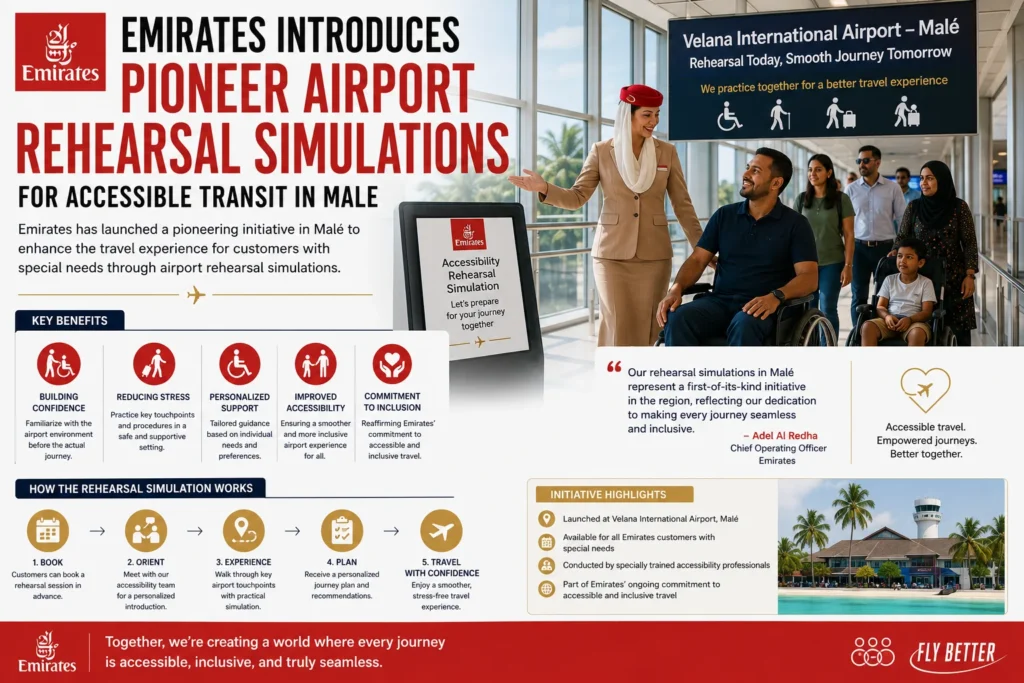
The aviation landscape in the Indian Ocean is taking a significant step forward regarding passenger inclusivity and neurodiversity management. In a formalized collaborative effort verified by regional civil aviation stakeholders, Emirates has launched its highly acclaimed travel simulation framework in the Maldives. Marking a historic first for the island nation, the carrier conducted an immersive travel rehearsal exercise at Velana International Airport in Male, setting a progressive operational benchmark for accessible travel initiatives across Central Asia and the surrounding resort networks.
The specialized orientation program is strategically engineered to provide individuals with neurodivergent conditions and unique learning requirements with a comprehensive, hands-on preview of standard airport processing. By navigating a simulated version of the entire departure and arrival sequence in a controlled, low-pressure environment, participants are able to safely demystify the sensory complexities of flight days. This structured approach helps alleviate deep-seated travel anxiety, allowing families to build necessary confidence before committing to international long-haul itineraries.
Strategic Inter-Agency Partnerships Supporting Neurodivergent Tourists
The successful execution of this inaugural exercise required extensive operational alignment between major public sectors and corporate aviation teams. To bring the simulation to life, the carrier worked in close tandem with the Maldives Airports Company Limited, the official state-authorized operator managing the infrastructure at Velana International Airport. The local education sector played an equally critical role, with specialized coordinators from the Inclusive Support Unit of the Aminiya School in Male selecting student groups and accompanying families to participate in the real-time exercise.
Throughout the afternoon, the visiting families were paired with dedicated guest relations personnel and pre-assigned terminal officers. The comprehensive walkthrough systematically guided the students through every critical checkpoint encountered during a standard international journey, including:
Handing over documentation at the primary check-in desks
Simulating the physical transit through active metal detectors and baggage scanners
Navigating the waiting areas inside the central departure lounges
Managing document validation loops at the immigration desks
Utilizing the automated carousel networks within the baggage claim hall
Navigating the final arrivals greeting area where transport operators assemble
By providing families with direct access to frontline personnel who could answer technical questions in real time, the exercise successfully transformed potentially overwhelming transit procedures into familiar, manageable steps.
Global Aviation Network Expansion of Autism Certified Travel Standards
This development in the Maldives represents the latest milestone in a much larger, multi-phased expansion of accessible travel initiatives spearheaded by the Middle Eastern carrier. The airline officially holds distinction as the world’s first autism-certified carrier, an accolade achieved after more than 35,000 active cabin crew members and ground handling personnel successfully completed rigorous, scientifically backed autism spectrum awareness modules. This extensive training curriculum ensures that frontline teams possess a deep understanding of neurodiverse needs, common travel-related stressors, and practical de-escalation strategies tailored to individual passenger comfort.
Since launching this global accessibility push, the airline’s airport service division has coordinated more than 40 independent travel rehearsal simulations spanning an expansive international map. These targeted outreach exercises are consistently executed in tandem with local non-profit groups, educational institutions, and municipal airport managers to ensure maximum local relevance. The growing list of global cities that have hosted similar inclusion programs includes prominent transit hubs such as:
London, Edinburgh, and Newcastle in the United Kingdom
Paris, Nice, and Brussels across Western Europe
Delhi, Hong Kong, and Guangzhou throughout major Asian sectors
Sydney, Christchurch, and Dubai within the Southern Hemisphere and Middle East
Toronto and Orlando representing major North American corridors
Future Proofing Island Tourism via Inclusive Infrastructure Realignments
As the Maldives continues to maintain its status as a premier global sanctuary for luxury leisure travel, the implementation of dedicated accessibility protocols is increasingly vital. Local tourism authorities emphasize that modern destination branding relies heavily on a country’s capacity to welcome all traveler demographics seamlessly. By eliminating the structural barriers that often deter neurodiverse families from taking flights, the regional aviation network directly supports the diversification of inbound tourism yields.
Aviation planners and regional directors note that the enthusiasm shown by local airport management teams reflects a broader commitment to optimizing terminal spaces for changing traveler demographics. Creating a supportive, predictable framework at the primary gateway ensures that the entry point into the archipelago matches the premium, hospitable environment found across the country’s world-renowned island resorts. As these inclusive exercises are integrated into the annual calendar, the region solidifies its long-term strategy of combining world-class natural beauty with highly sophisticated, modern passenger care systems.
For more travel news like this, keep reading Global Travel Wire